


Arriving in Australia from his native England in 2003, football broadcaster Simon Hill has become synonymous with Australian football and is often looked to as a voice lauded by football fans whom is dedicated to acting on behalf of the fans.
Hill’s role in Australian football has seen him be behind the microphone for many of the milestone moments in the sport’s recent history. From calling the iconic 2005 playoff win over Uruguay – to lending his distinct vocal tone to the A-Leagues since its beginnings – Hill has become a staple of the local game.
Having been a part of the broadcasting teams for the A-Leagues under Fox Sports and now Channel 10/Paramount+, Hill has seen the men’s and women’s competitions undergo significant peaks, troughs, and transitions, and is often tasked with encapsulating the context of each game with the behind-the-scenes of what is occurring within clubs and Australian football as a whole.
Speaking with Soccerscene, Hill discussed the year ahead for Australian football, the opportunities that he hopes will be capitalised on following the 2023 Women’s World Cup, and the challenges football in Australia needs to overcome to be a stronger unit.
2023 presents itself as potentially an even bigger year than 2022 in Australian football. What are you looking forward to from the year ahead?
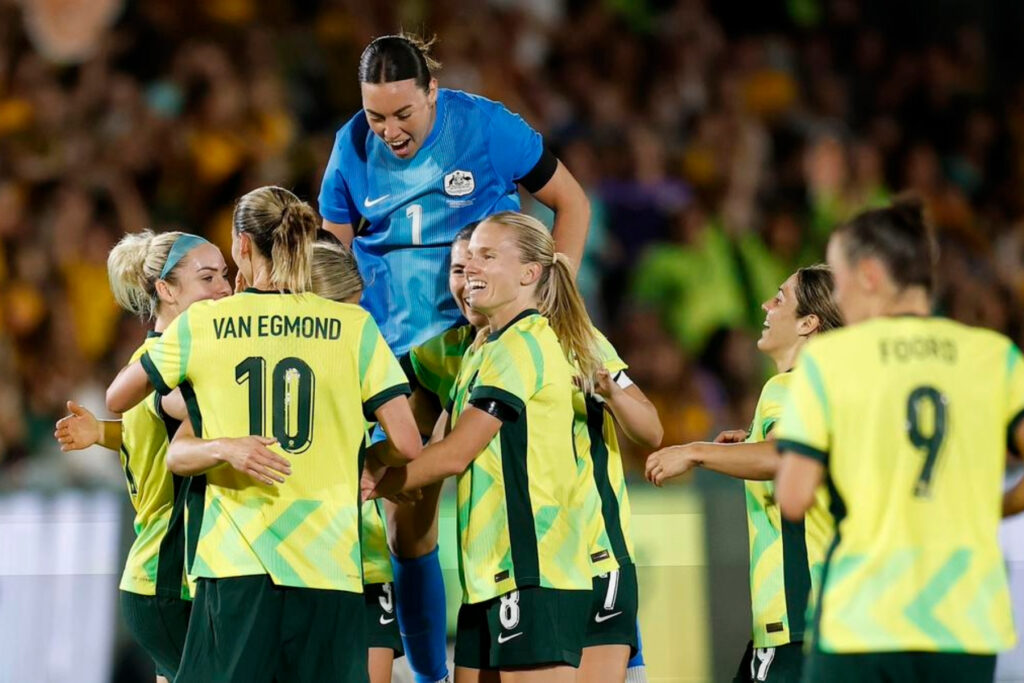
Simon Hill: Well, obviously the Women’s World Cup stands out because it’s on home soil and we don’t get to host World Cups very often. It’s probably a once in a lifetime opportunity really. So, that’s a big occasion for the game to leverage its global appeal, and the old maxim has always been ‘play local, think global’. I hope that we can see some after-effects and legacy for our game here. Whether we will or not I don’t know because it’s always a struggle in this country, but that’s definitely the standout.
Over the next 12 months, there’s an Asian Cup in early 2024 and the Socceroos will be building up to that. In terms of the domestic competitions, I think we just want to see some growth to be honest. It’s been a tough few years. Obviously, COVID hasn’t helped, but I think we’d like to see – to use the business speak – the KPIs trending in the right direction rather than the other way.

What opportunities do you hope will arise for football in Australia following the Women’s World Cup?
Simon Hill: We’ve already seen that global impact with regards to player transfers in the men’s and women’s game. The last few weeks we’ve seen Garang Kuol sign for Newcastle and Courtney Nevin, Remy Siemsen and Harry Souttar signing for Leicester City, and that’s our connection to the global game. Obviously, there’s a financial incentive for our clubs as well to produce players and to make money out of the transfer market, so that’s certainly one thing.
I guess, with regards to the Women’s World Cup specifically, what I’d really like to see is increased crowds and more eyeballs watching the A-League Women’s competition (and the men’s as well because this is a whole of game problem not a women’s problem). That will certainly be something I’d like to see leveraged, but whether it will be or not I just don’t know.
The attendances remain pretty static in the women’s competition and that’s disappointing when you look around the world and see what’s happening in Europe in particular. In the FA Women’s Super League we saw Arsenal draw a crowd of 45,000 in their game against Chelsea and sell-out crowds for Barcelona; the women’s game has grown exponentially. And we keep talking about growth of the women’s game here and participation numbers, but what we really need to see in the men’s and women’s is bums on seats. Because that’s how you grow your professional game, which we just haven’t been able to do successfully enough over the course of the journey. That’s something I’d like to see. Whether we’ll see it is a different story.
With the way everything has panned out post-World Cup, it ultimately feels as if the APL have struggled to capitalise on the momentum sparked by the Socceroos reaching the Round of 16. What work is needed to help win back fans left disenchanted by both the Grand Finals decision and the difficult scenes at the Melbourne derby?
Simon Hill: There’s no silver bullet; there never has been. It’s about long-term hard work and incremental growth. We’re not going to go from 0 to 100 in five minutes.
Really what is required, in my opinion, is a better connection between the clubs and their local communities, which of course the local participation base that we bang on about endlessly is a huge part of. To say converting players into spectators is the answer, it may be part of the answer, but people play football for lots of different reasons. I always use the example that I love to play a bit of social tennis for fitness and enjoyment, but does that mean I’m going to buy tickets to go and see the Australian Open? No chance, because I honestly have no interest in it.
I think people are the same with football; they play because their mates play, they play because of their kids, or for fitness, or for fun. And of course, we can try to convert some of that participation base into paying spectators but really, we have to target the local communities to build an identity that the fans resonate with.
That’s a multifaceted issue but for example clubs owning their own stadiums would be a game-changer, even if it seems impossible in Australia where nobody seems to be able to do it. This is why we admitted Western United in the first place because that would be a game-changer. To have that real home ground and identity, where fans are going to their cathedral every two weeks – you ask any football fan in Australia who watches the Premier League and they’d love to go to Anfield; the Emirates; the Etihad; or Old Trafford. These grounds are synonymous with those clubs, and whilst there are exceptions here with Adelaide and Central Coast, most of our grounds are generic sports venues that we drop in and drop out of. And they don’t resonate with supporters or help to build identity. Of course, that’s not the entirety of the problem but its certainly part of it.
Our clubs too often are like cookie-cutters of each other, and we need to build that separate identity to resonate with supporters because it’s an emotional game and an emotional connection between fan and club. And once you’re rusted on, you go every week whether you win or lose. It’s a long-term fix which isn’t easy, especially as our clubs are young and don’t have much history (which doesn’t help). It will come but I believe clubs have got to be better at trying to build identity. At the moment the focus is on survival and money, which I totally understand. But we’ve ignored the football community in too many ways in my opinion.
Football is very expensive to play in this country but we’ve got that large participation base. For me, if you’re under 16 and pay to play you should be able to turn up to an A-League ground on the weekend, show your pass and you get in for free. Not parents, they have to pay because clubs have to make some money somehow, but that’s about growing the next generation of supporters that hopefully become rusted on. At the moment, we’re asking people to pay astronomical amounts just to play but then also decent money to go and watch it and there’s a disconnect there.
Were the clubs out at the fan sites during the World Cup dishing out membership packs, free scarves, or incentives to leverage people who are clearly interested in football to go and turn up 10 minutes down the road on a week-by-week basis to watch their A-League club? I don’t know the answer to that. Maybe they did, and I might be being completely unfair to them.
But what is obviously hugely disappointing, off the back of a successful Men’s World Cup where the whole country was in love with the Socceroos, is that we have managed to shoot ourselves in the foot and almost go backwards. It beggars belief to be honest. But this is the history of the game in this country unfortunately, a series of wrong turns in which the Grand Finals decision was one. I understand the reasons for it, I know that the clubs need money and that they’re struggling, but for me that was the wrong decision.

In a conversation with Robbie Thomson for Soccerscene late last year, Thomson observed that football is perhaps still searching for a figure of Frank Lowy’s presence to stand up and ensure football is heard and felt amongst the dominance of the NRL, AFL, and cricket. Where does the APL go from here in solidifying the presence of the A-Leagues in Australia’s multifaceted sporting landscape? And are we missing a figure like Frank Lowy at present?
Simon Hill: Probably, but it’s easy to go down the road of historical revisionism and what we cannot forget – and this is what frustrates me more than anything else – is that the feeling is that the game kicked out the Lowy’s. The game didn’t kick the Lowy’s out. Frank Lowy had to stand down as it was the end of his term, as per the constitution. By comparison, Steven Lowy quit, and the reason stemmed from the push back he received by leading football through a revolution, which isn’t what we needed. We needed evolution, not revolution. The board at the time, led by Steven Lowy, refused to evolve.
Frank Lowy did a fantastic job in his 10 years and I went on record to say that he deserves a statue if they were ever to build a home of football because he did so many brilliant things for the game. But in the end, like all powerful rich businessman, it became a battle of egos that he had to win. And the clubs were the same. So, the game was the loser in the middle of it. A lot of people in this country have this great messiah complex and believe we need this ‘great leader’; it’s not about one person. The game doesn’t belong to Frank Lowy, and it doesn’t belong to me, or you, or any individual. It’s about all of us working together to get this game moving forward, and too often we are not prepared to do that. We retreat into factionalism and power bases, and the internal fighting is what kills this game.
So, Steven Lowy had that opportunity to negotiate with the clubs, to change the governance structure – not completely tear it up and start again but to evolve into something better because we were at the point in time where we had to do that. The clubs wanted a voice and I agreed with them because they were losing millions of dollars. What we didn’t need was the full-scale revolution that followed and it did because the two sides could not find a compromise.
In the end it went down to the wire in 2018 where it was won by the clubs by one vote. At the end of a three-year war it was one vote that gave them ultimately what they wanted. And on the back of that, Steven Lowy opted to leave as he wanted no part of it. Now for me, if you love the game, you work for the game no matter what the circumstances. Goodness me, there’s been many times I’ve wanted to walk away from the game in this country and I’ve only been here 20 years, and I’m sure lots of other people have the same thought. But if you love it, you persevere with it because it needs help in this country. And I’m sad that the Lowy’s walked away because they have so much to offer, but in the end, it became about power. And it’s the same for the clubs, and you can argue that what the clubs have done with it has not been good enough and I wouldn’t necessarily disagree with that, but I would add the caveat that COVID has been an issue. But, it’s not about ‘it was better under Frank Lowy’ or ‘the clubs will do it better’, it should be about a whole of game working together and we don’t do that in this country. Until we can work together as a sport, we are going to remain a divided entity at war with each other, but everybody thinks that they can do it better and everybody wants the game to exist on their own terms. Otherwise, they prefer to take a torch to it and see it blow up.
Currently you spread your time across work with Channel 10, SEN, alongside hosting duties at various football events in and amongst other work. Why do you believe it is important for aspiring football journalists and broadcasters to be across so many aspects of the game?
Simon Hill: Because you have to in this country. It’s a very broad church with lots of different layers to it and when I first arrived in 2003, I didn’t even pretend to understand the landscape at all. I remember for the first 12 months scratching my head at the things that went on and thinking it was like watching football on the moon.
It’s good to work across lots of different aspects of the game and different mediums as well, because in the modern era of journalism – if that’s still a thing – earning a living out of football in this country is damn difficult. The more skills you have, the more bows in your armoury you have, the better chance you have of earning a living. I’m fortunate that I wrote and worked in radio and television in the UK before I moved over, so this was no great leap for me. But it’s something that I would encourage all journalists to do. Obviously the one thing I had to learn was the social media stuff and I’m still coming to grips with that and how it effects the game.
There was a period in your broadcasting career where you weren’t involved for the final A-League season at Fox Sports. Even as someone who has been involved in the game for several years, what did you learn from this period?
Simon Hill: It was a tough period because obviously it was the first football season in my entire career that I wasn’t involved on a week-by-week basis hosting shows, going to stadiums, reporting on games, or calling games for a full-time employer. So, I was freelance for that period of over 12 months.
I took the opportunity to do a variety of things for a couple of different reasons. First of all, I needed the money as I definitely couldn’t retire. I had to take whatever work came my way. But also, it gave me the opportunity to expand my horizons to setup a podcast with Craig Moore and Zeljko Kalac. And that was a really interesting experience learning how to put together a podcast, how to try and make it pay its way (not that I was really successful at that), how to deal with advertising and different hosting platforms; it was basically constructing something from scratch and building an audience, which we were reasonably successful at doing probably because we had profiles within the game here.
It was fascinating. I did ground announcing for Newcastle Jets and columns for various outlets, and it was liberating in some ways because obviously I didn’t have that day-to-day commitment to a full-time employer. The flip side of that is that I wasn’t getting a full-time wage. And there was a period of time during that year out where I was ready to go home, and I thought it was time for me to start again in the UK. It was only the pandemic that stopped me because it was very difficult to travel and with everything happening in the UK during that period, I felt it wasn’t the most expediate move to go home, so I ended up staying and Channel 10 came in for me which I’m very grateful for. It was an interesting period, both challenging and rewarding in different ways.