



Norman Griffiths Oval upgrade boosted by Northern Suburbs Football Association’s support

West Pymble’s Norman Griffiths Oval upgrade has been given a major boost with the announcement that the Northern Suburbs Football Association (NSFA) have presented a $125,000 contribution to Ku-ring-gai Council for the project.

Ku-ring-gai Mayor Dr Cedric Spencer and Councillor Jeff Pettett met with committee members and players from local club West Pymble FC, NSFA President Ian Plant and CEO Edward Ferguson at the field earlier this month to receive the NSFA contribution on behalf of Council.

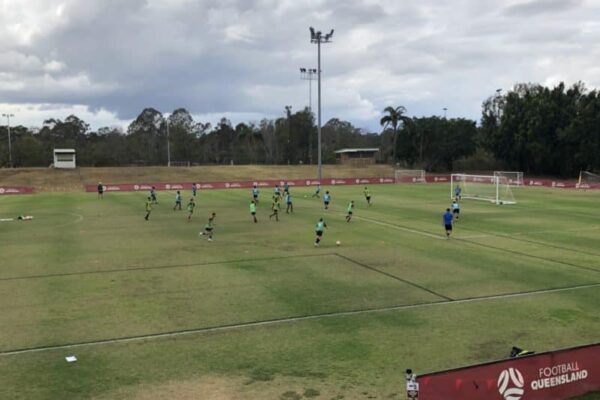
Work on the site is set to commence in March 2022, with council having executed the contract to construct the playing surface.

The total cost of the upgrade is estimated at $3.3 million, with local football clubs contributing around $1 million in total of government grants and club funds.

Mayor Spencer treated the long-awaited upgrade as essential for the Council and sporting groups to manage the expected growth in participation.

“Local football clubs in northern Sydney are predicting the number of players to be 20,000 by the year 2026,” he said.

“An all-weather surface for Norman Griffiths Oval is necessary to help manage this level of growth and prevent a huge increase in wear and tear and maintenance costs.”

Despite three months of organised sport being cancelled this year due to COVID, the playing surface at Norman Griffiths Oval remains in poor condition, underlining the importance of the impending conversion to a synthetic playing surface.

The field conversion and associated lighting upgrades will triple the number of hours the field can be used per week, with the added benefit of year-round usage instead of a rest period during summer.

The NSFA player base continues to grow, eclipsing 18,000 players in 2021 and on track to break the 20,000 before 2026 with increasing demand and the upcoming Women’s World Cup in 2023.

NSFA CEO Edward Ferguson underlined the importance of the project for the ongoing development of football within the region.

“The on-site clubhouse pairs brilliantly with the field upgrade for not just match day experience but also refereeing and coaching courses that are run each season,” he said.

“The Norman Griffiths project fits into the overall NSFA Facilities Strategy, which aims to increase field capacity approximately 40% by 2032 to meet our growing participation base.”

The funds provided for the project by NSFA are a member contribution from the NSFA Facilities Levy.

Previous ArticleNext Article

South Canberra FC Breaks the Mold: Equity-Driven Model Earns ‘Club Changer’ Honour

South Canberra Football Club has been named Club Changer of the Month for April, in a recognition that reflects a broader shift across Australian football toward rewarding clubs that are actively dismantling the structural barriers limiting women’s access to the game.

The AFC Women’s Asian Cup has just delivered record crowds and unprecedented visibility for women’s football in Australia, and the Club Changer program is now asking what comes next. Its decision to name South Canberra Football Club as Club Changer of the Month for April signals a clear shift in how the program defines contribution: away from participation numbers alone, and toward the equity frameworks that determine whether women stay in the game once they arrive.

South Canberra FC built that framework from the ground up. Established in 2021, the club set out to give women and female-identifying players a safe, inclusive environment to play football at any level. It runs entirely on volunteers, operates as a not-for-profit, and is governed by an all-female committee with 13 of its 14 coaches identifying as female.


Building the infrastructure of inclusion

In 2026, the club secured grant funding and put it to work immediately. Two coaches are completing their C Licence qualification, and ten coaches, players and community members have undertaken the Foundations of Football course, which directly tackles the cost and accessibility barriers that exclude women out of coaching pathways.

The club also commissioned a female-specific strength and conditioning program with sports physiotherapists ahead of the 2026 season, targeting injury prevention and explicitly supporting players returning after childbirth.

SCFC’s leadership team draws from LGBTIQ+ individuals, First Nations people and veterans, strengthening the club’s connection to the communities it was built to represent.

The Club Changer program is backing clubs that do this work- clubs that treat equity as infrastructure rather than aspiration. At a moment when Australian football is under pressure to turn its biggest-ever surge of women’s interest into something lasting, SCFC’s model offers a clear answer to the question of how.

Football NSW announces 2026 First Nations Scholarships as pathway access program enters new phase

Football NSW has announced the recipients of its 2026 First Nations Scholarships, with ten emerging Aboriginal and Torres Strait Islander players from metropolitan and regional NSW receiving support designed to reduce the financial and structural barriers that have historically limited First Nations participation across the football pathway.

The scholarship program, developed and assessed in collaboration with the Football NSW Indigenous Advisory Group, targets players across both elite and development environments – recognising that talent identification alone is insufficient without the resources to support progression once players are identified.

Co-Chair of the Indigenous Advisory Group Bianca Dufty said the calibre of this year’s recipients reflected the depth of First Nations football talent across the state, and the importance of structured support in converting that talent into long-term participation.

“Their dedication to football and the desire to be role models for younger Aboriginal footballers in their communities is to be celebrated,” Dufty said. “I’m confident we will see some of these talented footballers in the A-League and national teams in the future.”


Beyond the pitch and into the pipeline

The 2026 cohort spans both metropolitan clubs and regional associations, an intentional distribution that acknowledges the particular barriers facing First Nations players outside major population centres, where access to development programs, qualified coaching and pathway competitions is more limited and the cost of participation more prohibitive.

The next phase of the program will introduce First Nations coaching scholarships, extending the initiative’s reach beyond playing pathways and into the coaching and administration pipeline – areas where Indigenous representation remains among the lowest in the game.

The structural logic is clear. Scholarships that reduce financial barriers at the entry point of elite pathways matter most when they are part of a sustained ecosystem of support rather than isolated gestures. Football NSW’s collaboration with the Indigenous Advisory Group provides that continuity, ensuring the program is shaped by the communities it is designed to serve.

Most Popular Topics

Editor Picks

Send this to a friend