

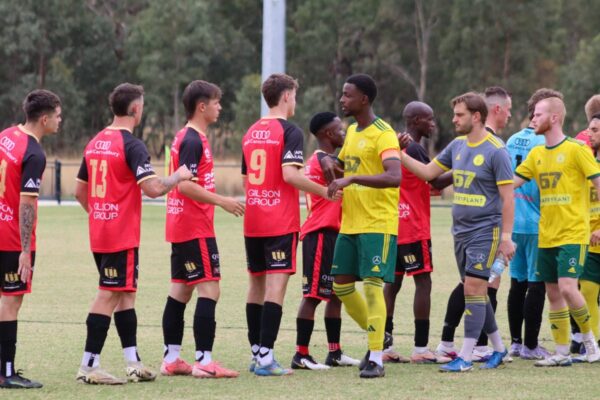

Northern NSW Football extends collaboration with Veo

Veo

Northern NSW Football has confirmed the renewal of its formal alliance with VEO, the AI-driven automatic football camera.

NNSWF has been an official collaborator with Veo since 2020, becoming one of the first Australian clients of the Copenhagen-based company.

Veo offers an affordable, all-in-one solution that allows football clubs of any size to automatically record and analyse matches and training sessions.

The portable Veo camera features two 4K lenses that capture a 180-degree field of view, enabling clubs to record every moment of a game in stunning video quality. This makes recording, watching, re-watching, and analysing football simpler than ever. The latest model, the Veo Cam 3, offers enhanced video quality, 5G live streaming, and an extended control range for remote operation.

Veo’s mission has consistently been to provide football recording and AI analysis to all clubs, regardless of their size, financial resources, or skill levels. Veo cameras are utilised by clubs at every level throughout northern NSW and Australia.

Veo has recently launched a new feature for users of the Veo 2 and 3 cameras. The ‘Player Spotlight‘ feature clips footage of individual players on the field, identified by their shirt numbers, facilitating quick and easy analysis.

Since their partnership began in 2020, Veo has introduced ‘Veo Live,’ enabling any club or team to livestream their matches from anywhere without the need for a camera operator. This feature allows games to be streamed on platforms like YouTube, Facebook, Twitch, and other preferred services.

NNSWF CEO Peter Haynes stated that he was happy to renew the partnership with Veo.

“NNSWF is thrilled to continue this partnership for another two years and provide our clubs with exclusive deals and discounts,” Haynes said via press release.

“Veo has been very useful for our organisation and we are looking forward to seeing how this can continue to help clubs in our region.”

Veo Market Lead for APAC, Jerry Jarnald, expressed his enthusiasm for continued collaboration with Northern NSW Football.

“At Veo, we are grateful for the continued trust from Northern NSW Football and its member clubs,” Jarnald said via press release.

“The adoption rate has been fantastic since 2021 when we started, with 100% of the NPL and Hit 106.9 Northern League One clubs, as well as around 45% of the Zone Football League clubs, choosing Veo as their recording solution so far. It’s a testament to the strong partnership we’ve built, but also to the clubs being progressive and aiming high with their player development.”

To find out more about Veo, click here.

Previous ArticleNext Article

Capital Football Introduces Pink Armband to Protect Junior Referees

Capital Football has launched a visible identification program for referees under 18, requiring them to wear a pink armband during matches. It’s intended to build awareness surrounding the concern across Australian football about the abuse driving young officials out of the game.

The Pink Armband Initiative, effective immediately across Capital Football’s competitions in the ACT and surrounding region, makes junior referees identifiable to players, coaches and spectators. The federation says the marker is designed to set clear behavioural expectations and signal that many match officials are minors still developing their skills.

Capital Football acknowledged a referee crisis as far back as 2022, at which point it restructured its entire referee department in partnership with Football Australia. The pink armband program is the latest layer of that response; this time by targeting the cultural conditions on match day rather than systems of recruitment and pay.

A problem that spans codes and states

Research has consistently linked referee abuse to declining retention rates, with officials quitting in growing numbers due to sustained mistreatment, a trend researchers warn will reduce the pool of skilled match officials available at all levels of the game. Studies also show that young, less experienced referees are disproportionately likely to be subject to abuse.

Capital Football is not alone in reaching for a visible solution. Similar programs operate across Football Queensland, Football South Australia, Football South Coast and several other federations, while Basketball Victoria and Basketball South Australia have adopted comparable measures through the Green Whistle initiative. The spread of these programs across codes and states reflects a shared administrative problem: many grassroots referees are teenagers and volunteers who do not officiate for money but because they love the game, and abuse is eroding that foundation.

For a federation overseeing nearly 29,000 registered players, fewer referees means fewer matches. Fewer matches means reduced participation. The pink armband is a low-cost intervention with structural consequences if it works.

Compliance and competition: Everton ordered to pay compensation following major verdict

In a landmark decision by the Premier League Independent Disciplinary Commission, Everton must now pay Burnley upwards of AUD 66 million (£35 million) after breaching financial rules in the 2021-22 season.

Behind the verdict

Playing in the Premier League is, in itself, one of the most lucrative positions for a club to be in. This year’s Championship Play-off final – a contest deemed ‘the richest match in football’ – guaranteed winners Hull City a revenue uplift of AUD 389 million (£205 million) according to Deloitte’s Sports Business Group.

It is no wonder, therefore, why teams are so desperate to stay at the top of the pyramid, especially given that relegation can lead to heavy financial hits in revenue, wage reduction and transfer spending power.

Competition is certain – and the football is all the better for it. But when this competitive edge overtakes compliance, what happens off the field is just as impactful.

In 2023, the Premier League charged Everton with breaching financial rules during the 2021-22 season – the same season which saw the Toffees finish just four points above relegated Burnley. Everton received an initial 10-point deduction, which ultimately decreased to six points on appeal.

That season, Everton stayed up. But for Burnley, had the points deduction come at an earlier date, their survival in the top-flight may have been secured.


What did the ruling find?

In its verdict, the Premier League’s Independent Disciplinary Commission deemed that Everton gained a competitive advantage over Burnley as a result of financial breaches.

Burnley will now receive AUD 66 million (£35 million) in compensation from Everton, although the Merseyside club will appeal the  commission’s decision.

“This ruling sets a dangerous and unworkable precedent for English football, given it is constructed on a principle that a club can be in breach of financial rules at any point in a financial year,” Everton said via an official club statement.

Burnley, on the other hand, reaffirmed its position that the case was a question of fair play and ensuring a level playing field.

“Our action has always been about making football fair,” the club said via an official statement.

“Clubs that comply with the rules deserve to compete on a level playing field. Fans deserve it. The sport demands it.”


The impact of the case

This is a landmark decision which may have profound effects on the future of financial compliance in English football.

In the past, financial breaches remained within the realm of just that – finances. But with the ruling between Everton and Burnley, it now opens up further questions on what compliance is actually worth in the game.

And whether future investigations may lead to similar – or even higher – compensation packages to affected clubs.

Most Popular Topics

Editor Picks

Send this to a friend