The future of football won't be built by people operating in silos. It will be built by bringing the best minds, leaders, administrators and businesses together to challenge thinking, confront difficult issues and find better ways forward.
Football has no shortage of conversations.
The real question is whether we are having the right conversations, with the right people, in the right room — and whether those conversations lead to better decisions.
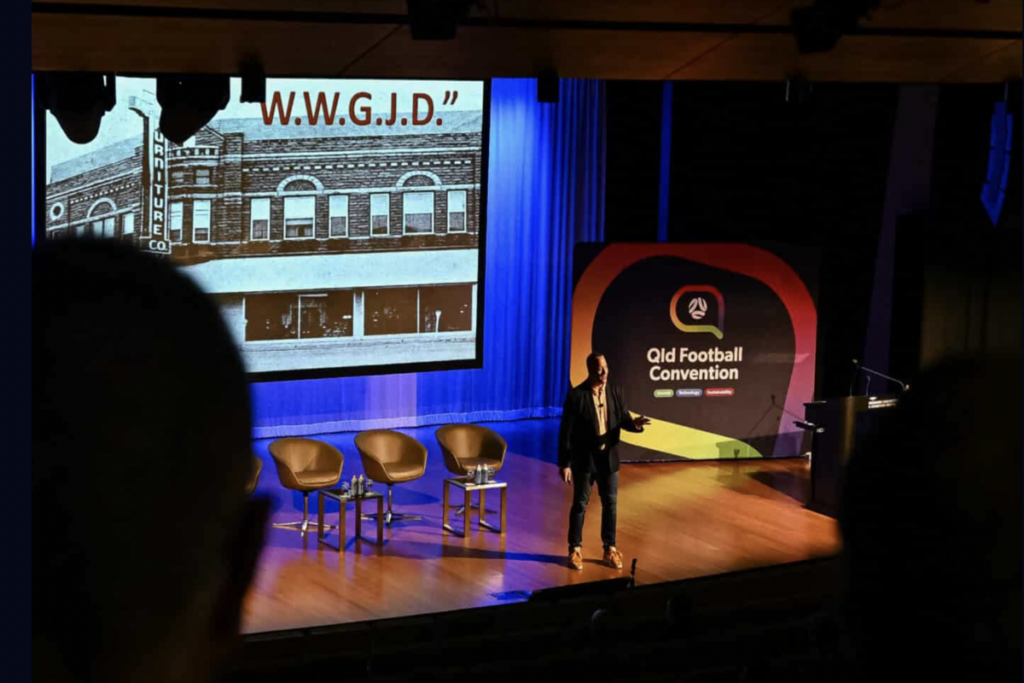
That is why the Queensland Football Convention has become an event that deserves far greater attention across Australian football.
What Football Queensland has created is more than a convention. It is becoming a meeting point for the people who are shaping, managing, delivering and investing in the game.
For those of us involved in football, that matters.
The modern football administrator is navigating an increasingly complex environment. Clubs are dealing with financial pressures, governance expectations, facility challenges, participation demands, workforce issues, commercial sustainability and the constant need to deliver better experiences for players, coaches, volunteers and communities.
At the same time, the football industry is changing around us.
Technology is accelerating. Artificial intelligence is beginning to influence the way organisations operate. Data is becoming increasingly important. Talent development continues to evolve. Commercial expectations are changing. Governance is under greater scrutiny. Facilities and infrastructure remain critical. And clubs are being asked to think more strategically about their future.
These are not simple issues.
They cannot always be solved in a boardroom, through an email or within the traditional football structures we have relied upon for decades.
Sometimes, you need to get the best people in the industry into the same room.
That is where the value of the Queensland Football Convention becomes apparent.
Getting the best people in the room
One of the greatest strengths of an event like this is the opportunity to hear from people who are experiencing these challenges from different perspectives.
Club presidents.
Chief executives.
Technical directors.
Coaches.
Administrators.
Commercial leaders.
Government and infrastructure representatives.
Technology providers.
Business leaders.
Industry experts.
And people who are simply prepared to challenge the status quo.
The value isn’t necessarily found in agreeing with every speaker or every idea.
In fact, it should be the opposite.
Football needs environments where people can respectfully challenge ideas, unpack difficult issues and ask the questions that sometimes don’t get asked within the everyday football ecosystem.
That is how we elevate the debate.
And that is something Soccerscene strongly believes in.
The conversations behind the conversations
There are plenty of subjects in football that create pressure for administrators.
Governance is one.
Financial sustainability is another.
Facilities and infrastructure continue to be a major issue.
Talent pathways generate debate.
The relationship between participation, performance and commercial sustainability creates its own challenges.
Technology and AI will increasingly change how football organisations operate.
And then there are the human challenges — volunteers, staff, leadership, culture and the expectations placed on people who are often trying to run complex organisations with limited resources.
These issues deserve more than surface-level discussion.
They need to be unpacked.
What does good governance actually look like at club level?
What does a sustainable football business look like?
How can clubs become commercially stronger without losing their community identity?
How do we use technology intelligently rather than simply because it is new?
How do we develop people as well as players?
How do we create better environments for administrators and volunteers?
And perhaps most importantly, how do we prepare football organisations for the next five, ten and twenty years rather than simply solving the problem directly in front of us?
These are the conversations that matter.
It is becoming a destination
From a Soccerscene perspective, one of the most interesting developments is the growing interest beyond Queensland.
I have personally had conversations with businesses here in Melbourne who are now looking at the Queensland Football Convention and considering 2027 as a genuine window of opportunity.
That tells us something.
When businesses outside the state begin looking at the event not simply as a football convention, but as a place to connect with clubs, administrators, decision-makers and industry leaders, its significance starts to change.
It becomes a marketplace of ideas.
It becomes a networking opportunity.
It becomes a business development opportunity.
It becomes a place where relationships can begin that may ultimately benefit clubs, organisations and the broader football industry.
And that is a positive development for everyone.
More than two days in the diary
For anyone running a football club or football-related business, the value of attending extends well beyond sitting in a room listening to presentations.
It is the conversation over coffee.
The introduction you didn’t expect.
The discussion after a panel.
The connection with another administrator dealing with exactly the same challenge.
The opportunity to hear how another organisation has approached a problem.
The chance to discover a technology, service or business model that could make your organisation better.
These are the things that don’t necessarily appear on the event program, but often become the most valuable part of attending.
That is why I believe the Queensland Football Convention has reached the point where it should be pencilled into the diary as a must-attend event.
Not because you have to be there.
Because there is a genuine opportunity to become better by being there.
A responsibility for the football community
I also believe there is a responsibility on Queensland’s football leadership and, importantly, its member federations to get behind this event.
If we genuinely believe collaboration is important, then we need to demonstrate it.
Member federations should be encouraging their clubs, administrators, coaches, technical leaders, volunteers and commercial stakeholders to participate.
This should not be viewed as simply another event on the football calendar.
It should become a pinnacle industry event for Queensland football.
The more diverse the room becomes, the stronger the conversations become.
And the stronger the conversations become, the greater the opportunity to improve the game.
That is the real opportunity.
Elevating the debate
Soccerscene is proud to support initiatives that create space for football to have better conversations.
We don’t need to agree on everything.
We do need to be willing to listen.
We need to challenge.
We need to learn from each other.
And we need to bring people together who may not otherwise have the opportunity to sit around the same table.
The Queensland Football Convention provides that platform.
For clubs, it is an opportunity to learn.
For administrators, it is an opportunity to develop.
For businesses, it is an opportunity to connect.
For leaders, it is an opportunity to challenge their thinking.
And for football, it is an opportunity to collectively look forward.
The football industry is changing quickly.
The organisations that thrive will be those prepared to keep learning, keep questioning and keep building relationships beyond their own walls.
That is why the Queensland Football Convention matters.
And that is why, from my perspective, this is no longer simply an event to attend when the calendar allows.
It is an event that belongs in the diary.
Elevate the debate. Build the relationships. Share the knowledge. And, ultimately, make football better.
That is the opportunity in front of us.