

Sydney FC Head Coach Steve Corica: “Double or Nothing”


In his first year at the helm of Sydney FC during the 2018/19 A-League season, Steve Corica’s squad finished second behind Perth Glory for the Premier’s Plate but was successful in winning the Grand Final to claim the championship.After winning the Premier’s Plate six weeks ago, the Sky Blues’ head coach knows a repeat victory in the Grand Final on August 30th will confirm Sydney FC are the best club team in Australia.

The man whose boyhood idol was former Socceroo player and manager, Frank Farina, has achieved the ultimate success in coaching and playing, rising through the ranks of international youth football to full Socceroo, culminating in an eleven year overseas career.

Five years with Sydney FC as a player before following a coaching career in youth and assistant coaching under Graham Arnold, ultimately led Corica to the appointment as first team coach when Arnold accepted the national team role in 2018.

It is little surprise that Corica has achieved so much success because he was a key player in what was arguably one of the greatest national teams we have ever seen, the 1991 u/20’s led by Paul Okon who were eliminated by Portugal at the semi final stage in front of 110,000 in Lisbon via a Rui Costa thunderbolt.

With players of the quality of Paul Okon, Tony Popovic, Brad Maloney, David Seal, Mark Schwarzer, Mark Bosnich,  Robbie Stanton, Kevin Muscat, Matthew Bingley, George Sorras, Mark Silic and Kris Trajanovski in that squad, it is hardly surprising success has followed Corica.

In this interview with Roger Sleeman, Steve Corica discusses his secrets to survival, visions for Sydney FC and overwhelming desire to complete the double.

ROGER SLEEMAN
After your initial entry into youth football at Innisfail, followed by your successful playing and current blossoming coaching career, is this all a dream come true?

STEVE CORICA
When I look back at the good and the bad times, especially when I was out with injury for fifteen months while at Wolves in the English First Division, the game has been very kind to me.

I have been at Sydney FC for fifteen years now and it’s a real privilege to be the senior coach and working with the players in this great club.

However, one can’t dwell in the past because we still have a bit of work to do to reach top form again and win back to back grand finals and the double.

ROGER SLEEMAN
How do you compare the standard of the NSL in your playing days with the current A-League?

STEVE CORICA
It’s difficult to compare because styles are different and when I played at Marconi in the NSL, there were great players like Ian Gray, Gary Van Egmond, Peter Katholos, Zlatko Nastevski and Jean-Paul de Marigny and in the national team Frank Farina, Graham Arnold and Robbie Slater who also learned their football in the NSL.

Times have changed since my early NSL days when a number of players ventured overseas and played at a high level in big clubs but we’re not producing these types of players at the moment.

We have to change this, but on a positive note I have observed since the A-League has returned, the clubs have been providing game time for some really promising young players.

Notwithstanding, the A-League has paraded quality players like Del Piero, Broich, Berisha and Ninkovic who I rate the best individual performer since the league started. 

ROGER SLEEMAN
What are your thoughts on changing the A-League from summer to winter next season?

STEVE CORICA
We’ve had fifteen years of summer football and the general observation is the crowds aren’t coming.

From a player’s perspective, it’s difficult in the heat to make those back to back runs.

In winter, there will be a higher pressing and tempo game and better quality football produced.

Hopefully, the better standard of football emanating will also influence grass roots supporters to support the A-League while they are thinking football during their own seasons.

ROGER SLEEMAN
Are you happy with the squad’s current performance, in view of the COVID-19 layoff and the results of late?

STEVE CORICA
Although we’ve had three losses, two draws and only one win since the A-League recommenced, we still won the Premier’s Plate five weeks ago.

At the start of the season, I asked the players to win the double and we’re half way there so far.

We only have to win our semifinal and we’re in the grand final to achieve the stated objective.

ROGER SLEEMAN
In the last six weeks, you’ve given your younger squad players a chance to impress which may partly explain the turnaround in results as they attempt to fit into the team’s structure.

Are you happy with their progress, and is their inclusion also part of next season’s plans?

STEVE CORICA
It was timely to provide opportunity to Harry Van der Saag, Chris Zuvela and Patrick Flotmann because we’ve had so many games over this period and they’re definitely in our plans for next season.

Van der Saag is a great backup for Rhyan Grant and the penetrating run he made through the middle, and the subsequent ball he laid off to Trent Buhagiar which led to Adam Le Fondre’s goal against Adelaide, was brilliant.

Flottmann played a full match in the centre of defence against Brisbane and more than held his own in his maiden first team start and in the same match, Luke Ivanovic who has been plagued by injuries scored that great goal from distance with limited backlift.

Joel King has stepped up to the plate in place of Michael Zullo and Buhagiar has returned from injury with great determination.

ROGER SLEEMAN
How good can Buhagiar be?

STEVE CORICA
Obviously, he has pace to burn and can finish well as he illustrated in the two well taken goals scored against Wellington.

If he can learn to hold the ball up longer and become stronger in riding tackles, he will improve his repertoire markedly.

It depends how much he wants to put into his game but I believe in time, if he plays consistently in the A- League, the overseas clubs will definitely come looking to sign him.

ROGER SLEEMAN
When you played Melbourne City, the pace of McClaren and Noone exposed your defence and it was a similar story in your last game against Western United.

Do you think the central pairing of Ryan McGowan and Alex Wilkinson still have the necessary pace to marshall your defence?

STEVE CORICA
I think they do and a few of the goals conceded lately were more due to not bringing the ball under control and winning and maintaining possession in vital areas.  McGowan is still very quick as confirmed by that mazy run he made into the penalty area against Western United.

ROGER SLEEMAN
Which players would you sign if you could and did you consider approaching Mitch Duke?

STEVE CORICA
Most teams have at least one player but I like Riley McGree and Jamie McClaren who has scored a lot of great goals this season.

However, I believe we have the best squad, and in Ninkovic and Le Fondre, the best foreign players.

As for Mitch Duke, he would be a great acquisition but we understand he always wanted to go overseas again to realise larger financial rewards from the game.

ROGER SLEEMAN
Can Sydney FC keep Adam Le Fondre?

STEVE CORICA
It’s difficult to retain players like him in the A-League and there were similar problems with Bobo who knocked in all those goals when he was at the club.

Obviously, Adam is at the age where he wants to maximise his earnings from the game so a possible pay cut next season could affect his decision, despite the fact he has one more year on his contract.

Nevertheless, he has been our top goal scorer in the last two seasons and has fitted so well into our playing structure and club culture, we hope it will influence his decision to see out his contract.
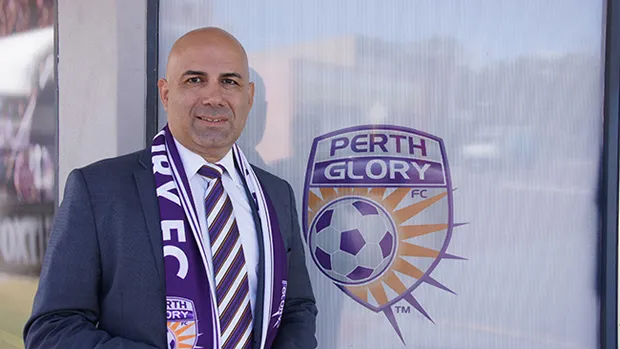
Previous ArticleNext Article

Pignata’s OAM Signals a New Era for Football Administration

In the Australian sporting landscape, administrative longevity is a rare commodity. The burnout rate for executives in the A-Leagues and state federations is notoriously high. It’s driven by the unique friction between commercial imperatives and grassroots politics. Consequently, the awarding of a Medal of the Order of Australia (OAM) to Football Tasmania CEO Tony Pignata is symbolic of more than individual recognition.

Pignata joins PFA founder Brendan Schwab, former Soccer Australia CEO Ian Holmes, and Alen Stajcic on this year’s Australia Day honour roll. However, Pignata offers a distinct blueprint for the modern sports executive. His trajectory moves from the banking sector to the Football Victoria boardroom, through high-pressure A-League franchises, and finally to the developing frontier of Tasmania.

A “Turnaround” Specialist

To understand Pignata’s executive philosophy, observers must look past the A-League. The mechanics of the Victorian Soccer Federation (VSF) in the mid-2000s tell the real story. Following the sudden departure of Damien Bown in 2004, Pignata inherited an organisation in crisis. Then-Chairman Manny Galanos described the body as being “on our hands and knees financially.”

Pignata leveraged a 17-year background in legacy financial institutions including NAB, AXA Australia, and HSBC. He applied corporate discipline to a chaotic sporting balance sheet. His tenure at the VSF (now Football Victoria) restored solvency and aggressively pursued commercial assets.

Pignata’s transition to the A-League demonstrated that these fundamental business principles could scale. His tenure across three clubs showed adaptability to different market conditions. Yet, his legacy remains inextricably linked to a singular, market-shifting transaction: the signing of Alessandro Del Piero.

In 2012, the A-League faced a relevance crisis. At its helm, Pignata executed a high-risk strategy that fundamentally altered the competition’s valuation. The Del Piero acquisition proved the league’s capacity to attract global brand equity. Pignata demonstrated that commercial viability requires bold capital investment backed by operational stability.

Bridging the “Old Soccer” Divide

Crucially, the OAM citation acknowledges a contribution that bridges the often-toxic divide between the “old soccer” NPL system and the “new football” professional era. Pignata is not a corporate outsider. His journey began as a junior at Salesian College and a player for Westall Inter and Box Hill Inter. He featured in the Reserves as the club ascended to the Premier League.

This “proximal” relationship with the grassroots gave him a unique license to operate. Long before the ubiquity of social media, Pignata engaged directly with stakeholders on public fan forums. He understood the importance of monitoring the digital pulse of its supporters when most administrators relied on press releases.

His unique ability to speak the language of both volunteer committee and corporate board drove organisational reforms in Victoria. He oversaw the rebranding to Football Federation Victoria and streamlined the V-League Academy by recruiting Eric Hollingsworth. His move to admit the Australian Institute of Sport (AIS) into the Premier League ensured elite youth talent had a vehicle for competitive match minutes. He prioritised technical development over short-term club politics.

The Tasmanian Mandate

Now 61, Pignata shows no signs of slowing down. His move to Football Tasmania in September 2023 signals a shift in the state’s ambition. Tasmania currently sits at a critical juncture, aggressively lobbying for A-League expansion and the requisite stadium infrastructure.

By appointing Pignata, Football Tasmania signalled to government partners that they are operationally ready for professionalisation. His presence de-risks the expansion proposition. He knows what a viable A-League licence looks like because he’s ran three of them.

His current focus on “high-performance pathways” addresses the state’s most pressing structural deficit: the talent drain to the mainland. Pignata’s mandate is to build an ecosystem where a Tasmanian junior sees a clear line of sight to professional football without leaving the state.

Ultimately, the OAM recognises a career defined by resilience and ROI. Pignata navigated the transition from the semi-pro era to the corporate demands of the A-League. He consistently delivered commercial growth and organisational stability.

“Football is more than a sport… it is a community, a pathway and a powerful connector,” Pignata said upon receiving the honour.

For the industry, Tony Pignata’s OAM is a benchmark. It rewards the “business of winning” off the pitch just as highly as the results on it. As he steers Football Tasmania toward a potential A-League future, the industry watches with interest. The “Pignata Effect” may yet deliver one final, historic expansion victory.

Two CEOs, One Code: Why Alignment Between Football Australia and the A-Leagues Matters More Than Ever

The NSL didn’t fail because of football. It failed because of structure, money and misalignment. With new CEOs at Football Australia and the A-Leagues, the sport now stands at a crossroads it has faced before.

Australian football finds itself at a rare inflection point. Not because of a single appointment, but because of two. With Martin Kugeler set to commence as CEO of Football Australia on 16 February 2026, and Steve Rosich now installed as CEO of the Australian Professional Leagues, the code has, perhaps for the first time in a long while, a genuine opportunity to align governance, commercial ambition and strategic execution across its two most powerful institutions.

This moment matters. Not symbolically, but structurally.

Kugeler arrives at Football Australia with a background that is markedly different from many of his predecessors. As former CEO of Stan and a senior leader across finance and strategy roles, he brings a media-native, commercially fluent mindset into a federation grappling with modern realities. Football Australia’s most recent financials tell a complex story: record revenues of $124 million, alongside a record $8.5 million loss. Chair Anter Isaac has been clear that grassroots programs and national teams will not be impacted, and projections suggest a return to surplus by 2026. But the message beneath the numbers is unmistakable: football can no longer rely on participation alone to sustain its future.

This is where Kugeler’s skillset becomes relevant. His mandate is not simply to steady the ship, but to modernise how Football Australia thinks about audiences, digital platforms, commercial partnerships and long-term value creation. Increasing commercial revenue, improving digital engagement and strengthening the federation’s market relevance are not optional objectives; they are existential ones.

Crucially, Kugeler does not inherit Football Australia in isolation. His tenure begins alongside Steve Rosich’s leadership of the A-Leagues, and that duality could become Australian football’s greatest advantage, if handled correctly.

Rosich, as previously outlined in my last CEO opinion, is not a caretaker. He is a commercial operator forged in high-pressure environments: the AFL, the Melbourne Cup Carnival and elite corporate sport. He understands sponsorship activation, broadcast value, governance discipline and the language of major brands. Where Kugeler brings media and platform intelligence, Rosich brings commercial deal-making and entertainment-led strategy.Together, they represent something Australian football has often lacked: complementary leadership at the federation and league level.


View this post on Instagram


A post shared by Soccerscene (@soccerscene.au)

For too long, the relationship between governing bodies and professional leagues has oscillated between tension and tolerance.

The recent Football Australia AGM made clear that, at least publicly, the relationship with the APL is currently characterised by “complete cooperation and collaboration.”

That sentiment must now be operationalised, not merely stated.

The $4.1 million expected credit loss linked largely to monies owed by the APL is a reminder that financial alignment, transparency and shared accountability are not abstract governance ideals. They are practical necessities. Disagreements over historical balances cannot be allowed to morph into structural dysfunction. Kugeler and Rosich must treat alignment not as diplomacy, but as strategy.

The real test of that alignment may arrive sooner than expected in the form of the Australian Championship.

The inception of a national second-tier competition is, in principle, a positive and necessary evolution for the game. But early signs should concern anyone paying attention. Clubs have already borne the brunt of operational and travel costs. Broadcast timings have been questionable, with examples such as Heidelberg United playing 1pm Sunday matches that clash directly with family and community priorities. There has been no major commercial sponsor announced, no broadcast-led narrative strategy, and no licensed merchandise program attached to the competition.

This is not sustainable.

Australian football has lived this movie before. The National Soccer League did not fail because of a lack of passion or history. It failed because of structure, economics and misaligned responsibility. The Crawford Report in 2003 was unequivocal in its findings: when Soccer Australia directly controlled the NSL’s operations, funding and commercial arrangements, inherent conflicts emerged. The governing body lacked the specialist commercial expertise to run a financially viable league, while the league itself became a financial burden that distracted from core responsibilities such as governance, development and national teams.

The solution then was clear: a licensed, semi-independent league model, aligned but not controlled. The A-Leagues were born from that logic.

The Australian Championship must not drift into the same structural grey zone that doomed the NSL. Kugeler will need to assess, early and decisively, where this competition sits within the ecosystem. Who carries the commercial risk? Who controls broadcast strategy? How are clubs protected from cost blowouts? And critically, where does the revenue model come from?

This is where alignment with Rosich becomes essential. Football Australia should not be attempting to commercialise a national competition in isolation, just as the APL should not be expected to absorb costs without strategic clarity. Joint sponsorship frameworks, coordinated broadcast planning and shared commercial storytelling are not nice-to-haves. They are safeguards against repeating history.

More broadly, the opportunity for knowledge-sharing between Kugeler and Rosich extends well beyond one competition. Both bring deep corporate networks. Both understand boardrooms, not just dressing rooms. Both speak the language of partners who expect return on investment, not goodwill.

If leveraged properly, this dual leadership can reshape how football presents itself to government, broadcasters, sponsors and global stakeholders ahead of the 2026 World Cup cycle. It can also restore confidence internally, among clubs, administrators and fans who have grown weary of fragmented strategy and reactive decision-making.

The warning is simple: alignment must be intentional. History shows that Australian football suffers most when roles blur, responsibilities overlap and commercial logic is secondary to sentiment. The promise, however, is equally clear. With Kugeler focusing Football Australia on governance, national teams and commercial modernisation, and Rosich driving the A-Leagues as a serious entertainment product, the code finally has the chance to operate as a coordinated system rather than competing silos.

Two CEOs. Two institutions. One code.

If they learn from the past, share expertise openly and resist the temptation to repeat structural mistakes, this period could mark not just a reset, but a genuine maturation of Australian football.

The opportunity is there. The question now is whether the game is ready to take it.

Most Popular Topics

Editor Picks

Send this to a friend