



At 28-years-old, Ed Ferguson has taken on the incredible role of Chief Executive Officer (CEO) at the Northern Suburbs Football Association (NSFA) and their representative National Premier Leagues side Northern Tigers over the last 18 months.
A lifelong football fan and Northern Suburbs local, Ferguson has helped to steer both the association and club through the immense challenges of not only grassroots football, but a worldwide pandemic alongside dedicated and aligned staff.
With the NSFA growing to reach its highest ever tally of participants in 2021 (18,000), a Home of Football in the works, a Female Football Mentoring Program, Sustainable Sports Program in place and a world-first environmentally sensitive synthetic football pitch to be constructed, Ferguson and the association’s contributions to the future of Australian football must not be undervalued.

Just for starters, can you give me a bit of a background about your start in football and how you ended up as CEO of the Northern Tigers and the Northern Suburbs Football Association (NSFA)?
Ed Ferguson: It all started with coaching at my grassroots club Lindfield Football Club in the Northern Suburbs when I was around 14-years old as part of Duke of Edinburgh. I coached there up until I was about 20, then I moved to Northern Tigers to coach within the SAP [Skills Acquisition Program]. At that time, I did my C License, and I did that with a guy called Oscar Gonzalez who was the Coach Education Manager at Football NSW – he recommended me for a job at Football NSW.
So, I became the Miniroos Manager which I did for two years whilst also continuing to coach at Northern Tigers. After that, I actually got a job with NSFA, becoming their Community Football Manager which was solely focused on grassroots – providing player development, coach development and club development. I did that for three years and started Inspire, the coach support program, the club coach coordinator program and also XLR8 player development programs – which has grown into a huge beast that has over 3,000 kids a week now.
After three years of doing that, I put my hat into the ring for the CEO job, and got that 18 months ago or so now. So, I’ve kind of been around Northern Tigers for 8 years. And then I’ve been a local boy in this area [all my life], first playing at Lindfield when I was Under 6. So, completely homegrown you could say.
What have been the most significant changes you’ve seen implemented in your time with the NSFA and Northern Tigers as CEO?
Ed Ferguson: In the last eighteen months I think it has to go to the Future Football strategy that we put together. The Future Football strategy was really the evolution of what we’ve been trying to create in NSFA for the last five years, and also what the board and clubs have been pushing for. It focuses retention through improvement of facilities, investing in capability building and the Northern Tigers program.
Over the last 18 months it’s been kind of hijacked by COVID if I’m honest. We’ve had a great outcome in that we’ve grown by 1,200 players between 2020 and 2021, so we’re now over 18,000 participants which is our record. And I think that hasn’t come about due to one thing in particular but lots of little things that have added up. Those little things are the support programs that we provide coaches and XLR8 player development programs. [Even] the way we structure our competitions now is about putting the experience of the player first. And other things like the improvement of our facilities with more synthetics going in and better upgrades of changerooms and the good news stories that we put out over social media [about the club and association].

What are some of the distinct challenges faced by a grassroots association and an NPL club?
Ed Ferguson: [With the association] some of the challenge really comes down to funding. Obviously, our participant numbers are increasing through the roof and yet we don’t have enough facilities to manage them all. However, we also don’t have the funds available to go and buy new facilities. We can’t go buy a football field when houses in Sydney are going for $2 million. It becomes a matter of do we buy that space or how do we convert it to synthetic? So, we need to work very close with councils and MPs to get that funding.
The other challenge for the association would have to be the club administration. So, on the ground we’ve got volunteers that are doing 20+ hours a week of work that’s completely voluntary to keep the ship running. I think our society is getting more and more demanding, we’re requiring better communication, better program offerings and more advanced development opportunities for youths. All these types of things add to the workload of those volunteers. So, I think that’s a big challenge and I hope that technology and the investment in football from the top – particularly with events like the Women’s World Cup coming up – will seep downwards so that our clubs can access that and we have better technology platforms that enable them to free up their time.
From Northern Tigers’ point of view, I think it’s quite similar to be honest. Making sure that we have suitable facilities and equipment to create the best environment for our players is a challenge. And it does all come back to funding in that. [Ideally] I would love to have half a field for every team to train on three nights a week when they train, but in reality, that’s just not possible, we don’t have enough space within the association. We’re always looking for those little 1%ers that will give us the most bang for our buck.
The NSFA recently launched its Sustainable Sports Program, in addition to reaching an agreement with the Lane Cove Council for the construction of Australia’s first environmentally sensitive synthetic pitch, why do you believe this is an important initiative as a sporting association?
Ed Ferguson: I think as a sporting association, and as citizens of the world, there’s an increasing focus on being environmentally conscious. Being very young myself I’m probably feeling it more than others that we’ve got to setup the world that we’re going to live in.
We’ve done this program to work with councils more and to raise the awareness of what our members can do that’s quite small, such as picking up their plastic bottles and recycling their gear, it can have a huge impact. Working with council on an environmentally conscious synthetic field also goes in that direction of wanting to make sure that the footprint we leave on this Earth is as small as possible. And I guess being a huge community organisation with 18,000 players, but probably 23,000 members with all the coaches and volunteers, we play a massive part in educating people towards that.

In addition to the Sustainable Sports Program, the NSFA currently have another significant initiative place, this being the Female Coach Mentoring Program. How successful has that been in supporting female coaches and the women’s game as a whole?
Ed Ferguson: The Female Coach Mentoring Program has been the brainchild of Eilidh Mackay, who we made our Head of Female Football in late 2020. It has allowed us to empower more women to take up leadership roles in football. I think we’ve all identified that football is a female sport, we’re huge on the international scale, but even on the grassroots scale we’ve got a lot of people that are involved and a lot of club presidents.
And so, the Female Coach Mentoring Program just gives the opportunity to more women and young females to get involved and provide them that experience and exposure. We’re hoping that [from there] they take on those leadership positions, they gain that confidence, they become involved in football and help us make things better for the future. Because having nine blokes around a boardroom isn’t going to provide a balanced opinion and a balanced approach to decision-making. We want to set ourselves up for the future whereby we can have lots of different perspectives – male or female, different ethnicities and age groups – at that table so that we can create the best kind of football environment for everyone.
Everything’s got a long-term development view on it. Particularly in empowering our kids and our youth to be the best that they can be.
[The NSFA’s Female Coach Mentoring Program can be accessed here.]

What do you identify as the most intrinsic values to the association and the club?
Ed Ferguson: Integrity, obviously being true to our word. Trust, in each other, a value of empathy and understanding where each other are from is a massive one. Understanding where each person is at and how we can support them. They’re probably three things that I hold quite close. And I think within our club we hold those very dear.
I was brought up through Jason [Eagar] being a coach in Northern Tigers and if he holds those things dear, and he obviously practices them on a day-to-day basis, they’ve sunk into me. And now me, being in this leadership position, I pass this onto our clubs and I think that shows stability in what we do. That consistency of approach and stability of people is important for any organisation, as it allows it to progress and move forward. If you’re swapping staff every few months you struggle to bed down the values of the region.
Over the years, the Northern Tigers have placed a great emphasis on youth development for both the Women’s and Men’s teams. How important has this been to fostering a strong culture around the club?
Ed Fergusion: It’s been everything. From day dot, since Jason’s come in, we’ve been a club that is focused on development. And I think our association vision; the focus on retention, supports that as well even more so now that we’re focused on building the capabilities of the people that we have within already. That long-term view of retaining people in the club and developing them for the game in the future has always been a priority.
Like I was saying with the stability of our values, it also then helps the culture. If you look at our First Grade Men, Adam Hett is our coach and he was involved as a player in the First Team with Jason as his coach. Over 50% of our First Grade Men’s players are locals, and it is pretty similar with the First Grade Women’s side also, with a lot of the girls coming back from Institute that used to be Tigers or NSFA players. I think having that culture where people don’t need to leave NSFA to get to the level of football that they desire is a huge thing for us.
Having that consistency of people and the trust to bring through young people, just like how the board have trusted me, a 28-year-old, to lead the third largest association in the country, speaks volumes of who we are and what we’re trying to create whether it’s SAP teams or board level.
Australian football in general is at a place now where it is working towards alignment in not just a literal competitions sense, but also in a collective alignment of goals for the game’s future. What do you believe is necessary for Australian football to get right over the next few years?
Ed Ferguson: That is the million-dollar question. To be honest I think football needs to listen to each other. And I feel that – from an NPL space, having been a coach, player and administrator – people do not listen to each other enough. People above us do not listen to what is actually going on in the grassroots. They don’t listen to why we can’t create the best environment in NPL and what we require to be able to create that. They don’t listen to the challenges that are happening on the ground with our volunteers. And, if they don’t listen, people are only going to keep going for so long and then cracks will appear.
So, I think the biggest thing for us to be aligned and to get it right, is to listen to each other and involve everybody in that conversation. And I know it’s a mammoth task because Australia is massive and there are so many different stakeholders, but you just have to start that.
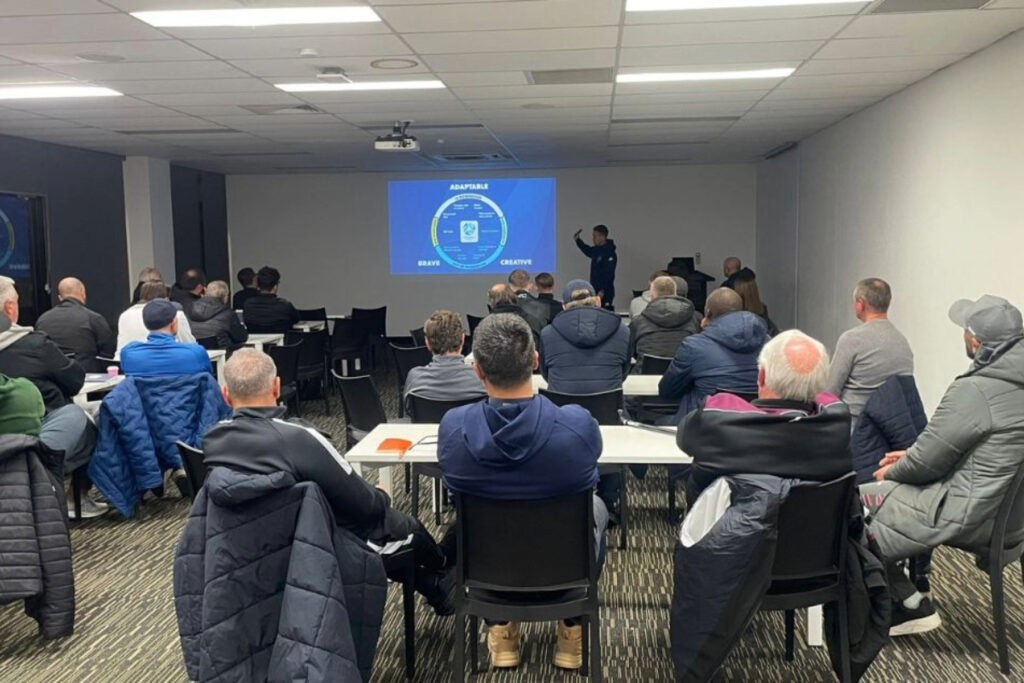
We all work in football because we love it, and I think if you can tap into that with correct leadership everyone on the ground will give you so much more backing. And I’ve seen that in my role where I might deliver a workshop or an engagement with my 30 Club Presidents, but I guarantee that if I’ve listened to their needs, met their challenges and have collaborated with them, that when they go back out, they’ll each give me 3, 4, 5 hours of effort to implement what we’re trying to do to make football better. And therefore, my 1 or 2 hours of workshop have created 90+ hours of effort into football.
And I think that if people at Football Australia and Football NSW understood that, and understood that leadership influence they can have just by listening and collaborating, we would be an absolute force to be reckoned with. Because we have some amazing people involved [in football] and to be honest, we have the perfect landscape to create some outstanding football players.
What are the plans for the NSFA going forward in regard to building from the Future Football plan and building on the current infrastructure and facilities?
Ed Ferguson: From NSFA’s point of view we’ve got two big priority areas. One is to build ourselves a Home of Football which will be a 300-seat undercover grandstand, as well as a gym, change rooms, referee room, which will be based at North Turramurra. This central Home of Football will be used by the Northern Tigers and the NSFA community. For us to build something like that is going to cost around $4 million, but it’s seen as a big priority of the association.
The second priority of the association is to increase sports field capacity. What that will involve is looking at grass fields and evaluating whether we can convert them to synthetic fields or returf them so that they can have a higher yield on them meaning we can get more traffic. Because as our player numbers go up, we obviously need more space for people to play. The challenge with that was funding but we’ve now got a Facilities Levy. So, $15 per season on every player’s head goes into this funding pool and then that now allows us to go to council to co-fund and contribute to priority facility.