


Knights Stadium: More than just a home ground

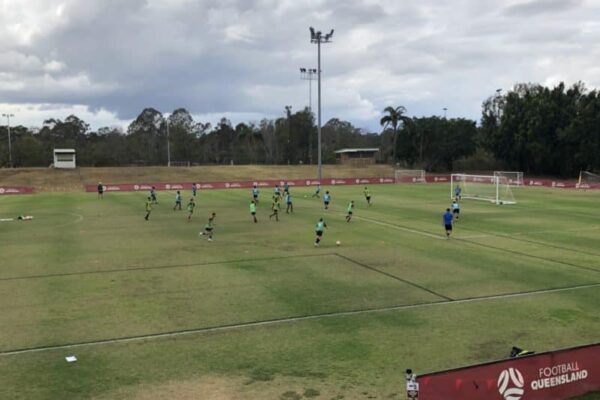
Knights Stadium is one of the most iconic venues in Australian football – for many it is more than just a stadium.

The ground was built in 1989 with storied history. Melbourne Knights, formerly known as Melbourne Croatia SC, were two-time National Soccer League (NSL) champions and four-time minor premiers at the ground during the 1990s.

The Mark Viduka Stand can seat up to 3,000 people, while another 12,000 can stand around the pitch. The ground represents the largest football-only sporting ground in the state of Victoria – testament to the history and strength of Melbourne Knights FC.

Knights Stadium in 2002 with the Mark Viduka Stand.

Former Melbourne Knights president Andelko Cimera says he was part of the club while Knights Stadium was becoming a reality.

“We were playing at the old number two pitch at Olympic Park, where the dog track was, and that was virtually our home. We were looking for alternatives and a couple of properties came up – a drive-in in Altona and a drive-in at North Sunshine,” he said.

“We settled on Sunshine because it was a little bit cheaper. I think we paid $180,000 at that time in 1984. 12 months later we started developing the stadium.”

Melbourne Croatia at the time tried to secure the rights to play at Heidelberg United’s home ground Olympic Park and several other venues, before a decade-long donation drive allowed them to raise the money to purchase the land and develop a facility at the current site of Somers Street.

94/95 NSL champions

Melbourne Knights FC President Pave Jusup says that much of his childhood was spent at Knights Stadium.

“We only saw the stadium for games. We would always strive to go there, and sometimes the juniors would have an important game that’d let us on the second ground, even the main ground,” he said.

“If you walked into the wrong part of the ground the groundskeeper would grab you and make you be a ball boy, and you’d get a hotdog and drink after the game. It was a whole childhood for a lot of us.”

Jusup adds that Melbourne Knights and the stadium serve as a key pillar within the Croatian community.

“There are a lot of memories that have been created there. A lot of people are tied to the physical place and it is a hub of the Croatian community along with the Croatian club in Footscray and the original Croatian church in Clifton Hill. We are the three constant and long-term fixtures in the community,” he said.

Cimera explains that there were both positives and negatives towards the stadium being community ran and operated.

“There were advantages and disadvantages. It was our property, it was our ground. It was up to us whether it was Sunday night, Saturday afternoon, or Friday night game. It was always available to us,” he said.

“The disadvantages were that everything was up to us. The maintenance of the ground was up to us. The facility became a burden to the Croatian community, which involved all our payments, all our rates which were paid for by the community.”


Both Jusup and Cimera agree that the biggest games were always against South Melbourne.

“It became a fortress for us in the 90s. It was difficult to take points away from our ground for teams,” Cimera said.

“I think our record crowd was when Hadjuk Split was here, that was close to 15,000. I remember when we played South Melbourne we had 12,000 people. The games between South Melbourne and us were always the biggest crowds.”

During the 2000 National Soccer League season, over 11,000 people descended upon Knights Stadium to watch Melbourne Croatia vs South Melbourne Hellas.

“Around 2001, they were top of the table and unbeaten, while we were mid to low-end of the table. We beat them 4-0. That is one game that sticks out in my mind,” Jusup said.

For both Cimera and Jusup, they acknowledge that the supporters and members of Melbourne Knights want to see Knights Stadium and the club feature in a second division.

“It’s not only the Melbourne Knights. It’s the juniors too because they can have a career path. Right now they can’t see a career path. Without promotion and relegation, it makes it very difficult,” Cimera said.

“We’ve got a lot of latent fans who are disappointed in the situation we find ourselves in. There are a lot of people who would put their hands up and into their pockets to help propel the club if given the opportunity. We’ve gone through a period of consolidation, but there’s a new generation of people who want to propel the club into the limelight as their parents and grandparents did,” Jusup said.

If the opportunity to join a second division does arise for Melbourne Knights, then their home ground won’t look out of place on the national stage.
Previous ArticleNext Article

Who are the Key Speakers at the 2026 FV Club Administrator Conference?

Football Victoria (FV) has confirmed the expert lineup for the 2026 Club Administrator Conference, set to take place at The Home of The Matildas on Saturday, 7 February.

While the annual forum remains a staple of the pre-season calendar, the 2026 edition arrives against a backdrop of increasing administrative complexity for the state’s grassroots ecosystem. Consequently, this year’s schedule moves beyond standard networking to prioritise specific subject matter experts who address three distinct pressure points: digital transition, infrastructure investment, and operational risk management.

Digital and Infrastructure Strategy

For club administrators, the immediate operational focus remains the integration of the new Dribl platform. However, FV’s Head of Government Relations & Strategy, Lachlan Cole, drives the broader strategic conversation.

Cole dissects the Facilities Strategy 2025-2035 during the “Level The Playing Field” session. Crucially, a bipartisan panel featuring Parliamentary Friends of Football Co-Conveners Anthony Cianflone MP and John Pesutto MP joins him. With the 2026 state election looming, their involvement offers clubs a rare mechanism to understand how to leverage political support for infrastructure funding.

Risk and Compliance

The burden of compliance on volunteers remains a central theme. Tom Dixon, National Manager at Play by the Rules, confronts the tightening regulatory environment regarding member protection. Dixon delivers a technical breakdown on complaints management, specifically targeting the tangible liability risks that volunteer boards face.

Moreover, Outside the Locker Room CEO Todd Morgan turns the lens toward the psychosocial environment. Morgan presents frameworks for managing mental well-being, equipping administrators with the tools to navigate high-pressure sporting contexts.

Further strengthening the governance focus, FV Diversity, Equity & Inclusion Project Manager Sophie Byrnes outlines the organisation’s new DEI Framework. Her session examines how clubs embed these standards into core business operations rather than treating them as peripheral activities. This structural approach finds a complement in Tarik Bayrakli. Bringing seven years of development experience, Bayrakli presents the ‘A.W.E.S.O.M.E.’ framework, a systematic methodology designed to help committees move beyond simple punitive measures and address club culture at the source.

Ultimately, this speaker lineup represents a shift from general club development to specific technical upskilling, reflecting the professionalisation required of modern volunteer committees.


Is the FW Regional Girls Training Camp bridging the access gap for talent?

In Western Australia, the tyranny of distance has historically functioned as the primary barrier to talent identification.

For regional footballers, the logistical and financial burden of accessing elite pathways often renders the concept of “equal opportunity” a theoretical ideal rather than an operational reality. However, the recent Regional Girls Training Camp, hosted at the Sam Kerr Football Centre, suggests that Football West is moving to operationalise the structural changes announced in its 2026 academy overhaul.

Earlier this week, nearly 100 players aged 10 to 17 converged on the State Centre for Football in Cannington. The three-day camp invited participants from the previous year’s Country Week carnival, represents the first tangible application of the “real-match” and high-performance philosophy outlined by Football West Development Manager Gareth Naven late last year.

While the previous announcement of the Regional Academy model focused on the structural shift from training camps to competitive “State Carnivals,” this current initiative addresses the resource gap. For stakeholders and policymakers, the camp serves as a case study in how centralised infrastructure assets can be leveraged to service a decentralised demographic.

Infrastructure as an equity lever

A lack of high-performance environments defines the economic reality of regional football. The facility gap between metro NPL setups and regional clubs is often vast. Football West uses the Sam Kerr Football Centre to subsidise the “professional experience” for regional talent.

Sarah Carroll, Female Football & Advocacy Manager, notes the purpose extends beyond simple engagement. The curriculum fused on-pitch technical training with athlete development workshops.

Geography usually blocks access to this sport science for a 14-year-old Pilbara or Goldfields player. By centralising this education, the governing body helps standardise the player pool’s knowledge base. Naven’s alignment strategy demands closing the “knowledge gap” alongside the technical one.

The economics of the “Legacy”

Critically, the WA Government funds the camp through the Female Community Legacy Program. This highlights the Legacy Program’s ROI for the Department of Local Government, Sport and Cultural Industries.

A stated aim to “enhance club capability” acknowledges that player development requires an ecosystem. The funding mechanism here is significant. Without state intervention, the cost per head would prohibit many families from attending.

Targeted funding bridges the gap between community participation and elite commercial viability. Regional Lead Tanya Amazzini calls these opportunities “essential” for player growth and confidence.

Strategic alignment with the 2026 pathway

Observers must view this camp alongside the Regional Academy system overhaul. The new “State Carnival” model demands players physically prepared for elite competition. This camp functions as the preparatory phase for that new competitive reality.

Football West uses elite exposure to mitigate the shock of transitioning to state programs. Furthermore, involving players from the Pilbara to the South West keeps the talent net wide. Maintaining sight on remote talent requires constant investment.

The residual challenge

However, the long-term impact warrants caution. The “re-entry” phase remains the primary challenge. Players return to clubs with significantly fewer resources than the Sam Kerr Football Centre.

Success depends on the “trickle-down” effect of the education provided. If players transfer this knowledge locally, the aggregate standard of regional football rises. If isolated, the experience may simply make the regional gap feel more pronounced.

Integrating 100 regional girls into the state’s premier facility executes the strategic plan. It signals that the Centre delivers dividends to the broader ecosystem, not just the elite.

Most Popular Topics

Editor Picks

Send this to a friend