Local Sport Defibrillator Grant Program

The Local Sport Defibrillator Grant Program allocates $4 million over four years to assist sporting clubs across NSW in the purchase and maintenance of Automated External Defibrillators (AEDs).

An AED is a life saving device which delivers a controlled shock to an individual experiencing cardiac arrest, increasing their chances of survival.

The Local Sport Defibrillator Grant Program provides NSW sports clubs and councils the opportunity to acquire an AED package for their club or sports facility at a reduced cost.

Sporting organisations and councils will be able to choose from a panel of approved AED Panel Service Providers and a variety of AED packaged services with the level of customer service that meets their needs.

An AED package will include:

  • An AED
  • AED familiarisation instruction (within 28 days of delivery)
  • A minimum of six years of essential AED maintenance

For full details of what an AED package includes, visit the Frequently Asked Questions.

AED Panel Service Providers, AED products and services are required to meet and maintain minimum requirements under the panel contract with the Office of Sport. Sporting organisations and councils must rely on their own enquiries to the suitability of the AED Panel Service Provider they engage.

Eligibility

  • Incorporated, not-for-profit sports clubs in NSW
  • State or national sporting organisations on behalf of member clubs located in NSW, to a maximum of 10 per Zone
  • Licensed sporting clubs, providing that the project directly benefits sporting activities
  • Sport clubs associated with a school, church or university providing they are an incorporated not for profit club in their own right
  • Councils on behalf of sports clubs
  • Councils, sport and recreational facilities owners on behalf of sports clubs
  • Service clubs such as Rotary, CWA and Lions, on behalf of sporting clubs

Funding range of grant

  • Grants are available up to 50 per cent of the AED package in Zones 1 and 2 and up to 75 per cent in Zone 3.Applicants can request more than one AED.
    Zone Maximum Grant Amount
    1 $1,250
    2 $1,300
    3 $1,900

    Applicants will need to contribute to the purchase price and accept any further operating expenses from their own budget.

    Grants are available up to 50% of the selected AED package price in Zones 1 and 2 and up to 75% in Zone 3, capped at the levels stated below.

    Funding should be expended within six months of the date of signing the funding agreement.

    What will be funded

More Info: Office of sport NSW

Previous ArticleNext Article

Victorian State Budget delivers $750,000 to football facilities as governing body signals more to come

Two of Victoria’s most prominent football clubs have secured a combined $750,000 in facility funding from the 2026 Victorian State Budget, in what Football Victoria describes as the beginning of a broader set of announcements for the sport from this year’s budget cycle.

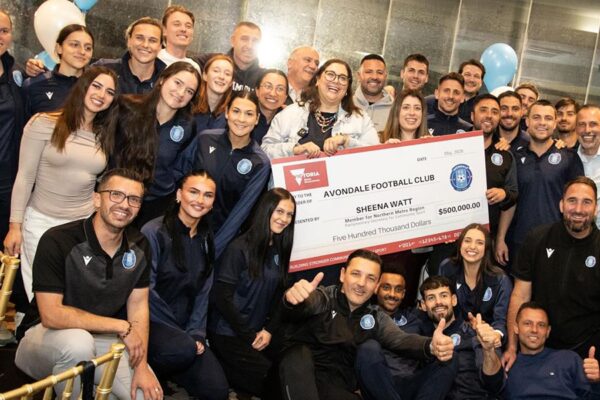
Avondale FC will receive $500,000 to install lighting at Avenger Park in Avondale Heights, while Hume City FC has secured $250,000 for major upgrades at Nasiol Stadium in Broadmeadows, including a new LED scoreboard and improved lighting infrastructure. Both clubs compete in the Victorian National Premier Leagues and serve large multicultural communities in Melbourne’s north and northwest.

The announcements are modest in scale relative to the infrastructure deficit facing community and semi-professional football across the state, but their political significance extends beyond the dollar figures. They represent a tangible return on Football Victoria’s sustained advocacy campaign, which includes the Level the Playing Field parliamentary petition calling for more equitable government funding for football relative to other codes.

Facilities as Equity Infrastructure

The Avondale funding addresses a problem that has constrained the club’s operations for years. Avenger Park currently cannot be used at night, forcing the club to play matches at neighbouring venues or arrange temporary lighting for significant fixtures, including last year’s Hahn Australia Cup tie. The $500,000 investment will allow the club to host evening matches and training sessions on its own ground for the first time, removing a structural disadvantage that has affected scheduling, participation and the overall experience for hundreds of players each week.

For Hume City, the implications carry a specific equity dimension. Club President Ersan Gulum noted that upgraded lighting and facilities would directly support the growth of the club’s girls’ and women’s programs by providing better access to training environments and creating more opportunities for female participation.

“We have hundreds of players across all age groups utilising these facilities each week, and these improvements will help create an even stronger environment for excellence, participation, and community engagement,” Gulum said.

The connection between lighting and women’s football access is not incidental. Inadequate or absent lighting at community grounds disproportionately affects female programs, which have expanded rapidly in recent years but frequently find themselves scheduled into daytime slots because evening use of the facility is not viable. Infrastructure that enables night training and matches does not merely improve conditions. It expands the hours during which the ground can be used, directly increasing the number of teams and players a facility can serve.

The Political Context

Both clubs are located in state electorates where local members played an active role in securing the funding. Avondale celebrated the announcement with Parliamentary Secretary Sheena Watt, while Hume City acknowledged the support of local members in its public statement.

The pattern is familiar in Australian sports funding. Facility grants flow through electorate-level political relationships as much as through any centralised allocation process. Football Victoria’s acknowledgement of both Merri-Bek and Hume City Councils, in addition to the state government, reflects the layered advocacy required to move funding from budget allocation to ground-level construction.

Football Victoria CEO Dan Birrell praised both clubs and pointed toward further announcements.

“Both Avondale and Hume City are pillars in the Victorian football landscape, building strong and supportive communities around their top level junior and senior football programs,” Birrell said. “Professional level facilities like Avenger Park and Nasiol Stadium are critical for the development of Victorian football.”

Football Victoria has indicated more budget-related football announcements are forthcoming and has urged supporters to sign the Level the Playing Field petition ahead of the next Victorian State Election.

Heidelberg United denied qualification to AFC UCL 2

In an announcement made yesterday, Football Australia revealed that, in place of Heidelberg United, Melbourne Victory will now take the AFC UCL 2 spot.

A premature ending

In what is sure to be a disappointing verdict for Heidelberg’s fans, staff and supporters, the NPL VIC side will no longer compete in next season’s AFC CL 2.

The decision comes despite Heidelberg meeting the necessary criteria outlined in Football Australia’s National Club Licensing Regulations.

“We understand that this will be a disappointing outcome for everyone connected to Heidelberg United FC,” said FA Executive Director of Football, Heather Garriock, via press release.

“The club earned enormous respect through its performances this season and should be proud of what it achieved both on and off the pitch.”

Indeed, through defeating several A-League outfits en-route to the Australia Cup Final against Newcastle Jets, Heidelberg did earn widespread respect and admiration across the landscape. Football Australia also strongly advocated for the side’s place in the AFC CL 2 following Newcastle’s qualification to the AFC CL Elite.

But despite the determined efforts of the club’s board to meet all necessary criteria, the Asian Football Confederation (AFC) ruled the side ineligible to compete.


Victory emerge as replacements

Filling the now-vacant position in next season’s competition is Melbourne Victory, who finished 4th in the A-League this year.

As 3rd-place Auckland FC are based in New Zealand, thus falling under the Oceania Football Confederation (OFC), they are also ineligible to compete.

So while the AFC CL 2 will still be arriving in Melbourne next season, fixtures will no longer be built on the underdog success story of Heidelberg’s immense rise from NPL to AFC CL matchdays.

The club, however, will appeal the decision, and has written to Football Australia for further clarity on the Appeals Process.

It remains uncertain whether the appeal will be successful or not, but Heidelberg will undoubtedly enjoy the backing not just of its own staff and supporters, but of the entire Australian grassroots community.

Most Popular Topics

Editor Picks

Send this to a friend