


Alex Brosque: A true football ambassador

Alex Brosque

When Alex Brosque first wore the colours of Marconi-Fairfield during the 2001-2002 N.S.L. season, he exuded a sense of anticipation and excitement which laid the foundations for a successful professional football career.

The striker with the sweet left foot, deft touch and genuine pace was always bound for glory. His goal scoring record at professional level of almost one goal in every three games was a testimony to his ability in the front third of the field, even though he played many games as a wide player.

Despite a satisfying career overseas in Japan and the Middle East, Brosque was content to ply much of his trade in Australia where he became a cult figure at Sydney F.C.

However, Brosque was more than just a footballer because he has always been a great ambassador for the game and on retirement. It was a natural progression for him to enter the media ranks.

In this interview with Roger Sleeman, Alex Brosque discusses his feelings about life after football as he reflects on his playing career, expresses his opinions on the current state of the game and his current role in the public eye as part of the football media ranks.

Roger Sleeman: Looking back on your playing career, what is the feeling of life after football?

Alex Brosque: Fortunately, everything I hoped it would be.

When your career ends, there’s always that uncertainty about what your next step will be and whether you can transition smoothly.

I spoke to a lot of ex players in my last years who advised me to play as long as possible because they said when you retire, it’s not a happy decision.

Three years on, I’ve had more time to spend with my family because travelling nationally and playing overseas take its toll in a long playing career.

Also, I don’t miss the daily grind when your body takes three to four days to recover after playing.

However, I’m very lucky to be involved with the media which has continued my connection with the game.

R.S. Do you believe you achieved enough in your playing career?

A.B. It’s all about perspective and when I was growing up, I was never tipped to be a star.

I played football because I loved it and enjoyed being with my mates.

Things progressed slowly for me and what I achieved was more than what I could’ve imagined as a young kid.

In my first years of senior football, there was hype in one newspaper article that I was the next Harry Kewell.

But I was different to Harry and my personality wasn’t about being the best player at the biggest club.

That characteristic just wasn’t in me.

R.S. So what is that magical something which defines success at the highest level?

A.B. It’s the mental part, not just your technique and work rate.

It’s whether you have that drive and passion to succeeed like a Craig Johnston.

Johnston had the determination to achieve at all costs.

This mental strength was also evident in succeeding generations with players like Jim Patikas and David Mitchell.

Currently, the mental strength of young players isn’t the same because it’s all too easy for them. Previously, parents made big sacrifices for their sons to succeed in football so we made sure we succeeded to justify their investment in us.
R.S. Can you relate your experience when you first went overseas in 2004?

A.B. Off the back of the 2003 World Youth Cup in which I performed well, an agent approached me to go to Feyenoord.

The plan was always to place me on loan  because I was only twenty and  they would’ve had to pay me a minimum wage.

I had a trial at Westerloo in Belgium and when they were happy with me, I signed.

At the time, the NSL was dying ,and the A-League hadn’t commenced, so the only option was to go overseas.

However, I dreaded leaving my family in Australia.

It’s just my personality and I had no regrets leaving Westerloo after one season to return to play in the A-League with Brisbane Roar.

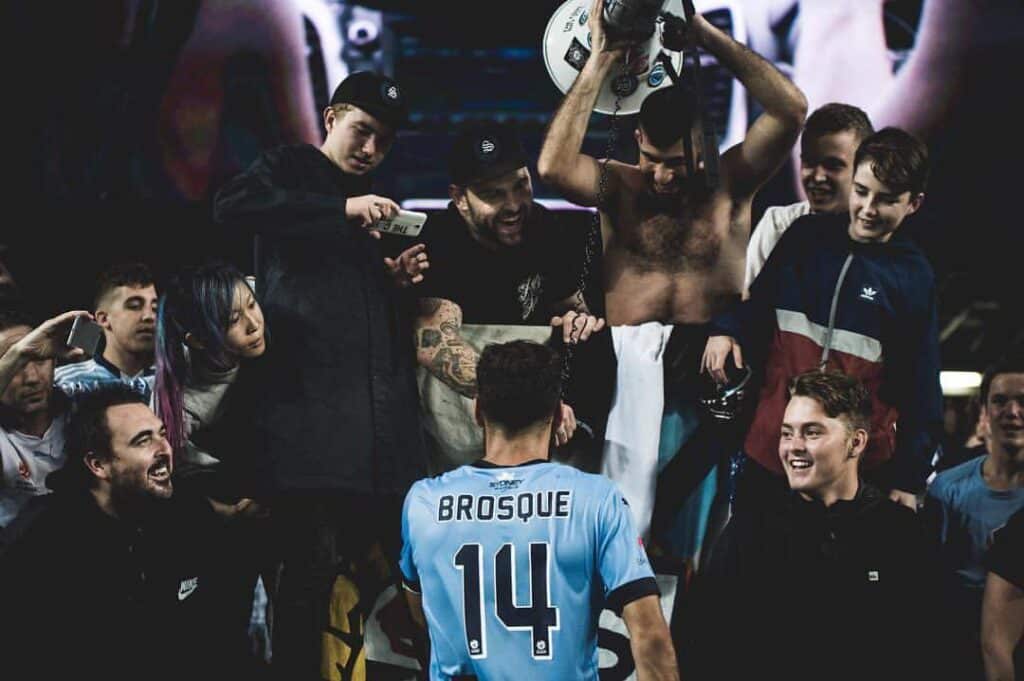
R.S. You established your name in Sydney FC folklore from 2006-2011. What are you memories of that first stint?

A.B. Terry Butcher was the coach in the first year and his coaching style was typically English.

His methods concentrated on a lot of sessions with lots of drills.

He was criticised in many quarters  but I found him to be a great guy with obviously an amazing football pedigree.

I didn’t do well in the first season and only scored five goals, although I had come in as a big signing. That was tough for me.

However, I improved my mental attitude which helped me immensely in the following season.

In that five year stint, I learned much about the game from the different coaches, Terry Butcher, Branko Culina, John Kosmina and Vitezslav Lavika

Lavika particularly was a pleasure to play under with his outstanding knowledge and the fact he was so calm and never raised his voice.

Amongst my team-mates, John Aloisi and Tony Popovic were amazing to play with.

R.S. There was some controversy in your move to Japan with Shimizu S Pulse for the 2011 and 2012 seasons. What were the circumstances surrounding this and what was life like in Japan?

A.B. At the time I still had a contract with Sydney F.C. and a court case ensued.

Eventually, Sydney FC released me and I promised Chairman, Scott Barlow, I would return to the club one day.

Japan has a real football culture and it ranks as one of the best places I’ve played in.

The football was a high standard and the players had great technique and speed of thought whereas we often are just quick and strong in Australia.

Going to training every day was a pleasure and playing with legends of the class of Shinji Ono and Takahara was something else. All players, whether defenders or attackers were technically proficient.

The fans took to me when I ssored a penalty in an early match and although the stadium was only small with a capacity of 15,000, it was always a great atmosphere.

Ironically, my time in Japan brought me to the attention of the Middle East and I was signed by Al Ain in 2012.

This decision was an important financial consideration for my family but it also meant I bypassed the chance to still compete for a spot in the Socceroo squad for the 2014 Brazil World Cup.

The rest is history as I returned to Sydney F.C. in 2014 to see out my career until 2019.

When you have team-mates in the class of Juninho, Steve Corica, Clint Bolton and Terry McFlynn and coaching staff at the level of Graham Arnold and Andrew Clarke, life is made much easier.

R.S. What is your opinion of the signing of Jack Rodwell, Joe Lolley and Robert Mak at Sydney F.C.

A.B. Jack Rodwell if fully fit can be a great asset to Sydney F.C.

I like his aggression and he can make a difference as a leader in the middle of the park as Luke Brattan did before his serious injury.

In reference to Lolley, take the case of Besart Berisha who was a relative unknown before he came to the A-League.

Adam le Fondre has proven what he can do and I believe Lolley can score goals in a competition where he’ll be playing only once a week for the most part.

I’ve seen him score some spectacular goals from long range in the UK.

Robert Mak has a wonderful pedigree and he should be an important part of the squad this season.

However, now that Bobo has retired, I would like to see Patrick Wood get more game time.

R.S. Are you enjoying your time in the media and is the game benefiting from theTen/Paramount coverage?

A.B. Originally, when Fox Sports approached met to become an analyst,  I did it to stay in the game and it developed into more regular work.

Certainly, we need more media like other codes with an emphasis on player profiles.

When I look at the Paramount/Ten Coverage investment, it would be ideal to see them grow the coverage over their five year contract.

The fans need more information and larger coverage because the print media is almost non existent.

Critically, there has to be more discussion round the game and former players need to be more than just a face.
Previous ArticleNext Article

Beyond the Pitch: Miyuki Kobayashi on the Real Challenges Facing Japan’s Women’s Game

Last week, Soccerscene spoke to pioneer of women’s football in Japan, Miyuki Kobayashi, about the game’s development in Japan and the intersection between sporting and social change in the country.


Talent, quality and recent silverware

After Japan’s recent AFC Women’s Asian Cup victory in the final against Australia, the women’s national team solidified its standing as the No.1 team in Asia.

Throughout the last 15 years, Japan’s women’s national team has grown into a formidable opponent, boasting a World Cup trophy, an Olympic silver medal, as well as three AFC Women’s Asian Cups.

The talent is undeniable. The quality is unwavering. And the team shows no signs of slowing down.

But these victories and trophies on the world stage wouldn’t be possible without the leaders behind the scenes – none more so than Miyuki Kobayashi, former WE League Board Member and current JEF United Ladies Scout and Academy Chief.


Laying the foundations

Kobayashi has led the charge for women’s football in Japan, promoting not only a sport which values success, but one which empowers female footballers across the nation.

“At university, not many girls were playing and we didn’t have an official team. I went to the US and the environment was so different,” Kobayashi explained.

“That opened my eyes – women can play. That’s how I started the women’s soccer league when I came back: to make an environment for girls to play.”

Thus, accessibility and opportunity became driving factors behind Kobayashi’s work, not only for those on the pitch, but for those in the dugout.

“I got involved at the JFA (Japanese Football Association) to promote women’s football. We wanted to create the opportunity for women to be coaches.”

“They are coached by men all the time, so even when the top players leave the football world, they never think to be involved.”

Furthermore, as a former coach of JEF United Ladies Youth and General Manager, Kobayashi was intent on employing as many female coaches as possible. It was not merely a personnel change, but a challenge to widespread social attitudes.

“When I started to employ female coaches, the girls’ parents asked why the coach wasn’t a man. But gradually, we started to make it equal – they didn’t talk about the gender, but about the quality of the coach.”


The mission to empower

In 2011, the same year Japan’s women won the World Cup, the domestic league was yet to become professional. Known as the Nadeshiko League, players would work during the day and train in the evenings.

The transition from an amateur to the current professional league required time, resilience and a change in perspective.

“The sports world in Japan is more traditional – it is dominated by men,” said Kobayashi.

“If you want to make the environment even, or (want) more women to come into the (football) world, you can change the mind of the players.”

Since 2021, the WE League has embodied a sense of growth and positive change for the women’s game. In name and nature, it looks to empower players, coaches and all involved in the industry.

“I was in charge of mission achievement for women’s empowerment. We wanted to educate the players, to inspire girls and women who watch the game.”

However, the drive to empower women in football was not without backlash and challenges.

“Some people don’t like that word: ’empowerment’. It’s too strong for them. Some women really appreciate it, but it’s not easy to change the mind of society through football,” Kobayashi admitted.


Growing and attracting talent

Although WE League clubs are accelerating youth development and expanding pathways across U15, U18 and first team football, Kobayashi acknowledged that the overall product must improve to bring foreign players to Japan and entice homegrown talent to stay.

“Most of the national team players go to Europe or North America. I don’t say it’s a problem, but from a young age, girls who can play in the WE League want to go abroad,” Kobayashi outlined.

Indeed, when looking at the starting XI in last month’s AFC Women’s Asian Cup final, only one player – Hana Takahashi – plays in the WE League.

But the key to attracting domestic and international players to the WE League, is aligning financial investment and industry attitudes.

“The reason why women’s football has developed in European countries is the social thinking – you have to be equal and have the same opportunities as men in football. The Japanese way of thinking, especially in the football world, is not that at all,” Kobayashi continued.

“When I speak to people at Spanish clubs, women’s football is not a charity, but an investment.”

“We have assets. We have good, young players, but we’re exporting them, so we need to import too.”

Indeed, Spain is a perfect example of what can happen when investment becomes intentional, not optional. Back-to-back UEFA Women’s Nations League titles, 90% television viewership increase since 2016, and record-breaking crowd numbers reflect what can happen when the industry aligns in vision and commitment.

Japan has the players to compete against any nation in the world. Purposeful investment, combined with its overall quality of players and style, could transform the WE League into a true, global powerhouse.


The vision for the future

Moving forward, Kobayashi hopes that girls progressing through JEF United’s academies develop confidence and resilience, whether as players or people.

“We want to make the girls – even if they aren’t in JEF United – continue playing football and continue to be leaders,” Kobayashi said.

“Some of them have a dream to be a coach or a leader off the field too, so that’s one of the attributes we want to develop.”

This resilience, reflected by the club’s ‘never give up’ philosophy, is testament to the vision of empowerment championed by Kobayashi across the women’s game.

Even in the face of social obstacles and a lack of financial investment, perseverance and hard work is at the bedrock of women’s football in Japan. It is not just that these values exist, but that they are consistently manifested on and off the pitch, which can show future generations that football is a sport for all – men and women alike.


Final thoughts

There is no limit to what the WE League and the national team can achieve if given the resources it deserves. All the ingredients are there: individual quality, a distinct playing style, football philosophy and ambitions to grow.

By following the example of industry leaders like Kobayashi, women’s football in Japan can hopefully continue to make waves of impact – in the sporting landscape and society as a whole.

Socceroos Make Powerful $15K Play to Back Organ Donation Awareness

The Socceroos have reinforced football’s power beyond the pitch with a $15,000 donation to Transplant Australia Football Club (TAFC). The funding will support its 2026 Transplant World Cup campaign while raising awareness for organ and tissue donation.

The contribution, delivered through Professional Footballers Australia’s (PFA) Community Impact Fund, will assist TAFC’s preparations for the upcoming Transplant Football World Cup in Frankfurt. It is also amplifying the organisation’s broader mission to promote the life-saving impact of organ donation.

Presented during a national team training session, the donation reflects a growing commitment from Australia’s elite players to use their platform for meaningful social impact. Creating a connection between the game and causes that resonate far beyond football.

The initiative builds on an ongoing relationship between the Socceroos and TAFC, following a previous player-led contribution in 2024 that supported the team’s participation in the inaugural tournament in Italy.

More than just financial support, the partnership signals a longer-term collaboration aimed at increasing visibility for organ and tissue donation, leveraging the reach of both the national team and the PFA to drive awareness nationwide.

TAFC provides a unique pathway for transplant recipients, donors, and their families to re-engage with sport—offering not only competitive opportunities but a powerful platform to share stories of resilience, recovery, and second chances.

With the 2026 Transplant Football World Cup on the horizon, the Socceroos’ support will play a crucial role in enabling Australia’s team to compete on the global stage, while championing a message that extends far beyond results: the life-changing impact of donation.

As football continues to grow as both a cultural and social force, initiatives like this highlight the game’s unique ability to unite communities, elevate important causes, and create lasting impact where it matters most.

Most Popular Topics

Editor Picks

Send this to a friend