
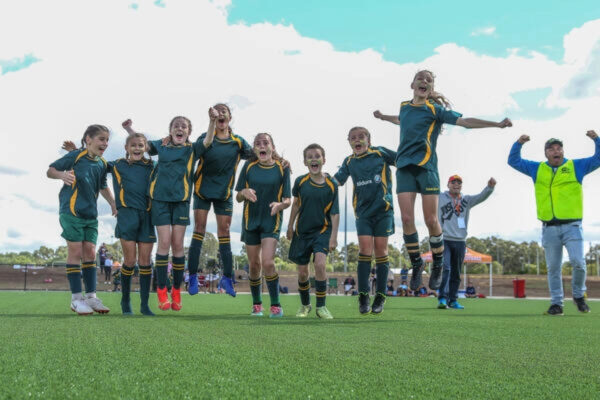


Females in football celebrated through She Can and the World Cup

She Can

With the widely anticipated 2023 FIFA Women’s World Cup just around the corner, it is becoming ever so more important to teach, support and empower young Australian females about their rightful place in sport.

It is acknowledged that being involved in sports can assist in breaking down gender stereotypes, improve the self-esteem of women and girls, and add to the advancement of leadership and strategic skills.

However, with all the positives of female participation in sports, it is a shame to see that young girls aged 11-17 in Australia have a lower retention rate in sports compared to their male counterparts of the same age.

Tackling this problem head-on, the 2023 FIFA Women’s World Cup, hosted jointly in Australia and New Zealand, is expected to be a celebration of women’s football in both countries.

Showcasing the footballing talent of females all across the globe, the World Cup is bound to supercharge women’s football in Australia and New Zealand. The hope is to increase future female participation, starting in grassroots programs.

Proactive in addressing this same issue, Sydney FC has recently unveiled its new grassroots initiative, the ‘She Can’ program.

The She Can Program was developed by Sydney FC to break down barriers to sports faced by young girls across the country. It involves both practical and theoretical elements that hope to provide participants with skills and a more in-depth understanding of their own support networks. The program acknowledges that barriers to participation can be overcome as they arise and encourages girls to continue to play their chosen sport in the future.

Rolling out the program in late 2022, students from Illawarra Sports High School were the first to take part in She Can.

The female participants discussed many important topics that young girls could potentially be too nervous or afraid to talk about, such as confidence, leadership, menstruation, body image, and relationships.

A young female participant expressed her gratefulness to the program in a statement:

“She Can has allowed me to open up and talk to the girls about things I wouldn’t normally talk about.”

Mirroring the same gratification, another participant added:

“I have also been able to learn more about who to talk to if I have issues with different things that might put me off taking part in sport.”

The Director of Sport at Illawarra Sport High School, Amy Child, was excited about the opportunity her students had to take part in the program. She spoke about the importance of the program via press release:

“It’s really important for girls to be involved in programs like She Can so that they remain in sport, and also become engaged in lifelong activity and start to overcome and think about the barriers to dropping out of sport.”

Sydney FC Foundation Chair, Jenny Abood is proud of the ‘She Can’ program, addressing her club’s pleasure in a statement:

“Sydney FC is a club known for supporting and developing champion women footballers. We are proud of what our women have achieved domestically and offshore over the last 15 years and now to roll out the She Can Program to keep young girls playing sport is fabulous,” she said.

“Our Board appreciate the importance of such a program, especially given the heightened interest in the beautiful game as we approach the Women’s World Cup this year, hosted in Australia.”

Sydney FC’s Premium Partner Under Armour supported the program by providing participants with a sports bra each to use during and after the program.

Currently, across the globe, different initiatives are designed to support and empower women. Similar to the ‘She Can’ program of Sydney FC, ‘Supporting Her Education Changes a Nation’ (SHE CAN) was developed in 2011. This initiative is aimed at building global female leadership by equipping and empowering talented low-opportunity women from post-conflict and climate-challenged countries with the education, mentorship, and leadership skills needed to change their nations and the world.

The Australia and New Zealand 2023 FIFA Women’s World Cup begins on July 20, with record crowds expected to attend.

Previous ArticleNext Article

What does the Football Victoria’s Annual Report mean for Victorian Football?

Football Victoria has released its 2025 Annual Report and held its Annual General Meeting at the Home of the Matildas at La Trobe University, presenting a picture of a governing body managing rapid growth while laying the administrative foundations it says will be required to sustain it.

Total participation across all formats reached 96,095 in 2025, a 14 percent overall increase, with women and girls players across outdoor, futsal and social formats reaching 30,928. MiniRoos participation climbed to 39,827, volunteer numbers grew 7.4 percent and female volunteer participation increased 40 percent. Across community competitions, 47,481 fixtures were delivered across 5,016 team entries.

The numbers reflect the sustained momentum of women’s football in particular, a growth curve that has accelerated sharply since the 2023 FIFA Women’s World Cup and continued through the AFC Women’s Asian Cup held in Australia earlier this year. Football Victoria’s report documents that trajectory in participation data but also in the decisions being made about governance, infrastructure and who is shaping the sport’s direction.

Who is shaping the game

The AGM saw the re-election of Elenna Niteros to the Football Victoria board, having first been elected at the 2024 AGM. Niteros, a long-time player and volunteer, is described by the organisation as dedicated to ensuring diversity, equity and inclusion and the growth of women’s football are central to board decisions. The election also returned Peter Filopoulos, an experienced football executive with more than two decades across club, state, national and international organisations. Steve Forbes was subsequently appointed as a director to continue overseeing the organisation’s digital and systems priorities.

The composition of the board matters in ways that extend beyond individual appointments. Football Victoria operates under a 40:40:20 constitutional requirement for gender balance, and the report documents that 94 percent of clubs met that criterion in 2025. That figure, alongside the 100 percent of clubs meeting diversity and inclusion criteria, represents the most structurally significant governance data in the report. The decisions that shape who gets to play, where facilities are built, how budgets are allocated and which programs receive investment are made by the people in those rooms.

Chair Dr Angela Williams, in her first full year in the role, acknowledged the broader environment in which the sport is operating, noting that 2025 had not been easy for everyone and naming violence motivated by race, religion, gender and politics as unacceptable. Her statement that football would play its role in providing peace, belonging and kindness was framed not as aspiration but as responsibility.

Life membership and legacy

The evening included the formal welcome of Life Members from regional associations transitioning into Football Victoria’s statewide structure, alongside the announcement of two new Life Members: Eugene Brazzale, a legendary referee and mentor, and Maggie Koumi, recognised as a trailblazing female administrator.

The In Memoriam section of the annual report carries its own weight. Betty Hoar and Maria Berry AM, both described as foundational pioneers of the women’s game, were among five Life Members farewelled in 2025. Berry’s four-decade legacy included advocacy that tore down systemic barriers for women in sport. Hoar was an inaugural Hall of Fame inductee. The document also recorded the tragic passing of Heidelberg United NPLW striker Keely Lockhart, described by her club as a legend and an angel, known for her kindness toward younger players and her impact on the women’s game in Victoria.

Infrastructure and the years ahead

CEO Dan Birrell framed the year as one defined by progress, describing growth not as a statistic but as a signal that football matters to more people than ever and that communities believe in what is being built. The language is carefully chosen. Progress implies direction, and Football Victoria’s advocacy for infrastructure investment is the clearest indication of where that direction leads.

The Level the Playing Field campaign and the Parliamentary Friends of Football group both received mention in the CEO’s report as central to the organisation’s relationship with government. The recent Victorian State Budget delivered $750,000 to Avondale FC and Hume City FC for facility upgrades, and Football Victoria has indicated further budget announcements are forthcoming. The connection between booming participation and facility access, as Birrell noted, remains central to the organisation’s work with government and partners.

The practical implications of that work are not abstract. Facilities without adequate lighting cannot host evening training. Grounds without gender-inclusive changerooms communicate, without saying a word, who the sport was built for. The $343 million grassroots infrastructure fund Football Australia and Football NSW have sought from the NSW Government reflects the scale of the problem nationally. Victoria faces the same challenge, and the governing body’s political advocacy exists precisely because participation growth without infrastructure investment produces a sport that is larger but not meaningfully better.

With 96,000 participants and a board mandated to reflect the diversity of the community it serves, Football Victoria is in a stronger position than it has been. Whether the infrastructure and investment follow is the question the next decade will answer.

Football West’s Female Football Week draws record engagement from Metropolitan Perth to Remote Kunurra

Football West has wrapped up its 2026 Female Football Week with activations spanning metropolitan Perth, regional Western Australia and national online platforms, as participation data from the state’s most remote football association underlined the scale of demand for women’s and girls’ football beyond the city.

Kununurra Soccer Association, situated in the East Kimberley more than 3,000 kilometres from Perth, recorded 47 new female registrations aged 7 to 12 across the first two terms of 2026 through Football West’s Junior Girls United program, representing a 30 percent increase in female membership that coaches Hannah Grominsky and Evie Marchetti described as overwhelming.

“The support from the community has been simply awesome,” Grominsky said. “We’re up to nearly 50 registered girls now. The majority of them have never played before or aren’t part of our association, so it’s great to give them a positive football experience in a comfortable environment.”

The program, supported by the Federal Government’s Play Our Way grant, now runs every Wednesday and has extended football activity into the cooler months of the Kimberley calendar, a season when the association would not traditionally operate. The result is a cohort of players new to the game, in a region where access to organised sport has historically been constrained by geography, infrastructure and seasonality.

Recognition across the state

Back in Perth, Female Football Week’s centrepiece event was the Women in Football Celebrate You Breakfast at the Sam Kerr Football Centre, featuring two panel discussions covering officiating pathways, coaching development and advocacy for women in football.

Subiaco AFC NPL Women’s head coach Christine Coppin, who is one of few women coaching at her level in the region, said events like the breakfast were critical to making the pathway visible for others.

“I’d love to see more women coaches putting their hat in the ring, both at junior and senior levels, realising that there’s more to football than just playing,” Coppin said. “They can stay involved in the sport as they get older in different ways.”

A regional Women in Football Breakfast in Albany drew more than 30 attendees, while a Girls Day Out event in the same city attracted more than 50 participants aged 6 to 16 for a come-and-try introduction to the game, extending the week’s reach into the Great Southern and reinforcing Football West’s stated commitment to building women’s football outside metropolitan areas.

Recognising those who make it happen

The week’s awards, nominated by the WA public, recognised five individuals whose contributions to female football across the state were judged most significant over the past year. Cassandra Paxman of Albany Rovers FC was named Coach of the Year, Georgia Whitelaw of Great Southern JSA and Albany JSA took Referee of the Year, Karen Harris of Carramar Shamrock Rovers FC was named Volunteer of the Year, Georgia Aiesi of Mandurah City FC received the Player of the Year award, and Melissa Spillman of Football Futures Foundations was named Community Champion of the Year— a recognition she also received at the national level.

Football West Female Football and Advocacy Manager Sarah Carroll said the week had reinforced both the momentum and the responsibility facing the sport.

“Female Football Week continues to showcase the incredible passion and growing appetite for the women’s game,” Carroll said. “It’s a reminder of how important it is that we keep working together to drive the game forward.”

The contrast between a packed breakfast at the Sam Kerr Football Centre and a Wednesday afternoon program in Kununurra working around wet season schedules captures something essential about where women’s football in Western Australia actually lives. The growth is real, and it is happening in places the cameras do not always reach.

Most Popular Topics

Editor Picks

Send this to a friend