Soccerscene the only online publication dedicated to the Australian and international football industry. It serves as a practical guide for those involved in the business of running a football club and bringing readers up-to-date research and development across all football matters providing insights, discussion and information related to topics that matter.
Deltatre and Endeavor merge to transform sports streaming
The acquisition will unite two of the industry’s most respected digital and over-the-top (OTT) technology providers, creating a powerhouse capable of delivering comprehensive, end-to-end digital experiences for some of the world’s biggest brands.
Deltatre’s advanced suite of products, which includes D3 VOLT, FORGE, AXIS and DIVA, will be combined with Endeavor Streaming’s VESPER platform. Together, they will also integrate their strategy, consultancy, and direct-to-consumer marketing services.
This deal will have a major effect on sports streaming and digital technology to improve fan experiences.
With clients such as the NFL, UEFA, NBA, UFC, WWE, MLB, World Rugby, ICC and Sky, the combined business is set to deliver reliable, scalable, and high-quality streaming and digital services across live and on-demand content.
For global football audiences in particular, the partnership strengthens the delivery of major competitions such as the UEFA Champions League and UEFA Europa League and the Euros, enabling broadcasters and platforms to create more immersive and personalised fan experiences for millions of viewers worldwide.
Expected to close in Q3 2025, the deal highlights Deltatre’s ambition to simplify the delivery of complex digital ecosystems for its clients, offering everything from video streaming and graphics to customer analytics and performance marketing under one roof.
By joining forces with Endeavor Streaming, Deltatre is positioning itself as a leader in powering the next generation of digital experiences across sport, media and entertainment.
Andrea Marini, CEO of Deltatre spoke about the two companies ‘complementing’ each other for this new deal.
“Together, we are extremely well-positioned to lead at every level of the industry – and this investment underscores our commitment to broadening the value we bring to existing and future clients. Endeavor Streaming is a highly respected player in our industry and its offerings are a natural complement to our existing products and services,” said Marini in a press release.
“I strongly believe this move positions Deltatre as a leader in delivering high-quality, fully integrated digital and OTT deployments.”
Fred Santarpia, President of Endeavor Streaming spoke about driving their product towards a larger audience.
“Endeavor Streaming has established itself as a trusted partner to the world’s largest sports and media companies, as they transition their businesses from linear-driven experiences into a direct-to-consumer driven future,” said Santarpia in a press release.
“With Deltatre, we look forward to delivering even greater opportunities to create value for our partners in growing audiences and revenue.”
This merger positions Deltatre as a global leader in digital and streaming solutions, offering sports organisations like UEFA the tools to deliver seamless, high-quality fan experiences.
By combining expertise and technology, the deal is set to shape the future of sports streaming worldwide.
South Melbourne versus Melbourne Victory is more than a long-awaited rivalry. It is an opportunity to unite Australian football around its history – and its future.
On 10 October, South Melbourne FC and Melbourne Victory will walk onto AAMI Park for an Australia Cup Final that represents far more than a trophy.
It brings together two proud clubs from different chapters of Australian football’s history.
One is among the most successful clubs of the former National Soccer League era. The other has become one of the defining clubs of the A-League era.
The atmosphere will be extraordinary. The rivalry will be genuine. The football will be fiercely contested.
Such is the anticipation surrounding the match that it also has genuine potential to break the modern Australia Cup Final attendance record of 18,751, set at the same venue in 2016.
That would represent much more than a number on a crowd sheet. A record attendance would send a powerful message about the public appetite for meaningful fixtures, authentic rivalries and competitions that connect every level of Australian football.
But this final can – and should – mean even more.
It presents Australian football with an opportunity to bring its past, present and future together.
It is an opportunity to dismantle the tired and damaging distinction between “old soccer” and “new football”.
Most importantly, it can demonstrate what becomes possible when the entire game is connected.
We Cannot Build the Future by Discarding the Past
Australian football needed reform at the beginning of this century.
The game required stronger governance, greater professionalism, better commercial structures and a national competition capable of reaching new audiences.
The establishment of the A-League in 2005 opened an important new chapter. It created clubs, rivalries and major occasions that have contributed enormously to the development of the professional game.
But somewhere during that transformation, the idea took hold that Australian football could only move forward by separating itself from much of what had come before it.
The labels “old soccer” and “new football” became a fault line.
Too many clubs, supporters, volunteers and communities that had carried the game for decades were made to feel that their history was no longer welcome at the top table.
In creating something new, the game sometimes appeared determined to dispense with everything associated with its past.
That included the clubs and development pathways that identified, nurtured and produced many members of Australia’s Golden Generation.
Australian football should never be embarrassed by that history.
It is one of our game’s greatest competitive advantages.
Traditional clubs were built by migrant communities that brought their passion, culture and football knowledge to Australia.
They established clubs, built grounds, developed players, created lifelong supporters and sustained the game when it received little mainstream attention or investment.
These communities did not merely support Australian football.
They built it.
Recognising that contribution does not require us to reject the progress made during the A-League era. Both can be true.
The game needed to evolve, but it did not need to marginalise its foundations to do so.
This Is Not “Old” Against “New”
It would be easy to promote South Melbourne against Melbourne Victory as “old soccer” meeting “new football”.
It might create a convenient headline, but it would miss the greater significance of the occasion – and perpetuate a division the game must leave behind.
South Melbourne is not a relic from Australian football’s past.
It is a living and ambitious club with generations of supporters, a distinguished record of national success and an enduring role in developing players and representing its community.
Melbourne Victory is not separate from Australian football’s history.
It is another important chapter in it – a club that has built an enormous following, delivered some of the country’s most memorable sporting occasions and demonstrated the scale that professional football can achieve in Australia.
These clubs were created in different eras, but they belong to the same game.
The future of Australian football is neither “old” nor “new”.
It is one football.
Supporters Want a Connected Game
This final arrives at a time when the appetite for a properly connected football pyramid is becoming impossible to ignore.
Supporters want clubs to have something meaningful to aspire to.
They want success on the field to create opportunity.
They want to see a genuine connection between grassroots football, state competitions, traditional clubs, national competitions and the professional game.
A connected pyramid is about more than promotion and relegation.
It is about unlocking aspiration, investment, relevance and growth throughout the sport.
When clubs can see a pathway forward, they invest in facilities, coaching, academies, commercial capability and community engagement.
When supporters believe their club’s journey can lead somewhere, they become more deeply invested.
When local rivalries carry national consequences, new audiences, media attention and commercial partners follow.
That energy already exists throughout Australian football.
Our opportunity is to harness it.
The Platforms Are Demonstrating What Is Possible
The Australia Cup has repeatedly shown what can happen when clubs from every level are given the opportunity to compete on a national stage.
It connects the grassroots and professional game. It creates genuine jeopardy. It brings national attention to clubs, grounds and communities that rarely receive that level of exposure.
It also produces compelling stories that cannot be manufactured through marketing alone.
The Australian Championship represents another important step. It gives some of the country’s most historic and ambitious clubs a new national platform and creates a stronger bridge between state-based football and the professional game.
Neither competition should be viewed in isolation.
Together, the Australia Cup and Australian Championship can help reconnect the game, restore national relevance to important clubs and build momentum towards a more integrated competition structure.
They also demonstrate something commercially significant.
These communities are not simply part of football’s history. They are active audiences with passion, identity, purchasing power and an enduring commitment to their clubs.
When those communities are respected and properly engaged, they respond.
That creates value for broadcasters, commercial partners, governments and the wider professional game.
A Perspective Spanning Different Eras
My perspective has been shaped by experiencing Australian football across different clubs, competitions and eras.
I served as CEO of South Melbourne Soccer Club during one of the most successful periods in its history.
After leaving in 1997, I returned 12 months later for the 1998/99 season, when South secured its second consecutive national championship under Ange Postecoglou.
Nearly two decades later, in 2015, I returned to the professional game as CEO of Perth Glory in the A-League.
I subsequently joined Football Australia as a senior executive, where I played a key role in strengthening the Australia Cup as a national platform and developing the Australian Championship.
That journey has reinforced my belief that Australian football’s future will not be secured by choosing one part of its history over another. It will be secured by bringing the best of every era together.
The game will fulfil its potential when it connects its professional clubs, traditional clubs, grassroots participants, diverse communities and national teams within a coherent and ambitious system.
This is not about returning to the past.
It is about carrying the best of our history into a stronger future.
South Melbourne Soccer Club newsletter, 1997. After stepping down as CEO, Peter Filopoulos returned 12 months later for the club’s 1998/99 national championship season.
More Than a Final
On 10 October, AAMI Park – the spiritual home of football in Melbourne—should become the stage for more than an Australia Cup Final.
It should be a celebration of the people and communities that built the game, the progress achieved during the professional era and the possibilities presented by a connected future.
South Melbourne supporters should be proud of what their club has contributed to Australian football and excited about what may lie ahead.
Melbourne Victory supporters should celebrate what their club has built and the role it continues to play in growing the professional game.
Every Australian football supporter should be able to look at this occasion and see something bigger than a contest between two clubs or two eras.
This final is not “old soccer” against “new football”.
It is Australian football – proud of its entire history, united around its future and ready to unlock its true potential.
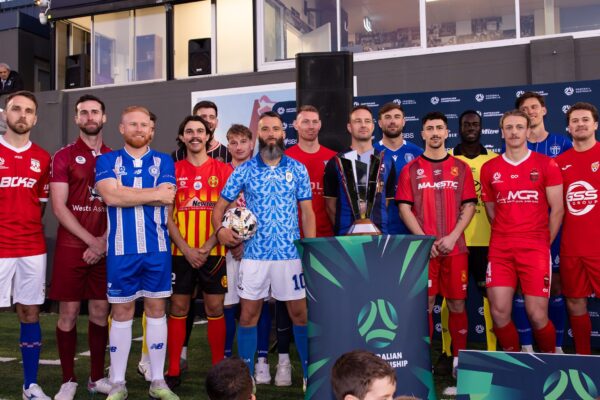
THE ASSOCIATION of Australian Football Clubs has reconvened to re-engage Football Australia on the long-term future of the Australian Championship, which returns next month for its second season. The AAFC is preparing a formal approach to head office in the aim of establishing the next steps for the tournament’s development. Little has been said from FA about its long-term prospects since South Melbourne won the inaugural title last summer. Operated last season as an end-of-year tournament for clubs pulled from NPL competitions around the country, under the (former) model of the UEFA Champions League, it was generally lauded by those who partook as a success. This year, the same format returns. But there remains a lack of certainty across constituent clubs as to where the Championship is headed. Those spoken to by Soccerscene, both within and outside the ‘foundation’ ranks, retain a firm desire to see it become a full-blown national second division – as was the competition’s working title for much of its development process. “We’re now in the process of pushing that timeframe [for future discussion] because the clubs’ concern is if you just wait another twelve months, and do nothing towards establishing the home and away competition, then another year will pass,’ said AAFC chairman Nick Galatas. ‘We’re keen on re-establishing the impetus for what we say the clubs and the fans actually want, and that is a proper competition that will be the bridge for what we all want. “We need to link our game from bottom to top and give more opportunities to our promising young players.” It is the general view of a number of foundation clubs that discussions with FA have always been due to re-open following this upcoming second season; however, actual specifics have proved harder to find. “As an aspiring club, we were under the understanding that after two years there’d be a review for the potential of promotion and relegation [to the A-League],’ said one club president from within the eight foundation clubs. “Or, to discuss expansion into the A-League. We’re not asking to get rid of A-League teams; we’re asking for a connection via expansion. For example: ‘keep playing this competition, keep performing strongly, and then if you meet the criteria, you can apply for A-League expansion.’” It is nearing three years since Football Australia selected its eight foundation clubs, from a pool of 32 that were invited to enter its Request For Proposal phase. At the time, it was stated that a refined process – to commence early-2024 – would seek to find an additional two-to-four clubs to join them. That this has not happened means the eight sides still fail to represent any state outside New South Wales and Victoria, a criticism levelled at the competition from its first day. From the outside, this continued inactivity could be construed as a lack of progress – although that’s not to say inactivity is the case. “We’ve explored it a few times, and FA have been really open about where they’re up to, and really what the trajectory is,” said the president of another club, who were part of the Request For Proposal phase, but were not selected as a foundation club. “I would describe their current position as ‘we’re doing it, we’ll review what we’re doing, and then we’ll plan to either keep doing it, or expand it.’ Does that mean expansion will happen? Not necessarily. ‘Maybe they’ll do that review and there’s a sense the timing’s not right, there are too many challenges… but I’m not getting any indication that that’s the case.’ Football Australia signed its Championship broadcast deal with SBS in September 2025 for two seasons with an option for a third. Last week, the partnership announced an increase in linear broadcasting for 2026 with an additional match per round to be broadcast on Thursday nights. The entire competition is available via SBS On Demand. Football Australia has also added a Penalty Shootout Bonus Point Model, where drawn matches in the group stage will see sides awarded a standard one point each, before heading to the penalty spot to contest an additional point. The competition also remains without a naming rights partner, while participant clubs have this season been charged an entry fee, which was not the case last season. Football Australia continues to foot the travel bill for parties up to a certain number for away fixtures. Football Australia was contacted for comment.