FA partners with Coca-Cola ahead of FIFA World Cup 2026

The two-year partnership will place the global soft-drink giants as the Official Supplier for Australia’s Men’s and Women’s senior national teams.


Global partner, global stage

As the Socceroos look to deliver performances on the pitch at this summer’s tournament, it is a move off the pitch which will capture the imagination of fans across the country.

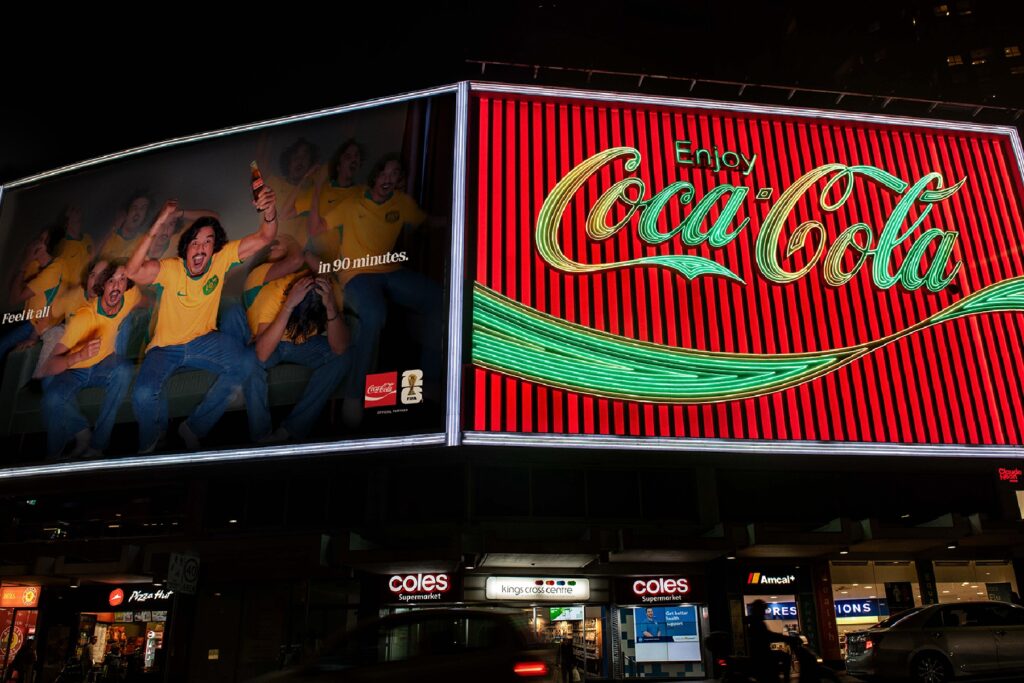
Football Australia announced an exciting deal with Coca-Cola, designed to align the global reach of football – and of the brand itself – to unite and engage fans this summer as well as during the FIFA Women’s World Cup 2027.

Thus, through national campaigns featuring prize draws and the chance to access various rewards, Coca-Cola will help to drive passion and interest in upcoming major tournaments.

“This partnership brings together the global scale of Coca-Cola with the passion and reach of football in Australia, creating new opportunities to connect with fans across the country,” explained FA CEO, Martin Kugeler, via press release.

“The upcoming FIFA World Cup 2026 represents a key moment for the CommBank Socceroos, and the Coca-Cola campaigns will help bring supporters closer to the team through unique and engaging experiences.”

Furthermore, with the FIFA Women’s World Cup 2027 also set to enjoy similar campaigns by Coca-Cola, the partnership’s impact and reach will extend across both the men’s and women’s game.


Marketing power

As football continues to grow – both in financial power and population reach – collaborations with global brands are now an expected aspect of tournament build-ups.

The Royal Spanish Football Federation (RFEF) also struck a deal with fashion brand Loewe, set in place for the next four years. In a similar vein, England’s off-pitch teamwear will feature the marks of both Nike and Palace Skateboards, while France will receieve their prematch jersey from Nike and Jacquemus.

This is the state of the landscape. Aligning global brands and household names with a sport capable of reaching billions at once.

Values, reach and connecting with fans. Three key ingredients to a successful collaboration.

Such alignment is key to the partnership between FA and Coca-Cola, as recognised by Managing Director, Coca-Cola Europacific Partners, Orlando Rodriguez.

“For nearly 90 years, Coca-Cola has been a part of the fabric of Australian life – bring people together through shared moments,” said Rodriguez.

“Partnering with Football Australia reflects our continued commitment to connecting communities through experiences that unite the nation, with the CommBank Socceroos and Matildas at the heart of that.”

Previous ArticleNext Article

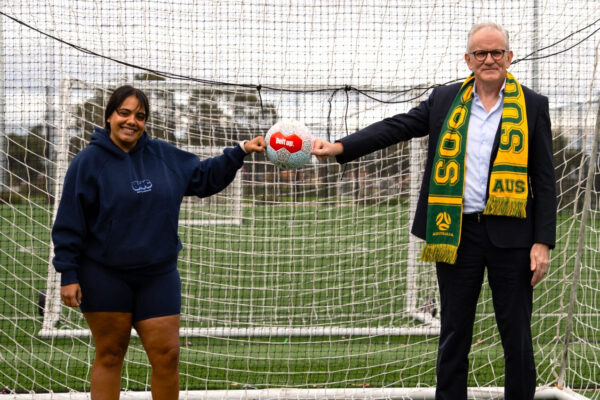
Football West’s NAIDOC ball competition turns Indigenous art into a road safety message, and a rare form of representation

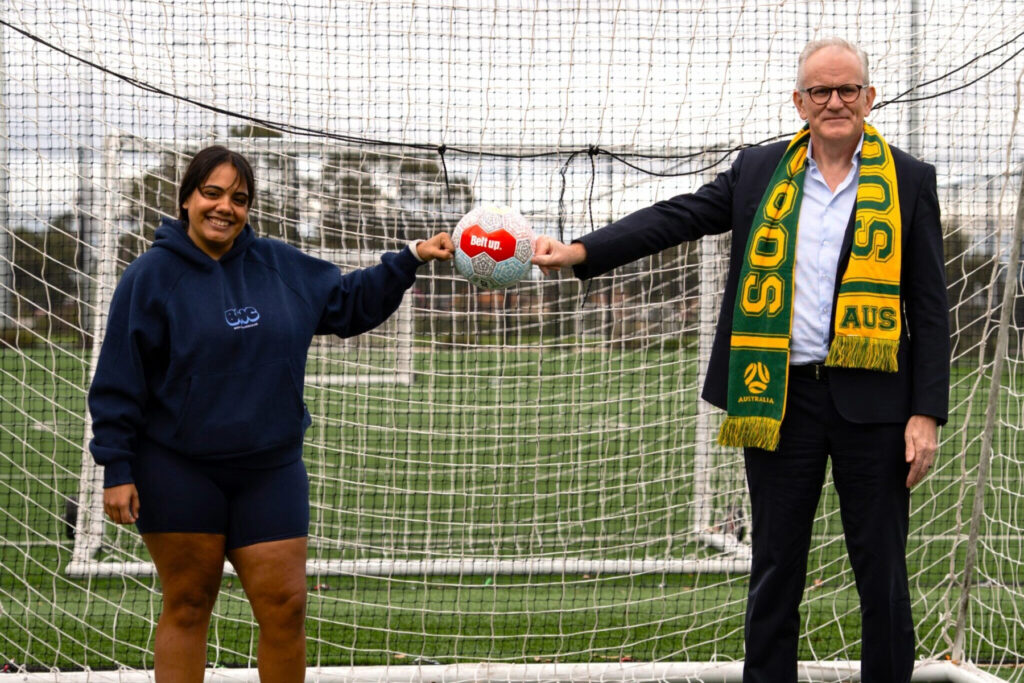
Football West has opened its 2027 NAIDOC Ball Design competition, inviting members of Western Australia’s Aboriginal and Torres Strait Islander communities to submit artwork that will end up printed on 500 footballs and distributed to schools, clubs and communities across the state. It is a small competition with a modest prize, a $1,000 voucher and a set of ten footballs for the winner. But what it is actually doing sits somewhere more significant than a design contest.

The 2027 edition is a joint initiative between Football West, the Insurance Commission of Western Australia and, for the first time, Football Futures Foundation. The winning design will carry the Insurance Commission’s Belt Up road safety message alongside the artwork, with the footballs distributed during NAIDOC Week, which runs from 4 to 11 July next year.

Football Futures Foundation CEO Michael Kerr framed the partnership as an extension of work the Foundation already runs across the state.

“Through programs such as Dreamtime Spirit and Yilkari, supported by former Matildas goalkeeper Lydia Williams, we are working alongside Aboriginal and Torres Strait Islander communities to create football opportunities that are culturally safe, community-led and built around genuine belonging,” Kerr said.

A message that travels further in a football

Road trauma in Australia isn’t evenly distributed. Indigenous Australians are consistently found in national research to be two to three times more likely to be killed in a road transport crash than non-Indigenous Australians, a disparity driven in part by higher rates of pedestrian and passenger injury and compounded by the realities of remote and regional life, longer travel distances, older vehicles, and limited access to emergency care when something goes wrong. Seatbelt non-use remains one of the most consistent contributing factors in that gap.

The Insurance Commission has invested more than 2 million dollars in the Belt Up campaign over its seven years, and its Chief Investment Officer, Steve McKenna, has been explicit about who the message is aimed at.

“About 170 people die on the road each year in Western Australia,” McKenna said. “About 60 per cent of those are male. Of that total, 17 per cent aren’t wearing seatbelts when they die.”

Generic road safety advertising struggles to reach communities where trust in government messaging is not automatic and where the delivery channel matters as much as the message itself. A football, carrying artwork made by a member of the community it is meant to reach, distributed through a sport that already has deep informal roots in many Aboriginal communities, moves in a way a billboard cannot. That is not incidental to the campaign. It is the entire design logic.

Whose stories get told

Jarnda Councillor-Barns, the Ellenbrook artist who won the 2026 competition, used the colours of the Aboriginal and Torres Strait Islander flags in her design, with circular patterns representing gatherings and connecting pathways representing the journeys, knowledge and skills each player carries.

“I really wanted to amplify the stories that are in the Football West community, whether you’re based metro or rural like I was, and how everyone in a team comes with their own stories,” Councillor-Barns said.

Her own football story reflects exactly the kind of informal, community-rooted participation the competition is built to recognise. She grew up in Broome playing social games whenever she could, and has family connections to the Jambinu team, a regional Indigenous women’s side based in Geraldton, despite never being formally registered with a club herself.

“Soccer is a sport that brings people from all walks of life together, creating a larger family built on respect, teamwork and shared passion,” she said.

Football West’s David Williams, a former Socceroo who now heads the National Indigenous Boys Under-16s program, said initiatives like this had value beyond the artwork itself.

“For the creativity of artists to be involved with sport goes a long way,” Williams said. “The more initiatives we have with this kind of stuff, the better.”

That is a modest way of describing what is, functionally, a form of representation that Indigenous communities in Australian sport have not always had. Governing bodies commission Indigenous rounds, jerseys and acknowledgements regularly. Fewer hand the creative authorship, and a public platform for it, directly to community members with no requirement that they already hold a formal position within the sport.

Insurance Commission Chief Investment Officer Steve McKenna, reflecting on the 2026 winning design at its unveiling, saw something in it that spoke to the broader purpose of the exercise.

“You see the Socceroos playing, and look across the team, and a ball like this, the designs, it reflects what Australia’s all about,” McKenna said.

In the meantime, five hundred footballs carrying a community-made design and a road safety message will reach further into regional and remote Western Australia than most government campaigns manage on their own. Whether that message changes behaviour on the roads that data suggests still needs the most attention is the harder, longer question the competition cannot answer by itself.

FIFA’s $871M World Cup Prize Pool Poses A Spending Question for Football Australia

FIFA will distribute a record US$871 million across the 48 nations at the 2026 World Cup, a 15 per cent increase on its original allocation and the largest prize pool in the tournament’s history.

The growth is stark set against history. Italy’s 1982 winning squad shared US$2.2 million. No champion earned more than US$10 million before 2006. Qatar 2022 distributed US$440 million in total, meaning this cycle’s pool has doubled in four years.

Football Australia banked a guaranteed US$12.5 million simply by qualifying and playing the group stage. That guarantee alone now exceeds the entire prize pool paid out at several World Cups played within living memory. The Socceroos then advanced into the new Round of 32, adding a further performance bonus, before losing to Egypt on penalties in Arlington, Texas, on 3 July.

Players do not receive the money directly. Under the Professional Footballers Australia collective bargaining agreement, squads are entitled to 40 per cent of prize money for qualifying, rising to 50 per cent in the knockout rounds.

At Qatar 2022, that formula paid each Socceroos player about US$226,000 for qualifying, plus a further US$290,000 for reaching the knockout stage. The balance stays with the federation.

Football Australia has banked a comparable windfall before. Its Legacy ’23 strategy, built on the 2023 Women’s World Cup, helped unlock US$398 million in government funding for facilities and programs.

Roughly two-thirds of that sum was earmarked to primarily benefit football. The outcome required a deliberate campaign, not just a strong tournament result.

This cycle lacks the one advantage that made Legacy ’23 work. The 2026 World Cup was not played on home soil, so there is no domestic economic impact figure to put before government.

FIFA sets no conditions

FIFA places no conditions on how federations spend their share. Its only requirement is that clubs releasing players are compensated separately, through a US$355 million Club Benefits Programme.

That programme is up 70 per cent on the US$209 million paid out after Qatar. But only five members of the 26-man Socceroos squad play their club football in Australia.

The majority of that compensation flows to clubs in Europe and Asia, not to the A-League. Beyond player payments under the CBA, what Football Australia does with the rest of its own share is an internal call.

The decision lands alongside a growing state-by-state funding ledger. Football NSW and Northern NSW Football have put a US$343 million decade-long infrastructure case to the NSW Government.

Victoria’s 2026-27 budget has delivered facility grants club by club: US$500,000 to Avondale FC, US$250,000 to Hume City FC, another US$500,000 to Darebin United.

Each grant required its own local advocacy push under Football Victoria’s Level the Playing Field campaign. Tasmania has secured US$350,000 in seed funding toward an US$80 million Home of Football.

Football Australia’s own World Cup payout this cycle dwarfs each of those figures, and most of them combined. Whether any of it is redirected toward those same facility and pathway gaps, rather than absorbed into existing high-performance and administrative budgets, will determine whether the payout changes anything below the national team.

Most Popular Topics

Editor Picks

Send this to a friend