

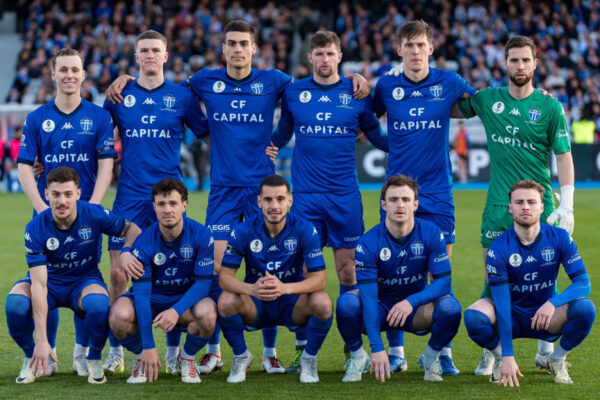

Adelaide United confirmed a new deal with 1KOMMA5° Australia

Adelaide United confirmed a new partnership with 1KOMMA5° Australia, a global leader in decarbonisation and renewable energy, specialising in solar power, battery storage, air conditioning, heat pumps, and energy control systems.

Through this collaboration, 1KOMMA5° will serve as the official back-of-shorts sponsor for Adelaide United’s 2024/25 Isuzu Ute A-League Men’s season. Their logo will be prominently displayed on both the home and away shorts for the duration of the season.

1KOMMA5° aims to empower individuals to manage their energy usage by reimagining energy solutions. Their mission is to help people live sustainably by using solar and wind power indefinitely, encouraging energy independence over reliance on external sources.

As an innovator in renewable energy and sustainable air conditioning, 1KOMMA5° is transforming energy consumption by combining advanced technology with efficient systems for homes and businesses.

The company’s objective is to lower energy costs and move away from traditional energy sources by harnessing clean, renewable power.

The deal also improves the carbon footprint and sustainability of Adelaide United which is becoming more popular amongst football clubs.

With local expertise from Kozco Energy Group, based in South Australia and now part of 1KOMMA5°, the company continues to push its mission forward with a strong local presence supported by global leadership.

Directors Wayne Faranda and Danny Mudronja spoke on the partnership building the relationship between them and the fans.

“We’re thrilled to team up with Adelaide United. This partnership offers an excellent chance to strengthen our connection with the fans and support the Club’s efforts both on and off the field,” they said in a joint statement.

Adelaide United’s Head of Commercial, Fabrizio Petrone also commented on the partnership.

“We are delighted to welcome 1KOMMA5° as our back-of-shorts sponsor for the next two seasons. Having both a global leader and a locally rooted company on our kits is a testament to the strength of this partnership,” he said via club statement. 

In August, Adelaide United revealed their 2024/25 home kit, featuring the iconic red shorts, which have received great praise from fans.

This partnership represents Adelaide United’s mission to improve their carbon footprint whilst also securing important finances for the upcoming season and adding to their corporate portfolio with another local business.


Previous ArticleNext Article

South Canberra FC Breaks the Mold: Equity-Driven Model Earns ‘Club Changer’ Honour

South Canberra Football Club has been named Club Changer of the Month for April, in a recognition that reflects a broader shift across Australian football toward rewarding clubs that are actively dismantling the structural barriers limiting women’s access to the game.

The AFC Women’s Asian Cup has just delivered record crowds and unprecedented visibility for women’s football in Australia, and the Club Changer program is now asking what comes next. Its decision to name South Canberra Football Club as Club Changer of the Month for April signals a clear shift in how the program defines contribution: away from participation numbers alone, and toward the equity frameworks that determine whether women stay in the game once they arrive.

South Canberra FC built that framework from the ground up. Established in 2021, the club set out to give women and female-identifying players a safe, inclusive environment to play football at any level. It runs entirely on volunteers, operates as a not-for-profit, and is governed by an all-female committee with 13 of its 14 coaches identifying as female.


Building the infrastructure of inclusion

In 2026, the club secured grant funding and put it to work immediately. Two coaches are completing their C Licence qualification, and ten coaches, players and community members have undertaken the Foundations of Football course, which directly tackles the cost and accessibility barriers that exclude women out of coaching pathways.

The club also commissioned a female-specific strength and conditioning program with sports physiotherapists ahead of the 2026 season, targeting injury prevention and explicitly supporting players returning after childbirth.

SCFC’s leadership team draws from LGBTIQ+ individuals, First Nations people and veterans, strengthening the club’s connection to the communities it was built to represent.

The Club Changer program is backing clubs that do this work- clubs that treat equity as infrastructure rather than aspiration. At a moment when Australian football is under pressure to turn its biggest-ever surge of women’s interest into something lasting, SCFC’s model offers a clear answer to the question of how.

How Husqvarna Is Helping Stadiums Cut Costs Without Cutting Quality

At a time when operational costs are rising across global sport, stadiums and football clubs are being forced to rethink one of their most overlooked expenses: turf maintenance.

From diesel consumption to labour hours, maintaining elite playing surfaces has traditionally been both resource-intensive and environmentally taxing. But new data emerging from venues like CBUS Super Stadium suggests a smarter, more sustainable model is already taking hold.

Leading that shift is Husqvarna, whose autonomous turf technology is quietly reshaping how professional venues manage their playing surfaces. Their product delivers measurable cost savings without compromising quality.

Cutting fuel consumption costs

At CBUS Super Stadium, the introduction of Husqvarna’s CEORA™ robotic mowing system has reduced diesel usage by approximately 20–30 litres per week. Over the course of a season, those savings compound into a significant reduction in both fuel spend and carbon emissions. This is particularly efficient for stadiums hosting regular fixtures and large-scale events.

CBUS Super Stadium General Manager Kristian Blundell said the robotic mower was a game-changer for the venue:

“This technology is not replacing staff but rather giving our grounds team the ability to do what they do best by helping to improve turf management processes, better manage fatigue and decrease our environmental footprint”

But the impact goes beyond fuel.


Time efficiency

By automating routine mowing, Husqvarna’s technology enables grounds teams to focus on higher-value maintenance tasks, from pitch recovery to detailed surface management. The result is not only greater operational efficiency but also improved turf consistency, which is an increasingly critical factor in elite football performance.

The benefits are being mirrored beyond stadium environments. At Oatlands Golf Club, Husqvarna’s autonomous mowing has delivered savings of up to 60 litres of fuel per week while freeing up staff for precision work. Quiet, round-the-clock operation also ensures surfaces are maintained without disrupting play—an advantage that translates directly to multi-use stadium settings.

Image Credit: Husqvarna

Importantly, Husqvarna’s lightweight robotic systems reduce the wear and tear typically caused by traditional heavy machinery. This not only protects the integrity of the playing surface but also reduces the need for costly repairs over time.

Football clubs navigating tight budgets at grassroots and semi-professional levels could benefit from such cost savings.

With rising energy prices, increasing sustainability expectations, and limited staffing resources, the ability to cut costs while improving performance is no longer optional. Solutions like Husqvarna’s CEORA™ are positioning clubs to operate more efficiently today, while preparing for a more environmentally accountable future.

As the sports industry continues to evolve, one thing is becoming clear: the next competitive edge may not just come from what happens on the pitch—but how it’s maintained.

Most Popular Topics

Editor Picks

Send this to a friend