Image Credit: Shutterstock
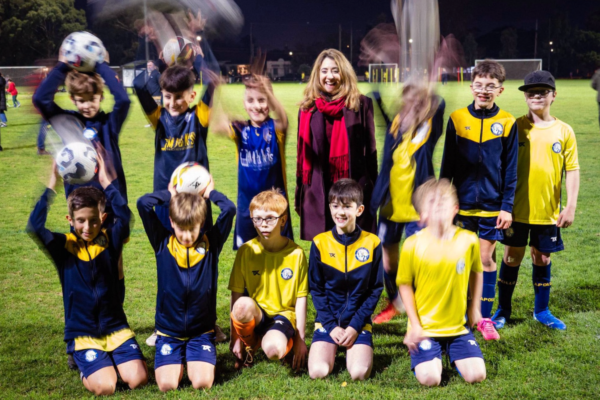
Football South Australia will run its fifth consecutive Violence Prevention Round in partnership with the Sammy D Foundation from 3 to 5 July, with junior teams again asked to wear blue armbands throughout the weekend.
The arrangement was formalised in March 2022, when Football SA and the Foundation signed a three-year agreement, funded by SA Power Networks, to deliver the Foundation’s Monkey See, Monkey Do program to more than 7,500 junior members across 52 clubs.The program is a 90-minute session delivered by Sammy D Foundation facilitators focused on changing players’ attitudes toward bullying and violence and educating parents and club members about the impacts of inappropriate sideline behaviours, built around the story of Sam Davis, the 17-year-old South Adelaide junior footballer whose death in a one-punch assault in 2008 led his parents to establish the Foundation.Football SA general manager George Georganas and Foundation chief executive Brigid Koenig confirmed the partnership at its 2022 launch, framing it as a mechanism for improving club culture from junior sidelines upward.
The round has run every season since, expanding in 2023 to incorporate the Federation Cup Final at ServiceFM Stadium,a weekend Football SA dedicated as the Sammy D Violence Prevention Round alongside the Federation Cup Final Day continuing through the 2024 season,when it was again scheduled as a designated round ahead of that year’s Federation Cup Final and shifting from an early blue tape design to the blue armbands used in 2025 and again this year.
A prevention model funded outside government
The Foundation’s programs, including its work with Football SA, are financed through corporate and philanthropic support rather than recurring government funding. Its rollout with Football SA was backed by SA Power Networks, and separate school-based programs in the state’s Far North have relied on grants from philanthropic trusts.Both the Perpetual Foundation’s Kevin Barnes Gift Fund Endowment and the Fred P Archer Charitable Trust have funded the Foundation’s work in that region.
The State Government’s response to the Royal Commission into Domestic, Family and Sexual Violence, released in December 2025, commits $674 million over ten years to a 136-recommendation reportstructured around themes spanning structural reform, workforce and community education, crisis response, and establishing a foundation for prevention, delivered by Commissioner Natasha Stott Despojaafter four women were killed in the state within a single week in November 2023. The Commission’s focus on domestic, family and sexual violence is distinct from the youth bullying and alcohol-related violence at the centre of Sammy D Foundation programs, but its response includesan expansion of abuse prevention programs to support behavioural change for people who use violence, alongside prevention and awareness activities aimed specifically at young people.
Separately, the Department for Education’s own violence prevention program, developed after a 2022 ministerial roundtable, has directed a $6 million Safe and Supportive Learning Environments Plan of Action toward schools, afterreported violent incidents in South Australian public schools rose 50 per cent in 2023, with more than 13,000 critical incidents recorded that year. The department has since reportedits first decline in secondary school critical incidents in 2024, a 4.5 per cent reduction from 2019 levels, along with a 7.3 per cent fall in suspensions and a 20.8 per cent fall in exclusions in 2025. It also noted thatviolence in primary schools has continued to rise since the pandemic, and that physical violence against teaching staff, the large majority involving primary-aged students, climbed from 273 incidents in 2021 to 662 in 2024.
Evidence from earlier rollouts
Sammy D Foundation programs delivered through junior sport have previously reported strong self-assessed outcomes. An earlier three-year rollout of a related program through SANFL Juniors, a separate competition to Football SA,reached up to 12,800 young players and their families, with 98 per cent reporting increased awareness of the impact of one-punch violence and 89 per cent reporting they avoided a violent situation because of the program.
A national evidence guide on preventing violence through sport, compiled by Our Watch, notes that69 per cent of Australian children and 87 per cent of adults took part in sport or physical activity over a twelve-month period, while also pointing toa lack of research assessing the effectiveness of such approaches, and the need for more robust evaluation of primary prevention programs within sport settings.
Clubs taking part in this year’s round have again been supplied with blue armbands for junior teams, with Football SA and the Foundation asking clubs to share images from the weekend under the round’s official hashtag.