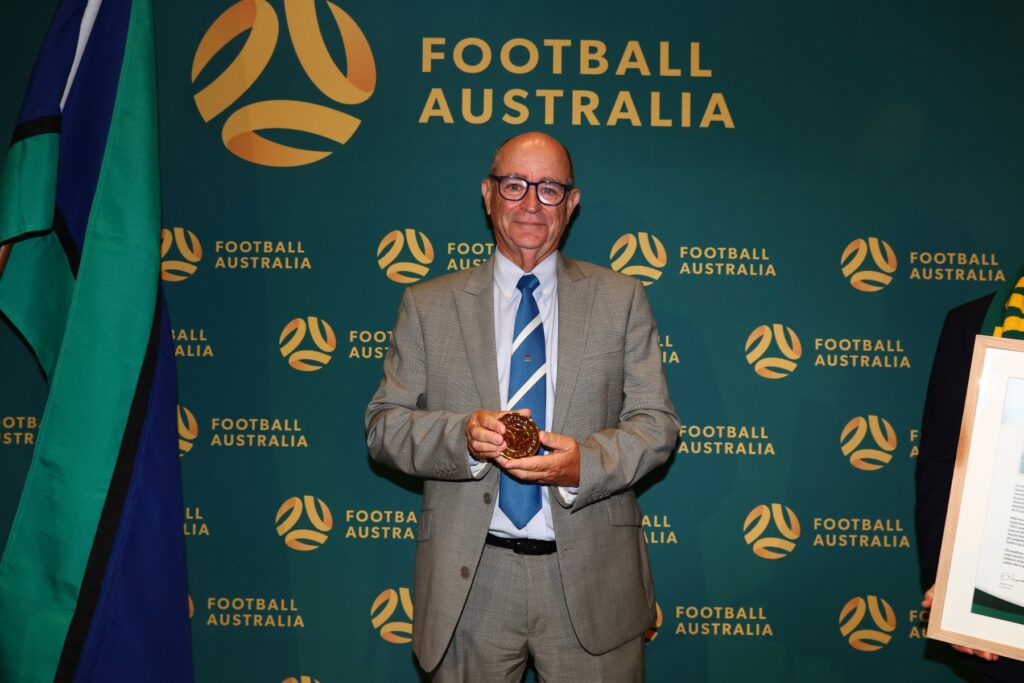



FFA CEO James Johnson: “We have many challenges in front of us as a sport”

James Johnson FFA CEO

Is James Johnson the trailblazer Australian football needs?

When James Johnson, the FFA CEO, attended his first press conference in mid January, he could never have predicted the enormous challenges facing Australian football.

Significantly, he was the first CEO in the history of the FFA to have a football background, having played for Brisbane Strikers at youth and senior level in the NSL and also being an original member of Les Scheinflug’s Joey’s squad of 1999 which performed so gallantly to reach the final in New Zealand before succumbing in a penalty shootout to the mighty Brazil.

In late March, mainly due to the impact of COVID-19, it seemed the sky was falling when 70 per cent of the FFA staff were stood down and there was extreme uncertainty about Fox Sports’ commitment to A-League coverage.

Fortunately, Johnson demonstrated all the negotiation skills he had gained in his senior roles at the PFA, Asian Football Confederation, FIFA and the City Group since 2009 to carve out a deal which ensured A-League backing from Fox for the remainder of the current season and to the end of next season.

He also played a major part in Australia and New Zealand securing the 2023 Women’s World Cup, and was the main architect behind the selection of the Starting XI and the proposed XI Principles which are designed to lead football into a new era.

Nevertheless, despite his track record and excellent credentials, Johnson has one of the toughest jobs in Australian sport as he tries to unite the stakeholders of a game which has always exhibited major political divisions.

In this interview with Roger Sleeman, James Johnson discusses all things football in his attempt to take the game to a new high in the Australian sporting landscape.

ROGER SLEEMAN
What are your views on the current state of Australian football?

JAMES JOHNSON
We have many challenges in front of us as a sport, intensified by COVID-19. These include the economics of cost and funding, as well as many football challenges, for example rankings in senior men’s national teams and not producing the same number of players competing in leading overseas Leagues. Also, our youth teams still find it hard to qualify through Asia in both the men’s and women’s game so this has to be addressed.

However, there are many opportunities, including capitalising on the large participation rate, local and global ownership, NPL clubs with an amazing history which has to be tapped into, and great products in the Matildas and the Socceroos, with the Tokyo Olympic Games, and World Cups, including one on home-soil in 2023, to look forward to.

ROGER SLEEMAN
Which of the Proposed XI Principles deserve major priority?

JAMES JOHNSON
They are all important as they include a vision, a narrative and definition of who we are. These philosophical football principles must be reinforced by commercial well-being of the game so real change can be implemented. Critically, changes in all parts of the game are required to realise the principles.

ROGER SLEEMAN
What is the state of progress in the efforts to fund the game, in light of the competitive marketplace and sponsorship dollars foregone?

JAMES JOHNSON
The traditional methods of business are broadcast, sponsorship, gate receipts and player registration fees. Undoubtedly, post COVID-19, broadcast revenues will be more difficult to obtain and sponsorship will be more competitive. Due to globalisation of the game across the world, the sponsorship funds go to bigger Leagues and clubs. Therefore, in Australia we need to look at new ways like O.T.T. and digitalisation of the game to produce more reliable revenue streams. Capital investment from the private sector and government also has to be increased.

ROGER SLEEMAN
What is being done to engage the general media in lifting the profile of the game within print, radio, television, and internet mediums?

JAMES JOHNSON
Firstly, we have to identify how our supporters are absorbing content. Our ongoing market research shows the A-League supporter is between 16-30 years of age and they are obtaining content through digital means, for example social media, especially Facebook. We have to capitalise on this further, but we shouldn’t ignore traditional and mainstream media. The Women’s World Cup can be very important in leading the transition to gain increased coverage through this medium. Also, we have to identify people in mainstream media who support our game and can influence the decision makers. In this regard, I recently met with Karl Stefanovic from the 9 Network who played youth football in Cairns and whose father played for West Ham. We have to be smart and find such people to put their hand up and make a statement for the code.

ROGER SLEEMAN
What are your plans to revamp the youth development system?

JAMES JOHNSON
In this space, there are significant challenges and it takes a long time to develop pathways. Some of our recent failures to qualify in both men and women youth tournaments must be reversed and we have to find ways to invest in youth development and pathways. Ideally, a transfer system will be an incentive for NPL and A-League clubs to focus on player development which will guarantee rewards and reinvestment in the game.

ROGER SLEEMAN
There is a distinct absence of technical players in Australia and very few playing regularly in the world’s top Leagues. What are you proposing in this area?

JAMES JOHNSON
The improvement in technical skills is a major priority for our game and we are discussing this in detail with the Starting XI. Regarding the fewer Aussie players in top Leagues, the freedom of movement of players in Europe sees more players moving across borders which increases the talent pool and can limit the opportunities for our players.

ROGER SLEEMAN
The selection of the Starting XI with former star players like Mark Viduka, Paul Okon and Mark Bosnich was an innovative step but what about former players who have achieved at the highest level in the game and in business but are not given a chance to contribute, e.g. Jack Reilly, Peter Katholos, Danny Moulis, Alan Davidson, Craig Johnston, Gary Marocchi, Glen Sterrey, Richie Williams, Manny Spanoudakis and Dave McQuire to name a few.

JAMES JOHNSON
The Starting XI is a football advisory panel and they have provided a lot of feedback already, including on the transfer system. Certainly, we have to listen to other football people to assist the game’s growth, and we are very open to doing so.

ROGER SLEEMAN
The game’s history reflects a lack of recognition for former players to be involved.
Your comment.

JAMES JOHNSON
I reiterate, it is important to draw on the expertise of former players and perfect examples are (Zvonimir) Boban and (Marco) Van Basten with FIFA and (Dejan) Savicevic at UEFA. The appointment of Mark Bresciano and Amy Duggan to the FFA Board last year was a positive move and former Socceroo and Newcastle Jets CEO, Robbie Middleby, is making a big difference at the FFA. Sarah Walsh, a former Matilda, is also a member of our senior management and works in our participation and grassroots space.

ROGER SLEEMAN
What are your thoughts on the proposed change of season from summer to winter?

JAMES JOHNSON
Obviously, the practical reason for a change is the late finish in August, rather than May this season. We have flagged the 2020/21 competition to start in December which will allow a fair time for the clubs and players to re-set and provide the opportunity for us to assess the benefits of A-League, W-League, NPL and grassroots playing simultaneously. This will also test the alignment of more grass-root supporters to become fans of senior football.

ROGER SLEEMAN
Many people believe the decision of the Board to deny the Southern Expansion an A-League license was a major mistake, particularly in light of their commitment to put down $15 million dollars on the table immediately and their Chinese backer’s intention to purchase Shark Park from Cronulla League’s club.
Your comment.

JAMES JOHNSON
I can’t comment because I wasn’t in the country at the time, but I can say, there is a solid commitment in the XI Principles for our Professional Leagues to be expanded.

Previous ArticleNext Article

Two CEOs, One Code: Why Alignment Between Football Australia and the A-Leagues Matters More Than Ever

The NSL didn’t fail because of football. It failed because of structure, money and misalignment. With new CEOs at Football Australia and the A-Leagues, the sport now stands at a crossroads it has faced before.

Australian football finds itself at a rare inflection point. Not because of a single appointment, but because of two. With Martin Kugeler set to commence as CEO of Football Australia on 16 February 2026, and Steve Rosich now installed as CEO of the Australian Professional Leagues, the code has, perhaps for the first time in a long while, a genuine opportunity to align governance, commercial ambition and strategic execution across its two most powerful institutions.

This moment matters. Not symbolically, but structurally.

Kugeler arrives at Football Australia with a background that is markedly different from many of his predecessors. As former CEO of Stan and a senior leader across finance and strategy roles, he brings a media-native, commercially fluent mindset into a federation grappling with modern realities. Football Australia’s most recent financials tell a complex story: record revenues of $124 million, alongside a record $8.5 million loss. Chair Anter Isaac has been clear that grassroots programs and national teams will not be impacted, and projections suggest a return to surplus by 2026. But the message beneath the numbers is unmistakable: football can no longer rely on participation alone to sustain its future.

This is where Kugeler’s skillset becomes relevant. His mandate is not simply to steady the ship, but to modernise how Football Australia thinks about audiences, digital platforms, commercial partnerships and long-term value creation. Increasing commercial revenue, improving digital engagement and strengthening the federation’s market relevance are not optional objectives; they are existential ones.

Crucially, Kugeler does not inherit Football Australia in isolation. His tenure begins alongside Steve Rosich’s leadership of the A-Leagues, and that duality could become Australian football’s greatest advantage, if handled correctly.

Rosich, as previously outlined in my last CEO opinion, is not a caretaker. He is a commercial operator forged in high-pressure environments: the AFL, the Melbourne Cup Carnival and elite corporate sport. He understands sponsorship activation, broadcast value, governance discipline and the language of major brands. Where Kugeler brings media and platform intelligence, Rosich brings commercial deal-making and entertainment-led strategy.Together, they represent something Australian football has often lacked: complementary leadership at the federation and league level.


View this post on Instagram


A post shared by Soccerscene (@soccerscene.au)

For too long, the relationship between governing bodies and professional leagues has oscillated between tension and tolerance.

The recent Football Australia AGM made clear that, at least publicly, the relationship with the APL is currently characterised by “complete cooperation and collaboration.”

That sentiment must now be operationalised, not merely stated.

The $4.1 million expected credit loss linked largely to monies owed by the APL is a reminder that financial alignment, transparency and shared accountability are not abstract governance ideals. They are practical necessities. Disagreements over historical balances cannot be allowed to morph into structural dysfunction. Kugeler and Rosich must treat alignment not as diplomacy, but as strategy.

The real test of that alignment may arrive sooner than expected in the form of the Australian Championship.

The inception of a national second-tier competition is, in principle, a positive and necessary evolution for the game. But early signs should concern anyone paying attention. Clubs have already borne the brunt of operational and travel costs. Broadcast timings have been questionable, with examples such as Heidelberg United playing 1pm Sunday matches that clash directly with family and community priorities. There has been no major commercial sponsor announced, no broadcast-led narrative strategy, and no licensed merchandise program attached to the competition.

This is not sustainable.

Australian football has lived this movie before. The National Soccer League did not fail because of a lack of passion or history. It failed because of structure, economics and misaligned responsibility. The Crawford Report in 2003 was unequivocal in its findings: when Soccer Australia directly controlled the NSL’s operations, funding and commercial arrangements, inherent conflicts emerged. The governing body lacked the specialist commercial expertise to run a financially viable league, while the league itself became a financial burden that distracted from core responsibilities such as governance, development and national teams.

The solution then was clear: a licensed, semi-independent league model, aligned but not controlled. The A-Leagues were born from that logic.

The Australian Championship must not drift into the same structural grey zone that doomed the NSL. Kugeler will need to assess, early and decisively, where this competition sits within the ecosystem. Who carries the commercial risk? Who controls broadcast strategy? How are clubs protected from cost blowouts? And critically, where does the revenue model come from?

This is where alignment with Rosich becomes essential. Football Australia should not be attempting to commercialise a national competition in isolation, just as the APL should not be expected to absorb costs without strategic clarity. Joint sponsorship frameworks, coordinated broadcast planning and shared commercial storytelling are not nice-to-haves. They are safeguards against repeating history.

More broadly, the opportunity for knowledge-sharing between Kugeler and Rosich extends well beyond one competition. Both bring deep corporate networks. Both understand boardrooms, not just dressing rooms. Both speak the language of partners who expect return on investment, not goodwill.

If leveraged properly, this dual leadership can reshape how football presents itself to government, broadcasters, sponsors and global stakeholders ahead of the 2026 World Cup cycle. It can also restore confidence internally, among clubs, administrators and fans who have grown weary of fragmented strategy and reactive decision-making.

The warning is simple: alignment must be intentional. History shows that Australian football suffers most when roles blur, responsibilities overlap and commercial logic is secondary to sentiment. The promise, however, is equally clear. With Kugeler focusing Football Australia on governance, national teams and commercial modernisation, and Rosich driving the A-Leagues as a serious entertainment product, the code finally has the chance to operate as a coordinated system rather than competing silos.

Two CEOs. Two institutions. One code.

If they learn from the past, share expertise openly and resist the temptation to repeat structural mistakes, this period could mark not just a reset, but a genuine maturation of Australian football.

The opportunity is there. The question now is whether the game is ready to take it.

The Footballing Figures Recognised in January 26 Honours List

In an announcement made on Monday, four individuals were celebrated in the January 26 Honours List for their respective services to the football industry in Australia. 

The cohort included Football Tasmania CEO, Tony Pignata, PFA Founder and former CEO, Brendan Schwab, former Football Australia CEO, Ian Holmes and former player and Matildas’ manager, Alen Stajcic. 


Leaders of Australia’s football landscape

Tony Pignata

Recipient of the Medal of the Order of Australia (OAM) is Football Tasmania CEO, Tony Pignata. 

From beginnings as a player for Box Hill Inter, to several leadership roles with clubs like Wellington Phoenix, Sydney FC and Perth Glory, Pignata has dedicated his life to the game. Since 2023, he has led Football Tasmania and helped to develop high-performance pathways and expand participation to ensure football has a long-term future in the region. 

Brendan Schwab

PFA Founder and former CEO, Brendan Schwab, was recognised with the Member of the Order of Australia (AM). 

Schwab’s contributions to football are undeniable, not only as a key figure in the creation of the PFA in 1993 and the A-League, but as an accomplished lawyer who advocated for Australian footballers on the global stage. As a Football Australia Hall of Fame Inductee and PFA Champion, Schwab has undoubtedly woven his name into the fabric of Australia’s football industry. 

Ian Holmes

Former Football Australia CEO, Ian Holmes, was another recipient of the Medal of the Order of Australia (OAM). 

With contributions to football in Australia spanning five decades, Holmes stands as an essential figure in the industry. His work has covered various levels of the game, including as President of New South Wales Amateur Soccer Federation, Football Australia CEO, and Director of Football New South Wales. His leadership and commitment has been pivotal to the growth of football at state and national levels. 

Alen Stajcic

Former player and football manager, Alen Stajcic, was awarded the Medal of the Order of Australia (OAM) for his services as a coach. 

In both the men’s and women’s game, Stajcic has forged a successful record on the international stage for the Matildas and the Philippine Women’s National team, as well as at club level for Sydney FC, Central Coast Mariners, Perth Glory and Western Sydney Wanderers. As Head Coach from 2014-2019, Stajcic helped the Matildas reach new heights on the pitch and thus pave the way for the development of the women’s game across the nation. 


Acknowledging dedication and commitment 

Whether in Australia or beyond, the football industry can be an unforgiving and ruthless sphere in which to work. This is why recognising the people who have made valuable contributions to the nation’s footballing landscape is so important. Through consistent hard work and commitment, they collectively helped to bring the football industry in Australia to where it is today. 

While development is constant and improvements can always be made, it is reassuring to know that the foundations were built with the help of four dedicated individuals deservedly recognised in this year’s January 26 Honours List.


See the full 26 January Honours List here.

Most Popular Topics

Editor Picks

Send this to a friend