


SD Huesca: A digital transformation strategy which is reaping rewards

SD Huesca, a club who currently plays in the top division of Spain, have been working on a global digital transformation strategy for the past few years in an effort to increase the club’s sustainability.

The club have begun various modernisation processes which allows them to grow globally and streamline their operations.

SD Huesca manager Luis Sanclemente explained that technological advancement is one of the club’s main priorities.

“We’ve had a digital transformation strategy that started in 2017 and it has various objectives,” he told the La Liga Newsletter.

“As well as digitally transforming the business internally and making things easier for fans and commercial partners, we’re targeting a zero-paper policy and, as far as it’s possible, the automation of internal processes.”

To support its transformation process, the club works with various apps, from those developed by in-house platforms to those developed by third parties.

Internally, the club has established a digital file tracker that monitors documents that pass through the club via a dashboard, while keeping track of all projects in progress using an open-source software.

That software has also been used to setup the structure of its online store, digital archive and fan club app.

“We then use third-party apps for some core elements to do with our internal processes,” Sanclemente added.

“We use SAGE that helps us in everything to do with accounting and invoicing, for example. We also use the classic social media apps as well as the Docuten supplier portal and e-signature platform.”

The club looks to receive all invoices electronically with this supplier portal, either through a PDF format that can be processed through an OCR system, or via other formats such as ‘Facturae’. This allows the club to sign all types of documents digitally.

“We’re starting to incorporate the signatures of players and employees and we’re talking about having everything on the e-signature platform in the next four months,” Sanclemente stated.

The club’s overall goal is to reduce the use of paper and processes that will improve their environmental footprint. The digitalisation of administrative processes is key to reaching this objective.

“Six months ago, almost all invoices were paper,” Sanclemente revealed.

“However, we have already reached a point where 95% of invoices are sent to us electronically, which saves money in postage and storage. We have 250 signed documents that were previously paper, some of them long labour contracts that can be 50 pages long.”

While SD Huesca’s digital transformation process has already brought benefits in various areas like HR, administration and purchasing, it has also increased its commercial growth.

Josan Oliva, manager of the club’s digital department, explained: “We’re working more and more with suppliers and partners who offer technological solutions. We’ve found a commercialisation channel for assets that we wouldn’t have been able to access if we didn’t have the technological portfolio that we now have.”

As part of its collaboration with La Liga, the club continues to work on ways to use technology to directly impact the fan experience.

“We were one of the first clubs to enter the data-driven programme from LaLiga, which has an objective is to integrate all the processes related to fans, season tickets, matchday tickets and marketing into digital platforms,” Oliva said.

SD Huesca is anticipating a more fluid experience when fans eventually return to their home stadium.

“Last year, we requested an upgrade for the turnstiles so that fans could enter with NFC technology, as well as their mobile phone or their season ticket card,” Oliva said. “We want entry into the stadium to be even simpler.”

“(On the day) Tickets are bought through the online ticket section of the website and the process is automatic, as we no longer gave paper tickets. Instead, we send the buyer a PDF with a QR code that can be used to enter the stadium.”

Other digital initiatives have been vital in connecting with fans of the club, wherever they may be in the world.

“In the spring we were the first club to join with LaLiga and use the Salesforce marketing cloud for newsletters,” Oliva said.

“An important part of our relationship with the fans is the new SD Huesca Fan Club, where there will be a high degree of implementation of digital activities and content.”

Sanclemente, in conclusion, believes the digital strategy organised is necessary to survive in the modern football market.

“It is very important to keep bringing technology into football,” he stated.

“We see that some public administrations in Spain have a high level of digitization in many of their processes and we believe this gives a good reference to football clubs when it comes to modernising their administration.”

Previous ArticleNext Article

Mizuno’s Australian gamble: can a 120-year-old brand break through?

When Mizuno unveiled a mural of Socceroos captain Harry Souttar on a Richmond wall during the 2026 World Cup, the company’s name did not appear on the artwork. The artist, Rory Ledge, painted Souttar as the “Minister of Defence” behind a brick wall. Channel 7 and Channel 9 turned up. The Herald Sun ran it in their Saturday edition. Mizuno’s brand director called it “mainstream awareness” without paid media.

The mural sat within a broader push by the Osaka-based company to expand in Oceania. For the fiscal year ending March 2026, Mizuno reported sales of ¥259 billion, up 7.8 per cent year-on-year, with net income of ¥18.4 billion representing 20.5 per cent growth . Operating profit rose to ¥22.6 billion. The Asia and Oceania segment is central to the company’s medium-term plan, which targets net sales of ¥290 billion by fiscal 2027.

The growth imperative

Australian football has not historically been kind to specialist boot brands. Nike, Adidas and Puma dominate retail shelves. A-Leagues collective bargaining agreements and club deals have locked in incumbents. For a brand without the marketing budgets of its competitors, the path to relevance runs through the players.

Mizuno has grown its Australian ambassador base from one athlete to around 20 across the A-Leagues in recent seasons. Melbourne City’s Tolgay Arslan, who played in the Bundesliga and Serie A before arriving in Australia, told Front Page Football: “If I discovered these boots ten years ago, I would wear these boots overseas in my career.” Western United midfielder Angus Thurgate called them “the comfiest boots I’ve ever worn”.

The mural moment

Richmond was chosen for the mural because of its location. The suburb sits at the centre of Melbourne’s sporting precinct, five minutes’ walk from the MCG and AAMI Park. It is already home to murals of AFL players. Rowena Corner Store owner Con, who agreed to host the artwork, had previously welcomed murals of Dusty Martin and an AFLW player.

“We didn’t have access to Harry because he was in the US competing,” brand director Rishi said. “We couldn’t do a photoshoot. So we had to be clever. The best ideas come from real time, aligned with what the public discourse looks like. Once we saw his Wikipedia page updated to refer to him as the Minister of Defence, we knew we could play into this.”

Ledge incorporated an existing window into the design to create a net behind Souttar’s figure. The mural appeared the morning of the Paraguay match, when Australia’s clean sheet sent them into the knockout phase.

The World Cup provided a massive backdrop. The Socceroos’ run captivated the nation: 4.84 million Australians tuned in to the Paraguay match, making it the most-watched World Cup match in SBS history at the time, with an average audience of 3.086 million . The final reached 5.26 million viewers, and cumulative tournament reach hit 18.04 million— 64 per cent of Australia’s population. SBS director of sport Ken Shipp said: “We’ve never seen engagement at this level.” Mizuno spent comparatively little and had Channel 7 and Channel 9 on site.

The commercial question

For a brand with limited marketing firepower, organic PR coverage is the prize. The question for the company’s Oceania division, still in growth mode, is whether a mural and a handful of player endorsements can convert into sustained commercial traction. Retail partnerships with Ultra Football, which has created a dedicated Mizuno space at its Melbourne store, suggest the company is thinking beyond campaigns.

Mizuno’s European expansion has taken a different path. The company signed a five-year deal to become AS Monaco’s technical equipment partner from the 2025-26 season, its first entry into Ligue 1. It already has a presence in Germany’s Bundesliga and Italy’s Serie A. In Australia, institutional partnerships are harder to secure. The approach has been slower: build through athletes, then through community, then through culture.

The Queensland government signed a Memorandum of Understanding with Mizuno in March 2026 to explore the Japan-Australia Sports & Health Innovation Exchange (JASHIE), a two-year partnership focused on sport and health innovation . The agreement supports Queensland’s preparations for the 2032 Olympic and Paralympic Games.

The mural campaign reflected a broader trend in sporting brand marketing, where IP restrictions and athlete availability increasingly demand creative solutions. “I love what Levi’s did because they were able to lean into their brand codes and tell what I believe to be the most memorable advertising story from the World Cup,” Rishi said. “This is a different page out of fundamentally the same playbook.”

Mizuno’s boots are not cheap. The Made-in-Japan models retail well above competitors’ offerings. The brand’s pitch rests on quality and heritage, not price or volume. That is a harder sell in a country where discounting dominates and cost-of-living pressures are squeezing households.

The Souttar mural will eventually fade or be painted over. Mizuno is betting that by the time it does, enough Australian football fans will have noticed the three stripes’ quieter rival.

Bentleigh Greens and Metricon Bring Local Business Community Together Through Networking Initiative

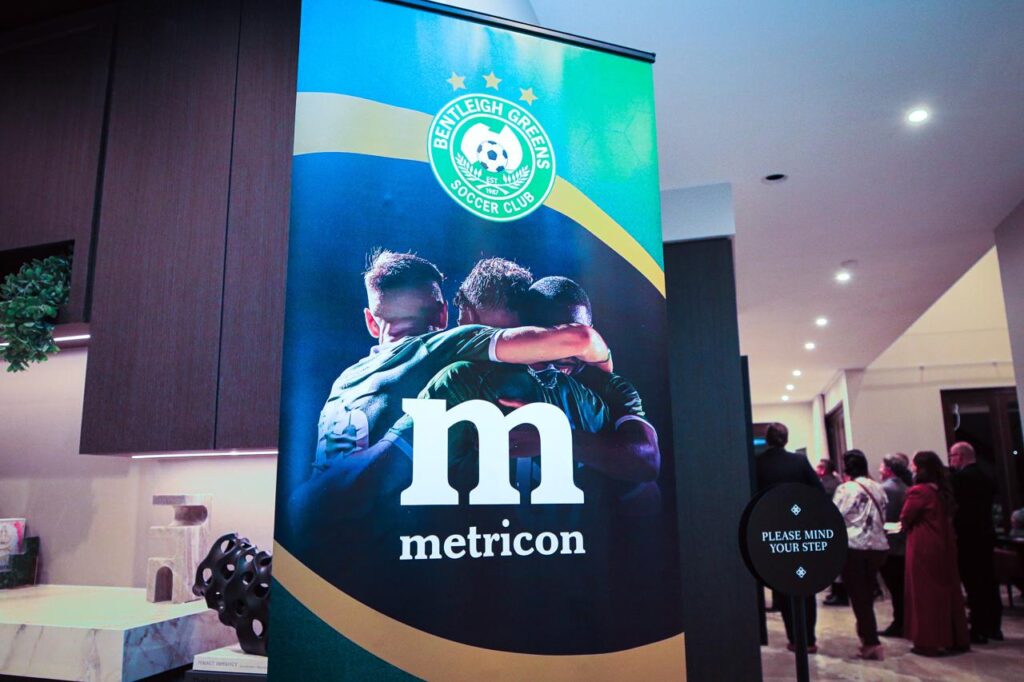
Bentleigh Greens FC has reinforced its commitment to supporting its community beyond football, partnering with Metricon Homes to host a business networking evening designed to strengthen relationships between local businesses, sponsors and club stakeholders.


A unique setting for meaningful connections

Held inside one of Metricon’s display homes, the Bentleigh Greens Business Networking Night welcomed around 60 local business owners, club partners and community leaders for an evening focused on connection, collaboration and knowledge sharing.

Rather than a traditional function space, Metricon opened the doors of one of its display homes, creating a unique networking environment that highlighted how the space could be transformed into a premium venue while providing guests with a relaxed setting to build professional relationships.

The event reflects a growing trend across community football, where clubs are increasingly positioning themselves as platforms for business engagement and local economic development, alongside their role in delivering participation opportunities on the pitch.

Guests also heard from strategic futurist Marcus Barber, who delivered a presentation examining the growing influence of artificial intelligence on modern business. His insights encouraged attendees to consider how emerging technologies are reshaping industries and the importance of preparing for future change.


Creating value beyond sponsorship

While commercial outcomes were never the primary objective, the evening was designed to create long-term value by fostering meaningful relationships between businesses connected to the Bentleigh Greens community.

Early feedback has been overwhelmingly positive, with several attendees already establishing new contacts and beginning discussions around potential collaborations.

The initiative also highlights Metricon’s broader commitment to supporting local communities beyond residential construction. By partnering with Bentleigh Greens and providing the venue, the company helped facilitate an event that encouraged learning, networking and stronger community connections.


Football clubs as community business hubs

For community football clubs, initiatives such as these demonstrate how partnerships can extend beyond traditional sponsorship models. By creating opportunities for local businesses to engage with one another, clubs can strengthen their commercial networks while delivering tangible value to sponsors and the wider community.

As football clubs continue to explore new ways of engaging stakeholders off the field, events like the Bentleigh Greens Business Networking Night illustrate how sport can serve as a catalyst for meaningful business relationships and long-term community growth.

Most Popular Topics

Editor Picks

Send this to a friend