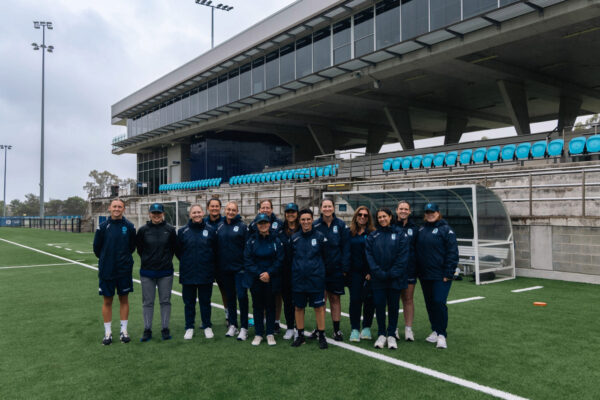


Daniel Girardi is the current technical director at Heidelberg United FC. He has previously worked at various clubs across Australian football, including Adelaide United, where he was a scout and an assistant to then head coach of the youth team Michael Valkanis.
Girardi has transferred the wealth of knowledge he has picked up over the course of his coaching career to spearhead the current youth development program at Heidelberg.
Girardi, alongside other coaches and staff, have implemented a philosophy at the club that focuses on critical areas to develop young footballers.
For example, it’s not enough to just develop a footballer, but rather a ‘total footballer’ that is a good person, friend and member of the community. Alongside having the technical, tactical and physical skills, Girardi believes it is necessary to exhibit good behaviours on a consistent basis.
Training programs are based around emphasising individual development within a team context, whilst coaches working with their different squads are encouraged to collaborate together as a unit to focus on the long-term development of players.
In a wide-ranging interview with Soccerscene, Girardi further explains why the youth development setup at Heidelberg has been successful, his career progression, the importance of a national second division, his own views on coaching standards in Australia and more.
First of all, tell me a little bit about your personal career in football and how you ended up in coaching?
I started playing in Adelaide. Like any junior you go through the ranks of a club, I went through Adelaide Blue Eagles. I went on to play with the senior team, from there I had coaching opportunities but I was very naïve and I didn’t want to take them. My senior coach at the time, Zoran Karadzic, said to me ‘Daniel, to be an even better player you need to understand the little intricate things, things that you don’t see that we need to see as coaches’. So at an early age of 17, he asked me to coach a junior team (under 8’s) so I did that while I was still playing. Then from there I went into further coaching, I became a junior technical director and coached all the way through from juniors to eventually senior head coach.
From there I moved to Adelaide United, Michael Valkanis asked me to come and join the team there. I joined United as a scout, as well as an assistant to the youth team, and that’s where my football mindset and career met as one. I honestly thought to myself ‘you can do this as a full-time job’. In Australia it’s very difficult, but at the same time you can put a program together to make it work. I tried to make it work now in my daily life, but again it’s very difficult. You have to coach early mornings and late at night, but it’s a passion that’s why you do it.
At Adelaide, I got to work with Josep Gombau, Michael Valkanis, Angelo Costanzo, Guillermo Amor and Pau Martí. Between all of them, my acceleration as a coach grew exponentially. Just the understanding, the little things that they can teach you about what to look for in a player, how to run, when they should pass the ball, timing, things like that, where in Australia we are not there yet. It was good for me to understand that the game is very simple but it’s the hardest thing to do. People talk about playing simple, but what does that mean?
There are 6 basic style rules that govern football throughout the world. If I see you, you see me, there’s a line of pass, we pass that ball. If there’s no line of pass, I need to run with the ball in order to find the next line. After that, the third rule being if you can’t find a line of pass and you can’t run with the ball, you need to protect the ball. We never player square – that allows counter attacks. Receiving always with your furthest foot so that you can face forward and no two players should be in the same line.
Would you say that standards and methods in local coaching have improved over the period of time since you began coaching?
That’s a hard question. I think the general understanding has improved. People are watching a lot more football, they understand they need to keep the ball and not give it away. But actually understanding the way you keep the ball is very different. In Europe, from a very young age, positionally, kids know where they are on the pitch. Kids know where they shouldn’t be, they know who they should pass to and when they shouldn’t pass to those players.
In Australia, people just see a pass and they just pass the ball. They are not understanding that if I pass the ball the wrong way to my teammate, not to his furthest foot, I’ve put them under pressure straightaway. If I don’t pass that ball with the right ball speed, I’ve put them under pressure straightway. When a player runs with the ball, does he or she use the furthest foot so their body is between the opposition player and the ball? What is the player’s orientation to the player with the ball and without? What’s their orientation to the defender? So, there’s the little things, I don’t think the level of detail is there in Australia yet.

Tell me a little bit about your current role at Heidelberg and your overall involvement in the current youth set up at the club. How did it come about?
I was speaking with George Katsakis a couple of years ago and he asked me if I was interested to join the club as technical director. At the time, I said yes I’d definitely be interested. Heidelberg is a big club. Heidelberg in the last five-six years is one of the best clubs in the country, because of the guidance from the board, Steve (president) and George as senior coach. So, I joined knowing that we are trying to develop players for that senior team. That’s what the goal always is.
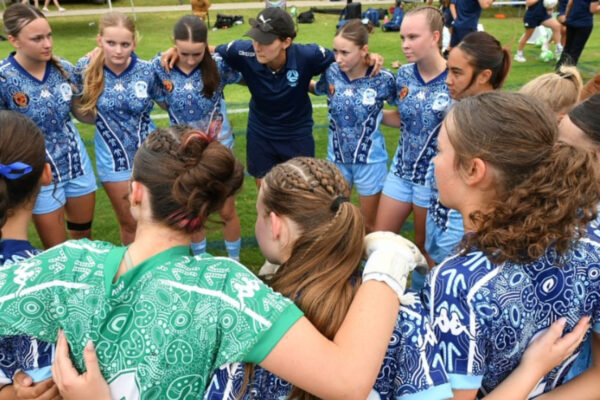
However, we focus on how we can accelerate their growth in order to get them to the first team quicker, but at the same time make sure they are our juniors. We don’t want to go and continuously buy players, we don’t want to continuously bring players in from other clubs, we want to bring through our own. We want to have a long-term culture of developing Heidelberg boys and girls. Boys and girls that live in the area, that live and breathe wanting to be a part of Heidelberg, of Alexandros, it means something. To have players who start with our MiniRoos and give them every opportunity to progress into the junior setup and then to the seniors. That’s the main goal.
Heidelberg have strong teams at a junior and senior level across men’s and women’s competitions, what do you think is the formula behind this success in developing young talent at the club?
For me, 100%, having the facility continuously upgraded is so important. You need to have pitches, equipment and the club has always been willing to buy all these things. They’ve bought us new goals, new mini-goals, the smart goal system now, trackers, VEO and we’ve established a new collaboration with Oxidate – we are always cutting edge. So, we are trying to build that DNA and at the same time use technology effectively.
Importantly, we have really good coaches. Brian Vanega (U21s) who unfortunately had to leave due to family commitments, Jeff Olver who has come back to help the club, Renato Liberto (U19s), Adrian Mazzarella (U17s), Sinisha Ristevski (U16s), Jim Daglaras (U15s), Kai Maxfield (U14s); these are all coaches who have either got A licenses or B licenses. They all understand that we are trying not just to look at one team, the U17’s or U19’s or whatever. It’s a culture of looking more at the overall picture, the 200 boys and the 200 girls at the club and saying ‘how can we develop them as a group rather than individually?’ Anyone can go and kick a ball but you can’t play football by yourself, there’s 10 other people on the pitch. So, we focus on how we can get all of them up to the level we want them to be at.
What type of programs, initiatives have you introduced in regards to learning opportunities for other coaches at Heidelberg United? What do you provide coaches at the club with?
We provide them with an innovative online session planning and player management system called SoccerPLAY. It’s got hundreds of different sessions and drills that they can use for ideas to create and implement our methodology. Additionally, at any time, we are able to provide feedback to help improve the sessions and the coaches. At the same time, we also do coach to coach sessions and are always looking to improve the program.
We have a new athlete development and high-performance collaboration with Oxidate, headed by Jacob Falla, which is specifically designed to educate the players about football development, physical performance (strength, conditioning, recovery, nutrition) and overall wellbeing. We have a club philosophy which connects all players via the ‘three wheels’, the Skills Phase for our MiniRoos, Growth Phase for our junior NPL teams and Elite Phase involving our seniors. You are trying to build across these wheels to get them into to the top teams at the club. We continually reassess what we are doing across all the different pathways to make the necessary improvements daily, weekly, monthly and yearly.

How crucial do you think a national second division is for the progression of youth development in Australian football?
It’s imperative. I’ve actually spoken with James Johnson and his team about it a few times. I think you need more than just a second division; you need a third division. I think that the NPL should be that you go from that league to a third division and so on. The more levels there are, you give more opportunities to the kids in order to develop at the level that they’re at. At the end of the day, we’re not just trying to develop a footballer. We’re trying to develop good boys, good girls, good sons, good daughters, it’s the overall person we are trying to develop…a total footballer.
The women’s side of the game is seeing huge increases in participation numbers and a home Women’s World Cup is on the way in 2023 which will lead to even more playing the game. How important is it capitalise on this and build female youth development standards and produce the next generation of Matildas?
Again, it’s imperative. The girls’ game has gone from A to Z in the last couple of years and it’s only going to continue to grow. The standard of the girls is phenomenal and improving all the time. It’s so important that the football community and country get behind the Women’s World Cup. I’ve coached girls’ teams and their enthusiasm for the game and desire to improve is brilliant. We need to capture that and harness it for both the girls’ and boys’ games to make a better competition for Australian footballers going forward.