
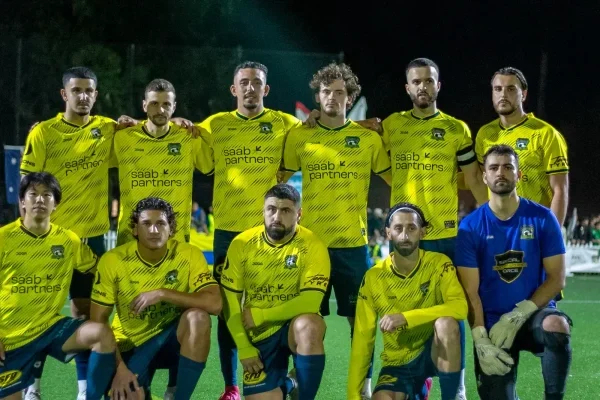

South Hobart FC Unveil Mason Merino as 2025 Sponsor

South Hobart Football Club have officially announced via social media that Mason William Merino will become the club’s front-of-shirt partner for the upcoming 2025 Australian Championship.

This marks the beginning of a proud partnership between two Tasmanian organisations united by shared values of excellence, sustainability, and community.

Mason William Merino is a premium Tasmanian apparel brand renowned for producing sustainable, ultra-fine Merino wool garments. The brand’s products are designed to perform in all environments, and are celebrated for their refined, high-quality craftsmanship. 

The collaboration brings together Tasmania’s footballing tradition and one of the state’s most respected lifestyle brands, reflecting a mutual commitment to showcasing Tasmanian innovation on the national stage. 

In announcing the partnership, South Hobart FC expressed their excitement at representing local quality and identity in the inaugural Australian Championship.

“As we compete in the inaugural Australian Championship, we couldn’t be prouder to wear Tasmania across our chests – literally,” the club wrote via social media.

The partnership will see the Mason William Merino logo displayed prominently on the front of South Hobart’s playing shirts throughout the 2025 season, as the club competes against some of the best teams in the country.

Both the club and the brand share a strong connection to Tasmania’s community and environment, both are values that lie at the heart of the collaboration.

South Hobart FC stated that they are thrilled to partner with a 100% Tasmanian-owned business that not only champions sustainability through its use of Merino wool, but also supports local sport. 

The announcement underlines the growing influence of Tasmanian enterprises in national competitions and the pride that comes with representing the island state. 

With this new partnership, South Hobart FC will proudly carry the spirit of Tasmania into the 2025 Australian Championship, both in performance and in purpose.
Previous ArticleNext Article

Mizuno’s Australian gamble: can a 120-year-old brand break through?

When Mizuno unveiled a mural of Socceroos captain Harry Souttar on a Richmond wall during the 2026 World Cup, the company’s name did not appear on the artwork. The artist, Rory Ledge, painted Souttar as the “Minister of Defence” behind a brick wall. Channel 7 and Channel 9 turned up. The Herald Sun ran it in their Saturday edition. Mizuno’s brand director called it “mainstream awareness” without paid media.

The mural sat within a broader push by the Osaka-based company to expand in Oceania. For the fiscal year ending March 2026, Mizuno reported sales of ¥259 billion, up 7.8 per cent year-on-year, with net income of ¥18.4 billion representing 20.5 per cent growth . Operating profit rose to ¥22.6 billion. The Asia and Oceania segment is central to the company’s medium-term plan, which targets net sales of ¥290 billion by fiscal 2027.

The growth imperative

Australian football has not historically been kind to specialist boot brands. Nike, Adidas and Puma dominate retail shelves. A-Leagues collective bargaining agreements and club deals have locked in incumbents. For a brand without the marketing budgets of its competitors, the path to relevance runs through the players.

Mizuno has grown its Australian ambassador base from one athlete to around 20 across the A-Leagues in recent seasons. Melbourne City’s Tolgay Arslan, who played in the Bundesliga and Serie A before arriving in Australia, told Front Page Football: “If I discovered these boots ten years ago, I would wear these boots overseas in my career.” Western United midfielder Angus Thurgate called them “the comfiest boots I’ve ever worn”.

The mural moment

Richmond was chosen for the mural because of its location. The suburb sits at the centre of Melbourne’s sporting precinct, five minutes’ walk from the MCG and AAMI Park. It is already home to murals of AFL players. Rowena Corner Store owner Con, who agreed to host the artwork, had previously welcomed murals of Dusty Martin and an AFLW player.

“We didn’t have access to Harry because he was in the US competing,” brand director Rishi said. “We couldn’t do a photoshoot. So we had to be clever. The best ideas come from real time, aligned with what the public discourse looks like. Once we saw his Wikipedia page updated to refer to him as the Minister of Defence, we knew we could play into this.”

Ledge incorporated an existing window into the design to create a net behind Souttar’s figure. The mural appeared the morning of the Paraguay match, when Australia’s clean sheet sent them into the knockout phase.

The World Cup provided a massive backdrop. The Socceroos’ run captivated the nation: 4.84 million Australians tuned in to the Paraguay match, making it the most-watched World Cup match in SBS history at the time, with an average audience of 3.086 million . The final reached 5.26 million viewers, and cumulative tournament reach hit 18.04 million— 64 per cent of Australia’s population. SBS director of sport Ken Shipp said: “We’ve never seen engagement at this level.” Mizuno spent comparatively little and had Channel 7 and Channel 9 on site.

The commercial question

For a brand with limited marketing firepower, organic PR coverage is the prize. The question for the company’s Oceania division, still in growth mode, is whether a mural and a handful of player endorsements can convert into sustained commercial traction. Retail partnerships with Ultra Football, which has created a dedicated Mizuno space at its Melbourne store, suggest the company is thinking beyond campaigns.

Mizuno’s European expansion has taken a different path. The company signed a five-year deal to become AS Monaco’s technical equipment partner from the 2025-26 season, its first entry into Ligue 1. It already has a presence in Germany’s Bundesliga and Italy’s Serie A. In Australia, institutional partnerships are harder to secure. The approach has been slower: build through athletes, then through community, then through culture.

The Queensland government signed a Memorandum of Understanding with Mizuno in March 2026 to explore the Japan-Australia Sports & Health Innovation Exchange (JASHIE), a two-year partnership focused on sport and health innovation . The agreement supports Queensland’s preparations for the 2032 Olympic and Paralympic Games.

The mural campaign reflected a broader trend in sporting brand marketing, where IP restrictions and athlete availability increasingly demand creative solutions. “I love what Levi’s did because they were able to lean into their brand codes and tell what I believe to be the most memorable advertising story from the World Cup,” Rishi said. “This is a different page out of fundamentally the same playbook.”

Mizuno’s boots are not cheap. The Made-in-Japan models retail well above competitors’ offerings. The brand’s pitch rests on quality and heritage, not price or volume. That is a harder sell in a country where discounting dominates and cost-of-living pressures are squeezing households.

The Souttar mural will eventually fade or be painted over. Mizuno is betting that by the time it does, enough Australian football fans will have noticed the three stripes’ quieter rival.

AC Milan and Puma Unveil New 2026/27 Away Kit

AC Milan and Puma have officially unveiled the clubs the new 2026/27 away kit, a timeless white kit that celebrates resilience, heritage and the winning mentality that has defined the Rossoneri for generations.

Inspired by the phrase “after Istanbul, there is always Athens” the kit pays tribute to AC Milan’s triumph in the 2007 Champions League Final in Athens following their defeat in Istanbul in 2005. The message printed on the back of the collar, reflects the club’s enduring spirit and serves as a reminder that every setback can become the foundation for future success.

Leading the campaign is club legend Filipo Inzaghi who scored two goals to lead AC Milan in the 2007 UEFA Champions League Final, embodying the determination, resilience and hunger that continues to define AC Milan’s identity.

Every detail on this years away kit reinforces this story. Gold accents and a laurel wrapped club crest celebrates a storied history of success, while the authentic version features the Greek inscription “Δύναμη Ψυχής” (“Strength of Spirit”) inside the collar. A subtle phoenix wing woven into the fabric symbolises renewal, resilience and the Club’s commitment to continually rising to new challenges.

The authentic jersey is engineered with PUMA’s advanced ULTRAWEAVE fabric, complemented by dryCELL and ThermoAdapt technologies to deliver lightweight feel and optimal performance. The replica version brings the same identity combining the same striking design with everyday wearability and is made with RE technology, incorporating 95% recycled polyester sourced from textile waste.

The new AC Milan 2026/27 Away Kit is available now through AC Milan Official Stores, the Club’s online store, PUMA and selected retailers worldwide.

Most Popular Topics

Editor Picks

Send this to a friend