Soccerscene the only online publication dedicated to the Australian and international football industry. It serves as a practical guide for those involved in the business of running a football club and bringing readers up-to-date research and development across all football matters providing insights, discussion and information related to topics that matter.
Western United deal with Smeg to elevate the Tarneit Regional Football Facility
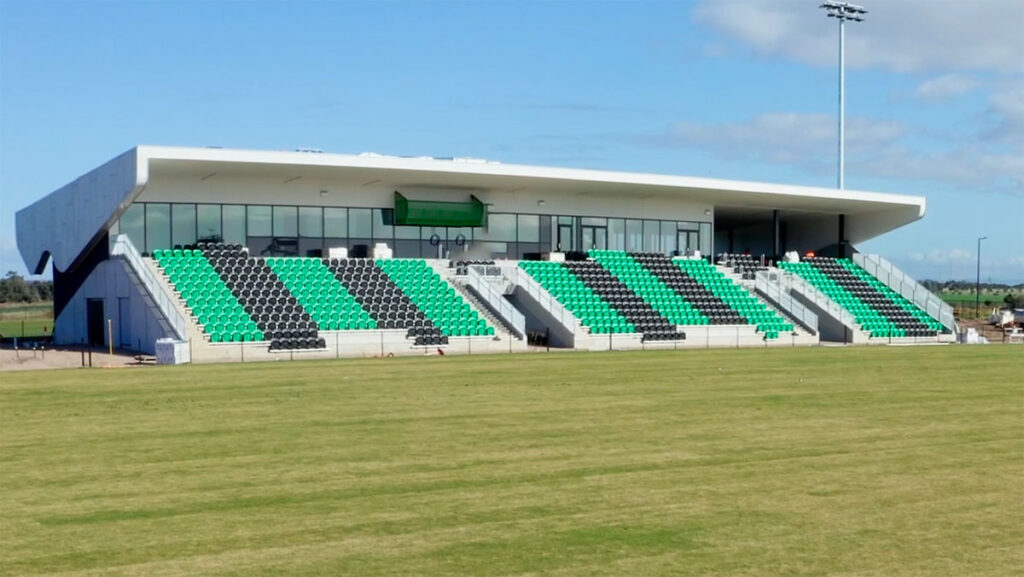
Western United are collaborating with global household appliances brand Smeg in a bid to enhance the Regional Football Facility in Tarneit after signing on a two-year partnership agreement.
In October of 2023, Western United were given the green light by the Wyndham City Council to play A-League Men matches at the Regional Football Facility for a select few matches in the 2023/24 season.
Whilst United prepares for its move into the new headquarters soon, Smeg have been tasked with the role to amplify the facility with their appliances and design.
As part of the agreement, Smeg will also have their branding present on LED signage at all home games for the rest of this current season and the next.
Smeg is the home of Italian appliances, brining an Italian style and state of the art technology to become a world leader in creating kitchen appliances.
Smeg aims to identify and reflect the defining characteristics of Italian design, such as inventive elegance, originality and product quality.
Western United General Manager of Commercial Chris Speldewinde explained the reasoning behind the collaboration to improve the facility.
“We are very excited to team up with Smeg. The excellence in coffee machines, combi ovens and dishwashers gives our new precinct the highest standards possible,” he said in a Western United press release.
“The Smeg brand will be seen on matchday LED, big screen and video content with players and coaches. We thank the guys from Smeg for the incredible support.”
Smeg Australia General Manager – Professional Division Leon Wolf expressed his excitement at being called upon to improve the Regional Football Facility in the west.
“Smeg are excited to partner with Western United to create an environment that helps nurture and develop regional football,” Wolf added via press release.
“We look forward to seeing the development of the Tarneit facilities, creating a hub for regional football development.”
The partnership between both parties is a fantastic idea as Western United quickly close in on calling Tarneit their home, with Smeg providing a different style and definitive, international quality appliances to the facility.
South Australian football clubs can tap into another round of government support, with the Active Club Program offering grants of up to $3,000 to help clubs improve participation and strengthen their local communities. The Office for Recreation, Sport and Racing (ORSR) opened its new round of funding on the 28th of August. Clubs have until midday on Wednesday, 14 October 2026 to apply.
The grassroots benefits
The South Australian Government has allocated $1.448 million to the round. Clubs with fewer than 100 members can receive $1,500. Clubs with 100 or more members can receive $3,000. The program targets grassroots sport, including football. It helps clubs purchase equipment and resources that make participation easier and more affordable.
Football clubs can use the funding for sporting equipment, uniforms and protective gear. They can also fund playing venue maintenance equipment, professional development, medical equipment and training. The program also supports projects that improve inclusion. Clubs can use grants for positive health initiatives and hardship subsidies. These measures can help remove barriers that stop people from playing sport.
That focus creates opportunities for football clubs to support more women and girls. It can also help clubs create more welcoming environments for players of different ages and backgrounds. Water and energy efficiency also form part of the program. Clubs can fund eligible initiatives that reduce water use or improve energy efficiency. That could prove particularly valuable for football clubs managing local playing venues and facilities. The program also allows minor club infrastructure upgrades and technology that directly supports participation or club sustainability.
Who is eligible?
To qualify, a club must operate as a not-for-profit sport or active recreation organisation in South Australia. It must have at least 20 members and have operated for at least 12 months.
ORSR will also consider a club’s participation profile when assessing applications. The assessment looks at female and male junior and senior participation, alongside factors such as the club’s affiliation and when it last received Active Club Program funding.
How to apply
The funding can make a direct difference at grassroots level. In the previous round, 558 South Australian clubs shared more than $1.4 million. The government says the investment helped clubs meet essential costs while supporting participation and inclusion.
For football, that support can stretch beyond the playing field. Stronger clubs create more opportunities for players, coaches and volunteers. They also provide places where people can build connections and stay active. Applications for Round 56 will be screened in November, assessed in December, with clubs notified in January 2027.
To learn more about the South Australian Active Club Program, visit their website.
If you’ve ever sat through a club’s end-of-season review, you’ll know the drill. A coach pulls out a folder of notes, someone half-remembers what a player was like back in Round 3 and a parent quietly wonders what they actually got for their rego fees beyond a team photo. Football club platform Majestri says it has a fix for that, and it’s built directly into its Player Assessment module.
Why clubs bother assessing players in the first place
According to Majestri, clubs run player assessments for one of three reasons – usually more than one at once. Some are chasing genuine development, using the data to lift the level across their high-performance squads. Others are after a fairer way to pick teams, putting every player on the same measurable scale so selection is based on evidence rather than a coach’s gut feel about who “looks the part.” And for clubs operating under a Football Australia or state federation licence, assessments at set intervals often aren’t optional – they’re a compliance requirement, with the paperwork to prove it when asked.
Whatever the motivation, Majestri’s pitch is the same: don’t let that assessment data die in a spreadsheet on someone’s laptop.
Build your own assessment, your way
There’s no one-size-fits-all template here. The Assessment Designer lets technical directors set their own criteria, sort them into whatever categories their coaching staff already use – think core skills, possession, defending, attacking – and decide what each point on the rating scale actually means. Crucially, every criterion also gets a comment field, because a bare number rarely tells the full story of a player’s development.
The Assessment Module Builder, showing an NPL Juniors assessment with a 1-10 rating scale banded from under performing through to excelling and role-specific criteria grouped into core skills, possession, defending and attacking. Source: Majestri.
Build it once and it’s reusable every time that assessment cycle comes around, so every player and every coach – is working off the same yardstick.
Something for the parents to actually take home
One of the more relatable pain points Majestri is targeting: most families never see much tangible return from a season of fees beyond a team photo. Player Assessment addresses that with report cards – colour-coded against the same scale coaches used, grouped by category with averages calculated automatically, and delivered as a PDF or an interactive web page a parent can read without needing a coaching badge themselves.
A report card for an under-15 player, colour-coded from under performing to excelling, with a score for every criterion and a group average across core skills, possession, defending and attacking. Source: Majestri.
Turning the numbers into something useful
The real value, though, sits in what Majestri calls the Player Analysis Lab. This is where clubs can plot a player against their team-mates or an entire age group across two categories at once, spotting clusters and outliers at a glance. Every score gets read against the group average – so a “7” actually means something in context – and clubs can report at the broad category level or drill into individual fields underneath. The results can be filtered down and exported for selection meetings or grading purposes.
The Player Analysis Lab comparing seven players across under-15 and under-16 squads, with a scatter plot, a sortable table of scores against the player average, and controls for choosing which categories and fields to report on. Source: Majestri.
The admin side nobody enjoys, made easier
Beyond the flashy analytics, there’s a practical layer built for the volunteers actually running the process:
Sweep monitoring – a quick view of which assessments are done and which are still outstanding, organised into defined assessment periods so progress can be tracked against peers.
Individual development plans – every player gets a personalised plan, and clubs can group common improvement areas to run cross-team training sessions that lift the whole club rather than just one squad.
Access control – coaches and technical staff can only see assessments for the teams they’re responsible for, and completed assessments are only visible to people linked to that player’s registration.
“Hard numbers to draw on when you review coaching staff and curriculum – and something tangible for the players and parents who pay the fees.” – Majestri
The bigger picture
Majestri frames all of this as sitting on top of the club’s own data – assessment results live on each player’s profile inside the platform rather than in a spreadsheet that walks out the door when a technical director moves on. For committees, it also means hard numbers to lean on when reviewing coaching staff or curriculum, rather than relying on anecdote.
It’s a fairly clear read on where club administration software is heading: less about digitising paperwork for its own sake, and more about making the data clubs already collect actually work for player development, team selection and compliance without adding to the workload of the volunteers who run the show.