



Karl Dodd’s proficient understanding of the nature of football on and off the pitch is unlike many others. Having undergone a playing career spanning the old National Soccer League, A-League, Scottish Premier League, National Premier Leagues Queensland and Hong Kong First Division, Dodd has focused his time since retirement in the early 2010s on mastering his skills and resilience as a coach.
A true believer in knowledge as power, Dodd’s professional post-playing career has seen him take on roles as Head of High Performance at Brisbane Roar alongside two separate stints at the Newcastle Jets, whilst also tackling the challenges of leading Guam’s men’s national team and his current role as a Technical Expert for FIFA.
Having spent the last few months recharging himself after some time away from the local game, Dodd speaks to Soccerscene about his aspirations to embody a generalist professional approach, his learnings from his time as head coach of Guam, and the current state of Australia’s football development system.
You’ve had an incredibly varied career in the footballing world, having started off as a player and then transitioned into coaching and consulting. Was it always an aspiration of yours to challenge yourself in multiple ways rather than just sticking to one field?
Karl Dodd: I got some advice early on in my career to have more of a generalist approach. That’s why my studies have probably taken me across varying domains so that when I am a head coach or in charge you have a good understanding of the environment and the staff that are underneath you. I just found with my playing career that there was always a disconnect between head coaches or assistant coaches and what other staff did. That was the main reason, I just wanted to know as much as I could to be well-informed as a head coach.
 How do you reflect as a whole on your footballing journey so far?
Karl Dodd: I think it’s one that has been pretty expansive. I’ve been to lots of different places and early on playing was about experiencing as much as I could and different cultures and countries. And then as a coach it was getting into the hardest places where I could learn the most. It’s a new journey where you’re developing yourself to a new point as a coach, and I didn’t want to go where things were easy.
I wanted to go where it was really going to challenge me so that I could handle whatever was thrown at me – and I think that’s where I’m at. After recent coaching experiences I feel that – and I don’t want to use the word ‘bulletproof’ – because I’ve been in some of the most challenging places, I’m in a good place. And reflecting on it, I’m glad I did that because now I can handle – especially with the Australian landscape where you’ve got to wear multiple hats and work in low-resource environments – those situations.
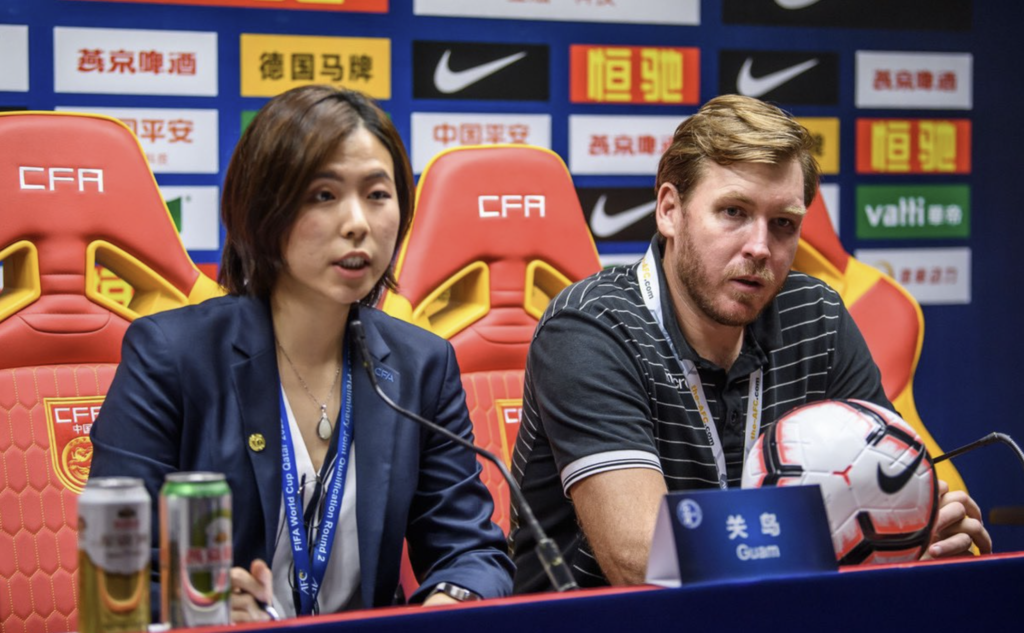
You spent over three years as Guam’s National Team Men’s Head Coach. What was that experience like for yourself? What did you learn from it?
Karl Dodd: For me personally, it’s a test of your values and who you are as a person because you get challenged every day when you go to a foreign place and you’re trying to implement change. That was a big one in terms of who you are and who you want to be from a football point of view.
Some of the best learnings came from being involved in the Asian Football Confederation (AFC) and having Japan – who have a really big push in trying to win the World Cup and being the first Asian team to do so – hold a lot of conferences where they invited experts from all around the world. When you’re sitting in rooms with Carlos Queiroz – who was the head coach of Iran at the time – it’s a massive eye-opener listening to these experts from England, France and Croatia explain their development policies or curriculums and how they go about things. You just get exposed to so much more. I think also understanding the international calendar, that was something I wasn’t really across but it makes you think differently as a club coach. Like ‘what players am I going to sign’? ‘Am I going to see those young boys if they have tournaments this year’? There’s a lot more to it and that was an important eye-opener being exposed to a totally different environment. From a match perspective, the pressure to win and tactics behind each game is very different to club football. For smaller nations, winning a qualifier is massive to future games being played in that four-year cycle.
What was that experience like taking in the values and perspectives of these experts from leading footballing nations?
Karl Dodd: It made me realise just how narrow-minded we are in Australia. I believe we’re very ‘big fish, small pond’ possibly because we’re so isolated from the rest of the world. The fact that Japan wants to invite all of the countries and confederations to these meetings and conferences to try help each other develop and grow without ego and with the intent of ‘how do we become better’ was really interesting and enjoyable.
How did you go about implementing your values and desired style of play on the Guam Men’s National Team? It seems like it required a lot of adapting to and with?
Karl Dodd: It certainly was. We get taught here [in Australia] that you have a philosophy and way to play but it might not fit in with other countries. The playing style in Guam was totally different so you have to compromise because you want to get from this playing style that they’re currently doing – which may be a risk-mitigative one where they park the bus – to a ‘total football’ style where you’re trying to play football and have a go against other teams rather than reducing the scoreline.
There’s a process to that and you’ve got to find an entry point. Those players and the community and the coaches have to come along with that. If you go in too high, they won’t know, because a lot of them don’t know what it looks like and they don’t know what your playing style looks like. So, you’ve got to explain that and where we’re at and how we’re going to transition across and that takes time. It’s not just a one or two-year process, that’s a decade-long one because those kids have now got to come through. There’s a lot to it in terms of trying to implement a new style, but also a way of operating which was a good challenge as well.
Currently you’re a Technical Expert at FIFA, what does that role entail?
Karl Dodd: I was asked to come on board in the women’s game and it’s been really enjoyable. We’re working with a lot of Member Associations or countries in setting up a lot of women’s football development programs. For example, we’re working with New Zealand with their league development as they’re trying to create a new women’s league, same with Mexico and Singapore. There’s a lot of strategy behind it which is massively enjoyable because you can’t be a one-trick pony, you’ve got to go in and be adaptable in order to understand where they’re at and what are the cultural barriers or what are the limitations and how do you overcome this. That’s what we’re working on plus just growing the professionalism of the women’s game.
Throughout your journey you have no doubt experienced a variety of football cultures and technical approaches. Comparing your experiences overseas to here, what is Australia’s development system lacking and what are its positive aspects?
Karl Dodd: To be honest, maybe I’m biased here, but I didn’t think there was too much wrong previously it just needed some fine-tuning. Perhaps more from a coaching side in terms of methodologies and the way it has gone, but I think we threw out our main strengths which is our physicality and also our mentality.
I think we need to have a holistic approach to our development, not just the football training. We go off on tangents and go too far and forget about the other stuff. Maybe there’s a lot of misconstrued information from the sports science field where it feels like the focus is all about monitoring, rather than the fundamentals of building the capacity of players. If we want to get players overseas in to the top leagues – Japan train 8-10 times a week and our players at the same level are training four times a week and one of them is an ice bath – we have to build the capacity of a player in a safe-manner. Otherwise, how are we ever going to compete with these top European or Asian nations? There’s too much focus on recovery rather than the periodisation or the building of a capacity of a player in a safe-manner. And that’s probably been lost, but that’s just one example. Again, having a holistic approach to the development of a player is key and we just go off on tangents too much instead of doing the basics well and then adding to it.
For many Australian football fans and casual sporting fans, there is arguably a degree of misunderstanding about the time and planning it takes to nurture a country’s growth as a football nation. What do you feel is essential for Australian football to get right over these next few years?
Karl Dodd: Well, that’s the hard thing because there’s no real quick fix. The reality is the situation we’re in is because of what’s happened in the past. What we need to get right is that we’ve got to start somewhere getting it right, you’ve got to start implementing a holistic approach but then it takes time for players to come through that process. If you’re looking for a quick fix, I don’t know how we’re going to do that. The only way is exposure. The more games the national teams can play the better, but then that comes down to a cost and availability of players, doesn’t it? It’s the million-dollar question.
I think one of the main things is getting the right people involved at all levels of Australian football rather than repeating the same dysfunctional processes. If you’ve got people involved that probably shouldn’t be there and those that don’t have a good enough understanding, it will keep going around in circles. It’s why you find a lot of good people aren’t involved because some find it difficult to have the current system and way of doing things challenged. You want a progressive system that’s going to be one of the best in the world, rather than remaining stagnant.