


How Patrick Spagnolo has revolutionised sporting apparel in Australia with OneSports

Patrick Spagnolo has really changed the game in the local footballing world in how to best go about the time-consuming task of customising kits, combining customer care and his huge passion for design to create OneSports that Box Hill United have managed to collaborate with for the current season.

Spagnolo boasts 35 years’ experience in the apparel industry, including a role with CK working with some big name retailers in Australia and abroad, fostering expertise crucial to OneSports’ success. His burning passion for both customer care and design excellence has led to the company being involved with some fantastic clubs in Victoria like Melbourne City and Avondale FC.

Patrick Spagnolo discussed the origins of OneSports and outlined what services the company offers for its many partners.

“OneSports was all about providing quality teamwear and that’s why we partnered with PUMA around 12 years ago. The company basically offers an end-to-end service so from design of the kits right through to the dispatch with all in-house production,” he explained.

“The key with an end-to-end service is partnership with our customers and really understanding what their requirements are. With that information we can collaborate and create a product they are really looking for.”

Whilst Spagnolo doesn’t quite have a football background himself, it was his kids early involvement in the sport that sparked the OneSports idea to partner with local clubs.

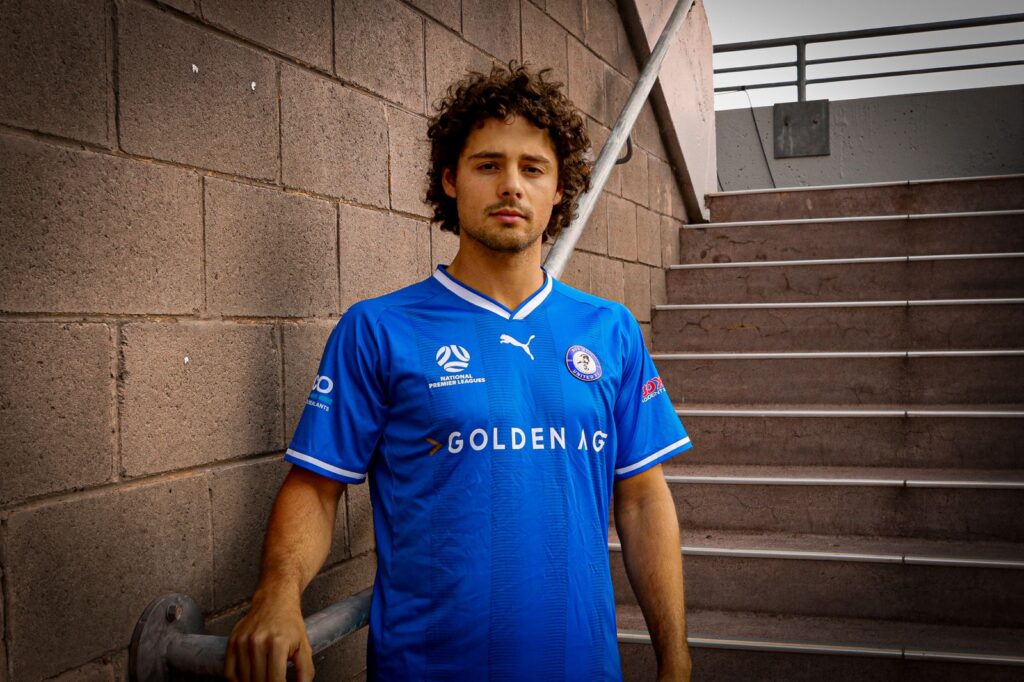
Luke Pickett in front of the Wembley Park stand.

He also touched on his wealth of experience in the apparel industry and the previous bigger roles he was involved in that guided him to early success with OneSports.

“My background is 35 years in the apparel industry, worked as a general manager for CK for 15 years and worked with big box retailers like Myer and Target as well as big retailers in the UK,” he mentioned.

“I’ve got a vast experience in the apparel industry and also come from a design background anyway so then built on that through OneSports from a marketing perspective as well.

“I’ve got an AFL background funny enough, but it started when my kids were playing soccer and what I could see was that all these clubs were struggling with supply, and they were quite unreliable.”

There is a reason why OneSports was able to succeed almost instantly with a partner like PUMA getting onboard. The company offers outstanding design and production services but also takes away the huge hassle for football clubs which is customizing their kits.

Spagnolo expanded on the company’s main point of difference in the competitive apparel market and why so many local clubs are partnering with the company in recent years.

“The point of difference with One Sports is the design element of it, on understanding what the DNA and the identity of each of our customers are and working back on their history to come up with a design that leads us towards success,” he said.

“I saw that there was an opportunity there, but I didn’t just want a no name brand or made up brand, we wanted a premium brand and that’s why we presented the business model to PUMA which ended up being a success.

“Being able to draw on PUMA’s vast library of designs and European influences that we’re able to give the latest trend of sports apparel but more specific teamwear.”

“PUMA has a brand sells itself, it’s probably one of the best football brands in the world which makes it all a lot easier,” he concluded.

Spagnolo’s experience in the industry has led to a big change in the way a supplier communicates with the clubs, searching a lot more in-depth into each club’s history and drawing inspiration from that to create a layered piece of teamwear.

In 2024, OneSports collaborated with Box Hill United to create two unique designs for its home and away kits that are an ode to the over century long history of the club and modernising it with some European inspirations.

Box Hill United’s training shirt for the 2024 season.

He discussed the exact process the company took in designing each of the kits and what the apparel means to the club on a deeper level.

“When we come in the point of design concepts for clubs, we give each of them 4-6 design concepts that look at what the trends are looking like and finding an identity,” he explained.

“The Box Hill home kit was drawn off Manchester City’s 2023/24 home kit design and we combined it with Box Hill’s history which predominantly had a striped jersey and also a cheval jersey back in the day.

“Being an over 100-year club, we used the old kit with the cheval to draw the inspiration for the away kit with a modern twist to it, and the key is keeping it trendy and modern,” he continued.

“The stripe on the home kit is like a shadow stripe so it was based on Man City’s look with a mixture of Box Hill’s original home kits that had the striped looks. The away kit recognises the club’s past with the cheval look and modernises it to make it look more presentable for this upcoming season.”

The Under 16’s recently showcased their new ‘Vista’ Royal Blue home kits designed by OneSports. This was inspired by AC Milan’s 2020/21 away kit, adding to it a collar and cuff design showcasing the colours of Box Hill, Blue, White and Black.

The goalkeeper kit comes in all black with a feature of ‘Ice break’ on the sleeves and side mesh, adding a subtle yet powerful touch to the kit.

Luke Del Vecchio in the black goalkeeper kit. Image credit: Passion Creations.

Spagnolo talked about OneSports’ ambitions in the future as a company that is currently focused on the local and domestic game but is potentially looking at expanding further. 

“OneSports is not really looking at moving away from partnering with local clubs mostly because of PUMA’s values,” he said.

“There is an ulterior motive there from PUMA because their belief is if the kids are wearing ‘the cat’, they will be more inclined to buy more PUMA products because you become loyal to a brand so grabbing them at a young age is important.”

Spagnolo mentioned the time-consuming nature of catering to every club’s needs and how that is important to the relationship with partners but also the integrity of OneSports.

“We are big on brand integrity, we’re not just out there to flog garments, we are invested in all our club partners no matter how big or small they are,” he said.

“We care and that use of the word ‘care’ is sincere and authentic because we don’t miss delivery dates and collaborate closely with clubs like Box Hill United now.”

OneSports’ partnership with Box Hill United exemplifies its commitment to honouring clubs’ histories. With just over a century of the club’s history and an important 40-year milestone for the women’s team this season, the innovative designs have given the club an array of kits that really represent the values of the club and successes of the past.
Previous ArticleNext Article

Beyond the Pitch: Miyuki Kobayashi on the Real Challenges Facing Japan’s Women’s Game

Last week, Soccerscene spoke to pioneer of women’s football in Japan, Miyuki Kobayashi, about the game’s development in Japan and the intersection between sporting and social change in the country.


Talent, quality and recent silverware

After Japan’s recent AFC Women’s Asian Cup victory in the final against Australia, the women’s national team solidified its standing as the No.1 team in Asia.

Throughout the last 15 years, Japan’s women’s national team has grown into a formidable opponent, boasting a World Cup trophy, an Olympic silver medal, as well as three AFC Women’s Asian Cups.

The talent is undeniable. The quality is unwavering. And the team shows no signs of slowing down.

But these victories and trophies on the world stage wouldn’t be possible without the leaders behind the scenes – none more so than Miyuki Kobayashi, former WE League Board Member and current JEF United Ladies Scout and Academy Chief.


Laying the foundations

Kobayashi has led the charge for women’s football in Japan, promoting not only a sport which values success, but one which empowers female footballers across the nation.

“At university, not many girls were playing and we didn’t have an official team. I went to the US and the environment was so different,” Kobayashi explained.

“That opened my eyes – women can play. That’s how I started the women’s soccer league when I came back: to make an environment for girls to play.”

Thus, accessibility and opportunity became driving factors behind Kobayashi’s work, not only for those on the pitch, but for those in the dugout.

“I got involved at the JFA (Japanese Football Association) to promote women’s football. We wanted to create the opportunity for women to be coaches.”

“They are coached by men all the time, so even when the top players leave the football world, they never think to be involved.”

Furthermore, as a former coach of JEF United Ladies Youth and General Manager, Kobayashi was intent on employing as many female coaches as possible. It was not merely a personnel change, but a challenge to widespread social attitudes.

“When I started to employ female coaches, the girls’ parents asked why the coach wasn’t a man. But gradually, we started to make it equal – they didn’t talk about the gender, but about the quality of the coach.”


The mission to empower

In 2011, the same year Japan’s women won the World Cup, the domestic league was yet to become professional. Known as the Nadeshiko League, players would work during the day and train in the evenings.

The transition from an amateur to the current professional league required time, resilience and a change in perspective.

“The sports world in Japan is more traditional – it is dominated by men,” said Kobayashi.

“If you want to make the environment even, or (want) more women to come into the (football) world, you can change the mind of the players.”

Since 2021, the WE League has embodied a sense of growth and positive change for the women’s game. In name and nature, it looks to empower players, coaches and all involved in the industry.

“I was in charge of mission achievement for women’s empowerment. We wanted to educate the players, to inspire girls and women who watch the game.”

However, the drive to empower women in football was not without backlash and challenges.

“Some people don’t like that word: ’empowerment’. It’s too strong for them. Some women really appreciate it, but it’s not easy to change the mind of society through football,” Kobayashi admitted.


Growing and attracting talent

Although WE League clubs are accelerating youth development and expanding pathways across U15, U18 and first team football, Kobayashi acknowledged that the overall product must improve to bring foreign players to Japan and entice homegrown talent to stay.

“Most of the national team players go to Europe or North America. I don’t say it’s a problem, but from a young age, girls who can play in the WE League want to go abroad,” Kobayashi outlined.

Indeed, when looking at the starting XI in last month’s AFC Women’s Asian Cup final, only one player – Hana Takahashi – plays in the WE League.

But the key to attracting domestic and international players to the WE League, is aligning financial investment and industry attitudes.

“The reason why women’s football has developed in European countries is the social thinking – you have to be equal and have the same opportunities as men in football. The Japanese way of thinking, especially in the football world, is not that at all,” Kobayashi continued.

“When I speak to people at Spanish clubs, women’s football is not a charity, but an investment.”

“We have assets. We have good, young players, but we’re exporting them, so we need to import too.”

Indeed, Spain is a perfect example of what can happen when investment becomes intentional, not optional. Back-to-back UEFA Women’s Nations League titles, 90% television viewership increase since 2016, and record-breaking crowd numbers reflect what can happen when the industry aligns in vision and commitment.

Japan has the players to compete against any nation in the world. Purposeful investment, combined with its overall quality of players and style, could transform the WE League into a true, global powerhouse.


The vision for the future

Moving forward, Kobayashi hopes that girls progressing through JEF United’s academies develop confidence and resilience, whether as players or people.

“We want to make the girls – even if they aren’t in JEF United – continue playing football and continue to be leaders,” Kobayashi said.

“Some of them have a dream to be a coach or a leader off the field too, so that’s one of the attributes we want to develop.”

This resilience, reflected by the club’s ‘never give up’ philosophy, is testament to the vision of empowerment championed by Kobayashi across the women’s game.

Even in the face of social obstacles and a lack of financial investment, perseverance and hard work is at the bedrock of women’s football in Japan. It is not just that these values exist, but that they are consistently manifested on and off the pitch, which can show future generations that football is a sport for all – men and women alike.


Final thoughts

There is no limit to what the WE League and the national team can achieve if given the resources it deserves. All the ingredients are there: individual quality, a distinct playing style, football philosophy and ambitions to grow.

By following the example of industry leaders like Kobayashi, women’s football in Japan can hopefully continue to make waves of impact – in the sporting landscape and society as a whole.

The Participation Boom Councils Didn’t Plan For Is Hitting Football Hard

Football in Australia isn’t being held back by passion, participation, or community support. It’s being held back by local government failure. From a CEO perspective, the warning signs are no longer subtle — they’re screaming. Confidence towards councils is collapsing, clubs are done believing the rhetoric, and the people carrying the game every weekend are telling us the same thing: councils don’t understand football, don’t consult properly, and don’t plan for growth. This isn’t opinion anymore. It’s measurable. And it should embarrass every policymaker in the country.

Football in Australia isn’t struggling because of a lack of passion. It isn’t struggling because communities don’t care. And it certainly isn’t struggling because participation is declining.

Football is struggling because, at the local government level, confidence is collapsing. What is more, the people closest to the game can feel it.

Soccerscene’s latest survey on council readiness and football planning shows something deeply confronting: trust in councils is at its lowest point, and clubs no longer believe the rhetoric. Councils frequently speak about “supporting the world game” and “investing in community sport,” but the data tells a different story.

The people building the game every weekend, people such as presidents, coaches, volunteers and administrators, are telling us councils do not understand football demand, do not consult effectively, and do not plan for long-term growth. And that’s not an emotional opinion. It’s now measurable.

In our survey, over 61% of respondents said their council has limited or no understanding of football participation demand. Consultation outcomes were even worse: 74% said council consultation is inconsistent or ineffective. And when asked if facilities are being planned with long-term growth in mind, the answer should stop every policymaker in their tracks: more than 71% said planning is short-term or non-existent.

Results graphic from Soccerscene’s January industry survey:

This is not a small problem. This is a national warning sign.

Football is not a niche sport. It’s the world’s sport

Councils across Australia are making decisions as if football is still an emerging code, competing for scraps. That thinking is decades out of date.

Football is not only Australia’s largest participation sport in many communities – it is also part of the global economy of sport, the largest sport market on earth, and a cultural engine that connects Australia to Asia, Europe, Africa and the Americas.

When councils underinvest in football infrastructure, they’re not just failing local clubs. They’re failing an entire economic pipeline: participation growth, player development, coaching pathways, community engagement, multicultural integration, women’s sport, health outcomes, events, tourism, and commercial opportunity.

And yet, football is still treated as the code that should “make do”.

The Glenferrie Oval case: a perfect example of the imbalance.

Take the redevelopment of Glenferrie Oval and the historic Michael Tuck Stand in Hawthorn.

This is a major project with a total estimated investment of approximately $30 million, with the City of Boroondara allocating $29.47 million over four years to transform the site into a premier hub for women’s and junior AFL.

Let’s be clear: there is nothing wrong with investing in women’s sport. In fact, it’s essential.

But this investment is also a symbol of something football people have been saying quietly for years: councils understand AFL. Councils prioritise AFL. Councils know how to justify AFL.

They don’t do the same for football, despite its participation scale, multicultural reach, and global relevance.

Across the country, football clubs are being told there is “no funding,” that “planning takes time,” or that facilities “can’t be upgraded yet.” Meanwhile, we see multi-million-dollar grandstands, boutique ovals, and legacy infrastructure funded and delivered for other codes.

Football isn’t asking for special treatment.

Football is asking for fair treatment based on reality.

Councils are stuck in a domestic mindset – while football is global.

Here is the core issue: local councils are making decisions through a domestic sporting lens, while football operates in a global one.

Football isn’t just a Saturday sport. It’s a worldwide industry with elite pathways, commercial frameworks, international investment, and an ecosystem that Australia must compete within.

If councils don’t understand this, they will keep making decisions that shrink our competitiveness.

And this is where the stakes become real.

Australia is not only competing against itself. We are competing against countries like Japan and South Korea, who treat football as a national asset. They don’t leave football infrastructure to fragmented local decision-making without a clear national framework. They invest strategically, align education with delivery, and build systems that create long-term advantage.

We cannot keep pretending we are in the same conversation globally while our local facilities remain stuck in the past.

Clubs are carrying the burden – and it’s breaking the system.

The survey results point to a harsh reality: football clubs feel like they are carrying the weight of growth alone.

When asked what the biggest council-related challenge is, nearly 49% said funding is not prioritised, while others pointed to poor facility design, limited engagement, and slow planning processes.

This isn’t just an inconvenience.

It is creating volunteer burnout, club debt, stagnation in women’s participation, and barriers to junior growth. It is forcing clubs into survival mode – patching up grounds, sharing overcrowded facilities, and trying to grow in spaces that were never designed for modern football demand.

And when planning is short-term, the problem compounds. Councils aren’t just falling behind- they’re building the wrong solutions.

So what do we do? We stop reacting and start leading.

Football cannot keep waiting for councils to “get it” organically. That approach has failed.

What we need now is a national strategic response that is structured, intelligent, and relentless.

This is where football must learn from high-performing football nations  not just on the pitch, but in governance, philosophy, and decision-making.

A powerful example is Korea’s “Made in Korea” project, which was built to identify structural gaps, align stakeholders, and create a unified development philosophy. It wasn’t just a technical framework, it was a national alignment strategy.

Australia needs the off-field equivalent.

A National Football Facilities & Readiness Taskforce.

I believe the time has come to establish a National Football Facilities & Readiness Taskforce, made up of the most capable minds across the game and beyond it.

Not another committee. Not another meeting group.

A taskforce.

It should include leaders from football, infrastructure, urban planning, commercial strategy, government relations, and corporate Australia. We should be selecting the most intelligent and effective people in the country, not based on titles, but based on outcomes.

This taskforce should have one clear mission:

Educate, influence, and reshape how councils plan, consult, and invest in football infrastructure.

Alongside a taskforce, we need long-term strategic working groups embedded across the states, designed to:

educate councils on football participation demand and growth forecasting

standardise best-practice facility design and future-proofing

create consistent consultation frameworks

align football investment with economic, health and multicultural outcomes

build a national narrative that football is an asset rather than a cost

Because right now, the survey shows councils aren’t prioritising football for economic reasons. In fact, only 2.56% of respondents said councils should prioritise football due to economic benefits. This is not because it isn’t true, but because councils haven’t been educated to see football that way.

That is a failure of strategy, not a failure of the game.

This is bigger than facilities – it’s about Australia’s place in the world game.

If we want to be taken seriously as a football nation, we must build a country that treats football seriously.

Not just at elite level.

At local level – where the entire pyramid begins.

The message from the survey is blunt: football’s confidence in councils is collapsing. But within that truth is also an opportunity.

Because when trust hits its lowest point, change becomes possible.

The next step is ours.

We either continue accepting a system that doesn’t understand the world game – or we build one that does.

Most Popular Topics

Editor Picks

Send this to a friend