


SAIVA Football: A powerful blend of AI and VR

AI and VR are undoubtedly two of the most cutting-edge technologies available for sports training.

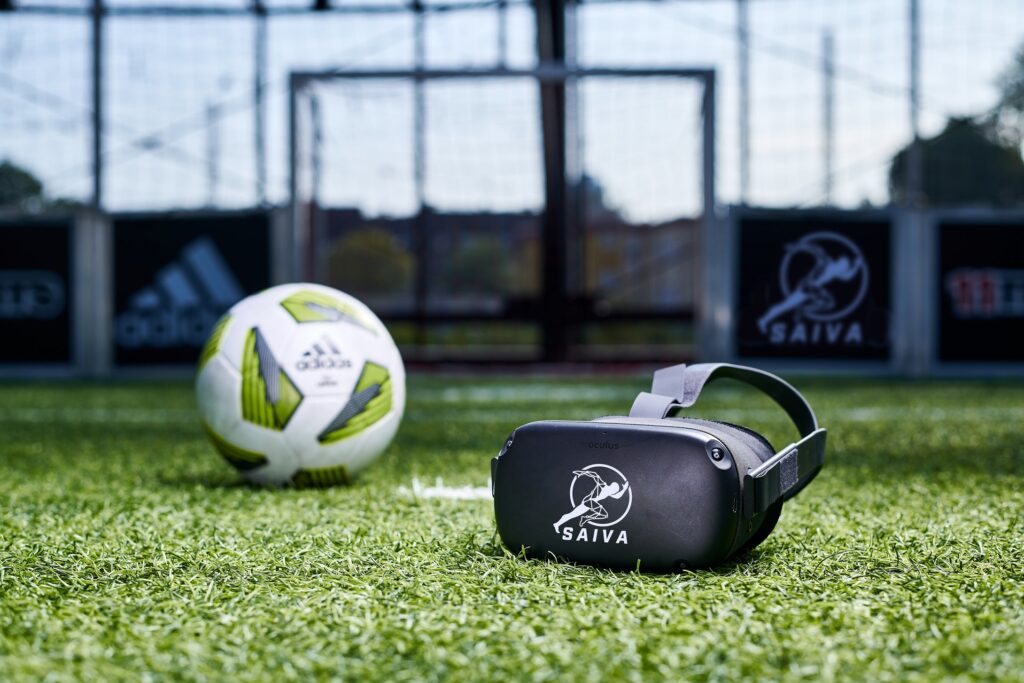
Sports AI Virtual Assistant (SAIVA) cleverly combines the two to create a virtual assistant platform tailored for every level of football – amateur, academy, and professional alike.

In 2018, two sister companies – Turing AI Cultures GmbH and AI Brain Inc. – organised a team of specialists in artificial intelligence, game design, and sports psychology.

These specialists delivered on SAIVA’s focus objective of developing innovative solutions for football.

The company’s mission is to revolutionise the sports tech industry by delivering a product that integrates both VR and AI into everyday training.

The technology behind SAIVA’s product stimulates cognitive and motor functions, enabling athletes to expand on their knowledge of the game and improve their overall performance. 

SAIVA’s key features

SAIVA’s main features are pre- and post-match analysis, immersive education modules, and an AI-driven coaching assistant.

Pre- and post-match analysis tool

Through this feature, SAIVA allows players to comprehensively analyse their games by reproducing actual gameplay in VR.

This virtual recreation of their game is derived from scouting feed videos or the team’s tracking data.

Once the footage or data has been simulated in a VR world, users may then step into the perspective of any player on the field.

The ability to do this allows players to significantly improve their decision-making skills and develop a better understanding of how to analyse the game.

The pre- and post-match analysis tool also allows for collaborative sessions, accommodating up to 10 users simultaneously.

Collaborative sessions enable coaches and players to engage in group-based learning where tactical scenes can be analysed within a more dynamic and interactive training environment.

The final dimension of the pre- and post-match feature is the tactical drawing tools.

3D annotation tools, including passing lines, dribbling lines, offside lines, arrows, and player highlights, allow users to effortlessly convey ideas.

Additionally, the ability to measure distances with these tools enhances analysis of pitch control and spatial awareness.

Immersive education modules

These modules provide a state-of-the-art learning program for coaches and educators.

The program is composed of three expertly designed modules that encompass key principles, dynamic exercises, and engaging gameplay.

The first module establishes the foundational knowledge required for a complete understanding of exercises and the sport itself.

Users are introduced to 18 fundamental principles, covering everything from constructing an impenetrable defence to breaking through opposition lines and executing swift transitions.

The second module introduces coaches to drills and how to effectively apply them to ensure optimal player development.

The combined learnings from modules one and two unlock the potential for coaches to effectively facilitate the growth of their players and guide the team with greater precision.  

The third module allows users to take charge of an 11-a-side game where they navigate through various in-game scenarios.

The goal of this module is to make strategic changes, identify spaces, and develop tactics to ensure victory.

These three modules are perfect for coaches who are seeking to elevate their expertise and strengthen their knowledge of the intricacies of football.

AI-driven coach assistant

This feature transforms coaching by auto-generating key metrics and offering insights from live gameplay situations.

The coaching assistant provides actionable recommendations, ranging from passing choices, team formations, and roster modifications.

All recommendations are tailored to real-time pitch conditions, allowing coaches to make accurate changes and optimise the performance of their team.

Implications for Australian football

Given the cutting-edge technology powering SAIVA’s product, there is immense potential for it to elevate football in Australia at all levels.

The powerful combination of immersive VR training and AI-driven analysis could be exactly what Australian coaches and players need to overcome training barriers and elevate their game.

High-level training equipment is often inaccessible due to geographical and financial barriers.

SAIVO addresses this issue by providing a relatively affordable and compact product that still delivers elite-level education and performance analysis.

Previous ArticleNext Article

SBS confirms exclusive Australian rights to 2030 FIFA World Cup

SBS has officially secured the exclusive Australian broadcast rights to the 2030 FIFA World Cup, meaning Australians will again be able to watch all 104 matches of the tournament live and free. The network will carry the tournament across television, video and radio and, as with 2026, all games will be streamed via SBS On Demand. 

The agreement was confirmed on 1 September, and will see the long-running partnership between the broadcaster and FIFA extend to 44 years. SBS first broadcast the World Cup 1986, when Argentina won the tournament in Mexico.

SBS Managing Director Jane Palfreyman said the World Cup remained central to the broadcaster’s role in Australian football, bringing Australians together across cultures, languages and communities.

The new deal follows a strong 2026 edition. More than 18 million Australians watched the coverage, while SBS also recorded more than 209 million hours of consumption across its World Cup content. Approximately 55 per cent of this consumption came via digital platforms. SBS offered full matches alongside shorter ‘mini match’ recaps through SBS On Demand.

First reporting that SBS and FIFA had extended their partnership emerged in July, although had remained unconfirmed until this point.

The latest announcement confirms that reporting. The earlier report also highlighted the importance of the deal for Australian football fans. SBS would retain a free-to-air pathway to every World Cup match. The deal also gives certainty around one of the biggest sporting properties in the world. This is particularly relevant as FIFA and its president Gianni Infantino come under increased pressure.

The 2022 edition saw FIFA increase its valuation over broadcast rights, with key markets such as China having a price tag of $349 million ($250 million USD) from the governing body. For Australian football, the significance goes beyond the tournament itself.

The World Cup remains one of the sport’s biggest drivers of mainstream attention. Keeping every match live and free gives Australian fans continued access to the competition without a subscription barrier.

Europe Is Packing Out Stadiums – Is Australia Missing the Bigger Picture?

More than 60 million fans attended matches across Europe’s five major domestic leagues during the 2025/26 season, with average attendances rising 2.4 per cent to 34,402 spectators per game.

On the surface, the figures paint a picture of a healthy ecosystem. Stadiums are fuller than ever, supporters continue to attend in large numbers and live football remains one of the most compelling entertainment products in the world.

But headline crowd figures only tell part of the story.

The more revealing measure is stadium utilisation how much of a venue’s capacity is actually being filled and the structural factors influencing those numbers.

For clubs, higher attendances don’t simply mean more ticket sales. Every additional supporter creates revenue opportunities across hospitality, food and beverage, merchandise and memberships. Modern stadiums are increasingly designed to maximise revenue per visitor, making infrastructure investment as much a commercial decision as a football one.

Attendance growth needs context

In Germany, the Bundesliga reclaimed its position as Europe’s best-attended league, averaging more than 42,300 spectators per match following a 9.4 per cent increase on last year’s figures.

However, much of that growth was driven by the return of traditional powerhouses Hamburger SV and 1. FC Köln. Both clubs continued to attract crowds of more than 50,000 despite spending recent seasons in the second division.

Their promotion didn’t suddenly create new supporters.

It returned two of German football’s biggest fan bases to the top flight, demonstrating how promotion and relegation can significantly influence league-wide attendance trends.

Everton shows how new stadiums can unlock demand

While the Premier League recorded another increase in average attendance, much of that growth can be traced to Everton’s move into the new Hill Dickinson Stadium. The larger venue added almost 13,000 spectators per home match compared with Goodison Park, accounting for more than half of the league’s overall attendance growth during the season.

Rather than generating new demand, the project unlocked demand that already existed.

That distinction matters.

Attendance should be viewed alongside stadium utilisation because many clubs have effectively reached capacity.

A stadium averaging 98 per cent capacity tells a very different story to one averaging 60 per cent, even if the latter attracts more spectators overall.

High utilisation suggests strong demand, pricing power and a compelling matchday experience, while lower utilisation can indicate untapped potential or a venue unfit for its market.

Capacity is becoming a strategic issue

In competitions where grounds are regularly close to full, future growth will depend less on attracting new supporters and more on expanding or redeveloping stadiums.

Elsewhere, the opportunity lies in making better use of existing capacity.

Spain illustrates how infrastructure can also temporarily suppress attendances. Barcelona’s continued absence from the Spotify Camp Nou during its redevelopment has limited crowd numbers despite strong demand.

Real Madrid’s renovated Santiago Bernabéu, meanwhile, demonstrates how modern stadium investment can increase not only capacity but also commercial revenue through premium hospitality.

League structures also shape attendance trends

Ligue 1’s growth over recent seasons has coincided with its reduction from 20 clubs to 18, concentrating a greater number of well-supported clubs within the competition and lifting average attendances as a result.

Stadium investment, league composition, promotion and relegation, and long-term supporter culture all play a role.

Taken together, the figures suggest that attendance growth is rarely driven by a single factor.

The lesson for Australian football

Crowd figures are often viewed as the primary indicator of a league’s health, but European football demonstrates that context matters just as much as the headline number.

The recent Australia Cup fixture between South Melbourne and Preston Lions provides a good local example. While the official attendance was 6,673, the packed grandstands, active supporter groups and television presentation created an atmosphere that felt far larger than the raw figure suggested.

It was a reminder that fan engagement, venue utilisation and matchday experience can often say more about the health of a competition than attendance alone.

A sold-out 15,000-seat stadium may indicate stronger demand than a half-full 30,000-seat venue, while investment in infrastructure can unlock thousands of additional supporters without changing underlying interest in the game itself.

As clubs continue to invest in new stadiums and redevelop existing venues, attendance should increasingly be measured not simply by how many people are watching, but by how effectively football is meeting supporter demand.

The crowds may be rising, but the real story is why.

Most Popular Topics

Editor Picks

Send this to a friend